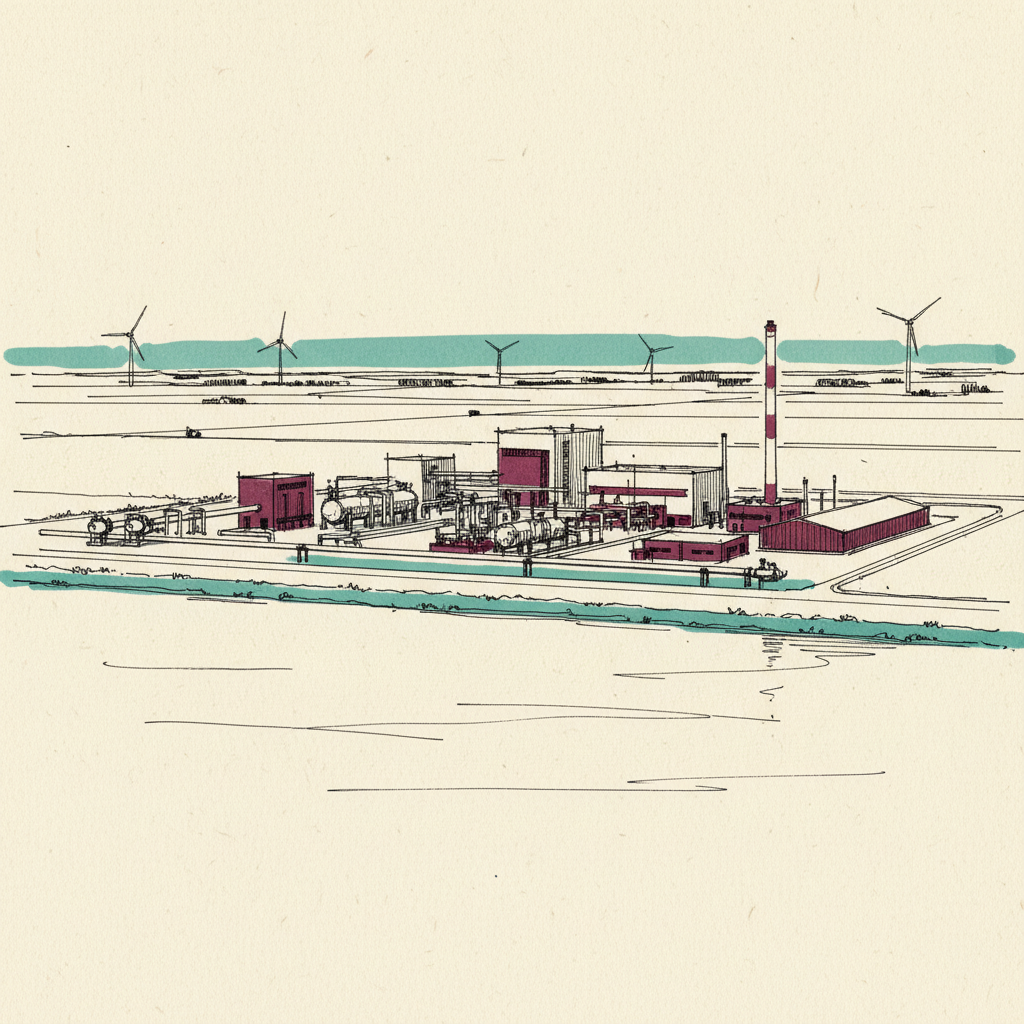
Bergermeer
Netherlands' largest gas storage cavern; 4.5 bcm capacity, state-backed injection underpinning TTF pricing.
Last refreshed: 8 May 2026 · Appears in 1 active topic
Why does Bergermeer's low fill matter to every European gas buyer, not just the Netherlands?
Timeline for Bergermeer
Mentioned in: Netherlands fills at 13.9% on EBN alone
European Energy MarketsBergermeer carries Dutch injection load alone
European Energy MarketsHeld only 15 TWh of its 46 TWh capacity at end-January 2026
European Energy Markets: EU storage 32%, refill pace below targetMentioned in: BBL halved, IUK drops in October: GB-Continent link cut
European Energy MarketsTargeted for EUR 233m state-backed injection campaign in 2026
European Energy Markets: Netherlands at 8.95%, with state-backed buyer behind itBackground
Bergermeer is the Netherlands' largest underground gas storage facility, located near Alkmaar in North Holland. A depleted natural gas field converted to storage, it has a working volume of approximately 4.5 bcm and is operated by TAQA (Abu Dhabi National Energy Company). It sits at the physical heart of the Dutch gas system that underpins TTF, Europe's dominant gas price benchmark. As of 25 April 2026, Dutch storage as a whole stood at just 8.95% fill — the lowest of any major EU storage market by more than 15 percentage points.
The Dutch state injection programme makes Bergermeer strategically distinct from commercial storage elsewhere in Europe. EZK (the Dutch Ministry of Economic Affairs and Climate Policy) has earmarked €233 million for 2026 stockbuilding. GTS (Gas Transport Services) runs the injection to a 115 TWh cold-year target using a €146.7m per year transport-tariff levy, making injection price-insensitive.
Bergermeer's significance extends beyond Dutch borders: because TTF physical delivery points are in the Netherlands, state-driven price-insensitive demand at Bergermeer tightens SPOT availability for all European buyers pricing against TTF during the Q2-Q3 injection window.
Bergermeer's role in the 2026 injection season is shaped by the depletion of legacy Groningen-linked caverns. The Norg and Grijpskerk facilities, historically used as swing buffers for the high-calorific system, have been progressively wound down following the Groningen closure. This shifts greater injection-season Reliance onto Bergermeer's low-calorific system capacity.
As of early May 2026, Dutch storage remained among the lowest in Europe, at approximately 9% fill. The €233m EZK backstop programme is state-funded and price-insensitive, meaning GTS bids for injection capacity regardless of SPOT price — creating structural TTF demand at whatever the market clears during Q2 injection. This backstop is visible in TTF forward premiums versus Henry Hub and LNG netback throughout the injection window.
Where is Bergermeer gas storage and how big is it?
Why is Bergermeer gas storage important for European prices?
Who owns and operates Bergermeer?
What is Bergermeer and why is it important for European gas prices?
Why is Dutch gas storage so low in 2026?
How much is the Dutch government spending on gas storage refill in 2026?
