Skip to content
Briefings are running a touch slower this week while we rebuild the foundations.See roadmap
Russia-Ukraine War 2026
27MAR

Khamenei invisible for 17 days

2 min read
20:48UTC

No video. No audio. One written statement read by a TV anchor over a still photograph. The longest absence of any Supreme Leader since 1979.

ConflictDeveloping
Key takeaway

Iran's wartime decisions lack visible supreme-leader authority.

Supreme Leader Mojtaba Khamenei had not appeared in public for at least 17 days as of 30 March, the longest absence of any Supreme Leader since the 1979 revolution. 1 2 His only communication was a written statement read by a state TV anchor over a still photograph. No video or audio of Khamenei himself has been released.

The absence coincides with the most consequential period of the war: ground forces converging on the Gulf, a third Bushehr strike, the NPT withdrawal bill, and 1,700 wartime arrests. Jerusalem Post sources described the Iranian power arrangement: 'The Revolutionary Guards are controlling him, not the other way around.' A Middle East Institute senior fellow assessed that Mojtaba Khamenei 'owes his position to the Revolutionary Guards.'

Whether the absence reflects security precautions, incapacity, or IRGC-imposed isolation cannot be determined from open sources. The CIA, Mossad, and allied agencies were actively searching for evidence he is alive and functioning as of Day 23. His predecessor missed no Nowruz address in the revolution's entire history; Mojtaba's silence over the Persian New Year on 20 March remains the most striking public absence.

The practical consequence is institutional: the IRGC appears to be the decision-making authority in a wartime state that constitutionally vests supreme authority in a single individual. The 1,700 arrests across Kurdish provinces , the Hormuz toll system, and the university ultimatum all bear IRGC institutional fingerprints. Who authorised them is an open question.


Deep Analysis

In plain English

Iran's Supreme Leader is the highest authority in the country, above the president, above parliament. For seventeen days, no video and no audio of the current Supreme Leader, Mojtaba Khamenei, has been released. His only communication was a written statement that a news presenter read on television over a photograph. This is the longest any Supreme Leader has been absent from public view since the Islamic Republic was founded in 1979. During those seventeen days, major decisions have been taken: the NPT withdrawal bill was filed, the Bushehr reactor was struck three times, 1,700 people were arrested, and Iran has been managing a war against the United States and Israel. But the person who is constitutionally in charge has not been seen. The Revolutionary Guards appear to be making the decisions. Whether the Supreme Leader is directing them privately, is incapacitated, or is under their control is genuinely unknown.

What could happen next?
  • Risk

    A wartime state where executive authority is constitutionally vested in one person who has not been publicly visible for 17 days faces a succession ambiguity that could fracture decision-making at a critical moment.

  • Meaning

    If the IRGC is exercising de facto command without visible supreme-leader authority, the institution is operating as an autonomous wartime decision-maker, not an instrument of political oversight.

First Reported In

Update #52 · Trump wants Iran's oil; 3,500 Marines land

CNBC / Financial Times· 30 Mar 2026
Read original
Causes and effects
This Event
Khamenei invisible for 17 days
The 17-day absence raises questions about whether the IRGC is operating independently of visible political authority. Wartime decisions are being made, but the head of state is not visibly making them.
Different Perspectives
North Korea / DPRK
North Korea / DPRK
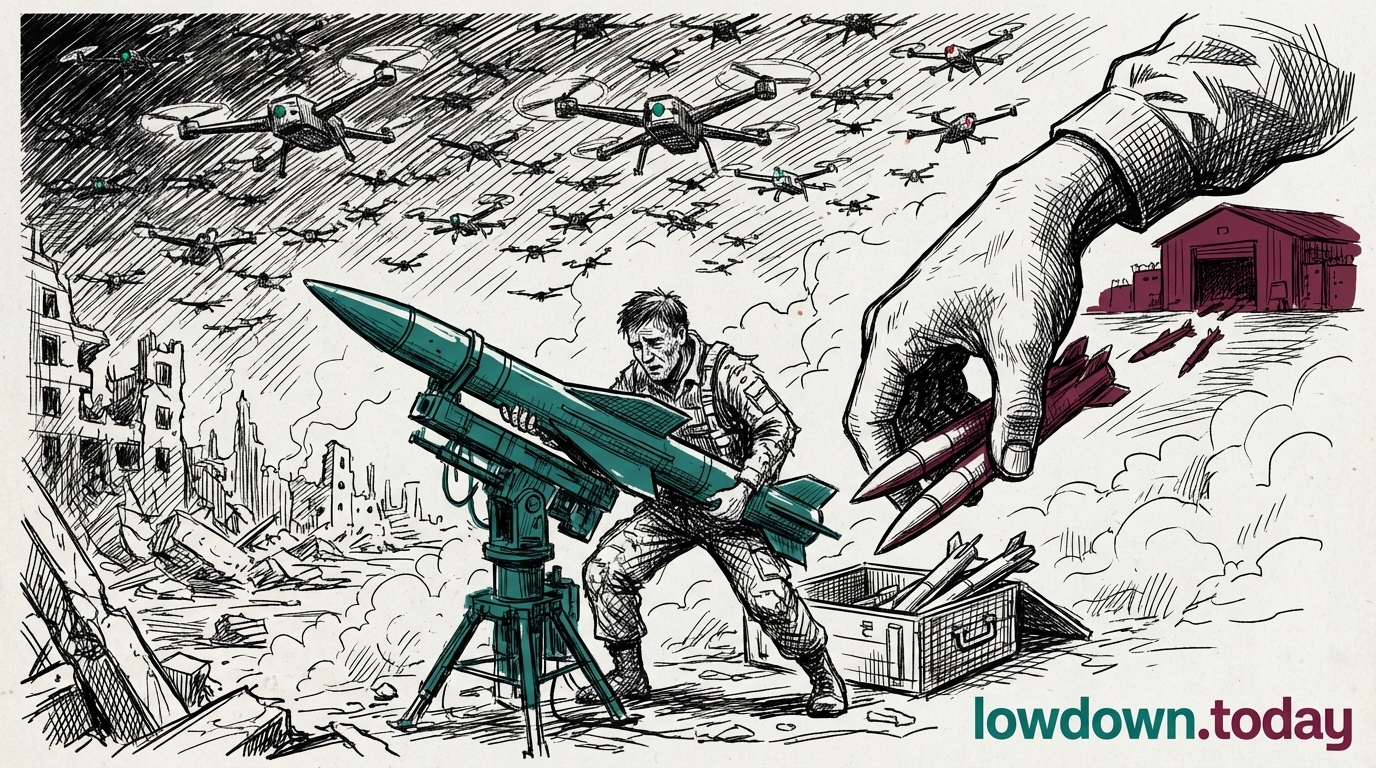
ISW confirmed the first mounting of DPRK Type-75 MLRS on Russian autonomous UGVs near Kharkiv on 7 June, the latest step in a supply axis that escalated from shells in 2023 to troops in 2024. Pyongyang gains live battlefield data on its ordnance and on Russia's uncrewed-systems programme.
IAEA / Rafael Grossi
Grossi confirmed Chornobyl structural damage with nuclear material metres away and could not attribute the ZNPP 15-hour blackout during the agreed repair window. Six ceasefires brokered and broken at ZNPP, compounded by Rosatom's May attack on IAEA neutrality, have eroded his ability to enforce the windows he negotiates.
Emmanuel Macron / France
Macron co-signed the E3 framework whose line-of-contact baseline marks Europe's first formal acceptance that 1991 borders are not the opening position. France's role carries weight because Macron had previously proposed a European force for Ukraine, and the framework's multinational force point is the vehicle for that.
Keir Starmer / E3
Keir Starmer / E3
Starmer, Macron and Merz met Zelenskyy on 7 June and backed a five-point framework taking the line of contact as the talks baseline, conceding roughly one fifth of Ukraine in exchange for a multinational force and frozen assets. With US mediation ended, the NATO Ankara summit on 7-8 July is the next test.
Vladimir Putin / Kremlin
Putin used SPIEF to reject Zelenskyy's summit letter, citing 'elements of rudeness', and repeated the pre-agreed treaty precondition that has frozen every diplomatic round since May. The SPIEF platform's message of investor confidence was punctured by naval fires visible from St Petersburg, which Moscow declined to dispute in scale.
Ukraine / Unmanned Systems Forces
Commander Brovdi confirmed USF units tracked and set fire to Boikyi at Kronstadt, while Code 9.2 struck the Chonhar Bridge the following day. Ukraine is sequencing strikes for rear-area interdiction and political timing rather than ground gains, trading the Baltic Fleet's home base for the logistics squeeze Russia cannot absorb without rationing its own occupied territory.



