Skip to content
You can now search across every topic, entity and event.What's new
Russia-Ukraine War 2026
27MAR

DroneShield sensor joins US kill chain

3 min read
20:48UTC

Parsons confirmed on 10 June that its DroneArmor system folds DroneShield's electronic-warfare sensor into a single AI-driven kill chain now running at a US security agency's southern border.

ConflictDeveloping
Key takeaway

DroneShield is wiring into a US prime's recurring pipeline while a shareholder revolt and regulator's probe persist.

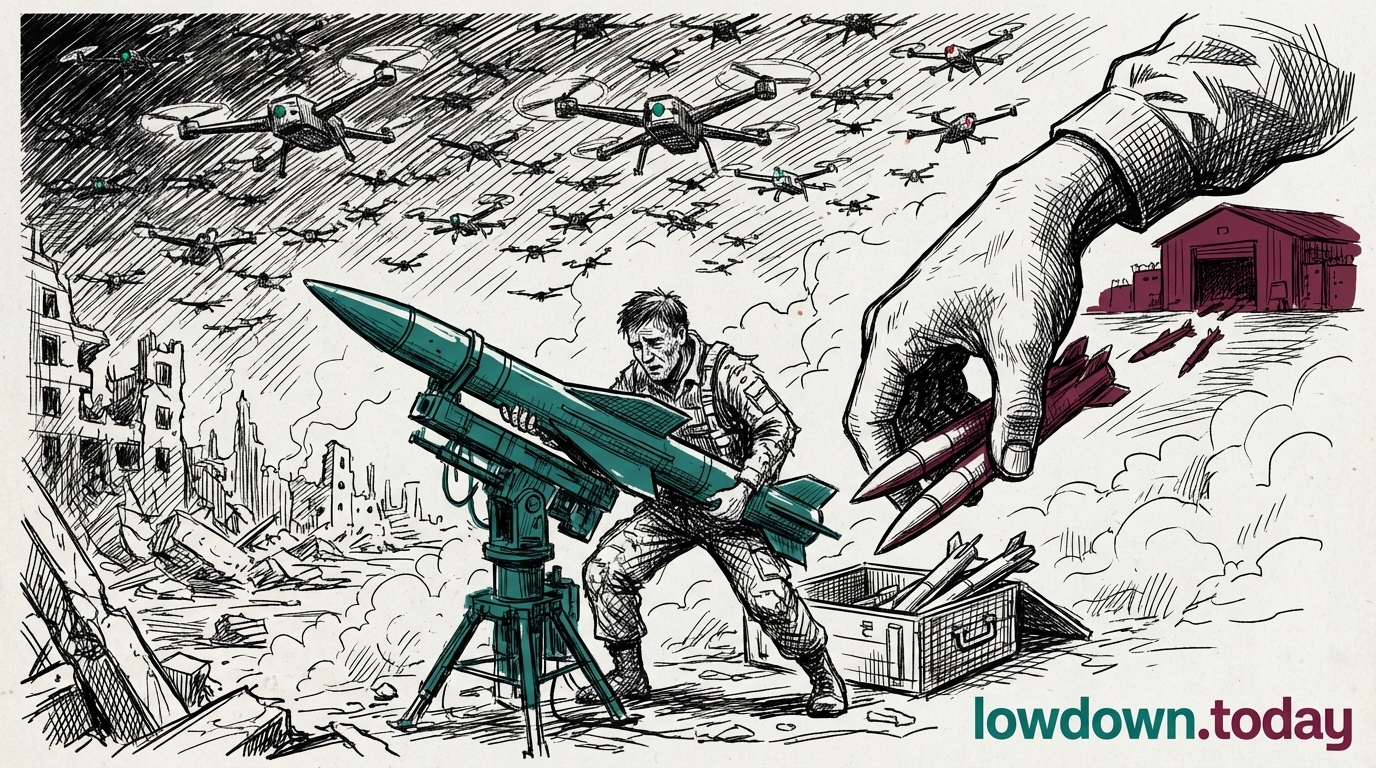
Parsons Corporation (NYSE: PSN), a US defence and engineering prime, confirmed on 10 June that its DroneArmor command-and-control system folds DroneShield's electronic-warfare (EW) sensor, alongside HurleyIR electro-optical kit and commercial radars, into a single AI-driven kill chain now deployed at a US security agency's southern border 1. DroneShield is the Australian counter-drone firm whose detection and jamming gear armies and police forces already buy; a kill chain is the loop that spots a hostile drone, decides, and defeats it. The sensor's new position inside Parsons's system carries the significance here.

DroneShield has sold its hardware directly before. Here its sensor sits as a sub-component inside a prime contractor's integrated system at an active US site, and that placement changes the revenue shape. Once a sensor is certified into a fielded command architecture, swapping it out carries integration cost and re-certification risk, so the customer tends not to. That stickiness is the mechanism by which a component supplier earns recurring defence income rather than episodic sales, and it is the standard US value chain a direct-sale vendor cannot reach from outside.

The timing cuts against the company's governance. DroneShield's 29 May annual meeting drew a first strike, with 50.51% voting against the remuneration report , and an Australian regulator's probe into November 2025 share sales remains open . Strengthening commercial fundamentals and an unsettled boardroom are now running in parallel: the firm is wiring itself into a US prime's procurement pipeline at the same moment its own shareholders and a regulator are questioning how it is run. Buyers of integrated systems weigh supplier stability, so the governance overhang is not cosmetic; it sits beside the very contract momentum the integration creates.

Deep Analysis

In plain English

Parsons is a large US engineering company that built a drone-detection and defeat system called DroneArmor. It needed a sensor that could spot and jam hostile drones using electronic signals. It chose a sensor made by DroneShield, an Australian company, and put it inside its system. Parsons deployed DroneArmor, with DroneShield's sensor inside it, at a US government border security site in June 2026. This matters for DroneShield because, once your hardware is built into someone else's bigger system that is already deployed, it is expensive and time-consuming for the buyer to swap it out. DroneShield goes from making one-off sales to earning steady income as long as Parsons keeps its contract with the US government.

Deep Analysis
Root Causes

DroneShield's component-supplier position in DroneArmor reflects two structural features of the US defence sensor market.

First, US primes do not typically build EW sensor hardware in-house. Electronic warfare detection and jamming requires deep signal-processing expertise that sits in specialist firms. Parsons is an engineering and programme-management prime, not a sensor manufacturer.

It required an external EW sub-component and selected DroneShield's hardware, most likely on the basis of its existing deployments with US law enforcement and the border security community governance context aside. That gap in prime-contractor capability is the opening DroneShield exploited.

Second, the US southern border has been a pilot site for C-UAS (counter-unmanned-aircraft-system) technology since 2019, when CBP (Customs and Border Protection) began operating DroneShield equipment at several crossings. Parsons built DroneArmor to integrate that existing sensor heritage into a more capable AI-driven command architecture. DroneShield's inclusion is partly a legacy of its early border-market positioning, not solely a result of competitive selection in 2026.

What could happen next?
  • Consequence

    DroneShield's sensor embedding inside Parsons DroneArmor at an active US government site generates 6-9 years of structurally durable recurring revenue if Parsons retains the prime contract, reducing DroneShield's dependence on episodic one-off hardware sales that previously made its revenue lumpy.

    Medium term · Reported
  • Risk

    DroneShield's governance overhang, the open ASIC probe into November 2025 insider sales and the 50.51% first-strike AGM vote, may cause Parsons or its US government client to conduct heightened supplier-stability reviews at the next annual contract renewal, a risk not present in a direct government sale.

    Short term · Assessed
  • Opportunity

    If DroneShield replicates the L3Harris WESCAM model, it can convert sub-component status in DroneArmor into direct-sale agreements with US Customs and Border Protection for follow-on sensor deployments that bypass Parsons entirely, capturing the full margin rather than the sub-contractor share.

    Long term · Suggested
First Reported In

Update #12 · Pentagon's drone buy lands a third short

Parsons Corporation· 15 Jun 2026
Read original
Different Perspectives
Belarus
Belarus
Minsk announced completion of its own 37th Separate Airborne Assault Brigade near Gomel, under plans dating to August 2025 rather than a response to any single frontline event this window, keeping its hedge of hosting the war without formally joining Russia's mobilisation drive.
European Union / Operation IRINI states
Italy, Greece and Poland boarded the sanctioned tanker Toa Payoh off Pantelleria under a standing EU mandate rather than a national decision, extending enforcement from the Channel and Baltic and the Black Sea and Azov into the Mediterranean. Italian Defence Minister Guido Crosetto praised the crew; the captain's refusal to produce documentation left detention unconfirmed.
Poland and the NATO eastern flank
Warsaw's Coordination Team said explicitly its forces tracked the 30 July missile incursion and were ready to shoot it down, then flew air cover for an EU tanker interdiction three days later. Poland is simultaneously the war's nearest spillover victim and a contributor to enforcing sanctions against the state causing that spillover.
Ukraine (government, defence establishment and civilians)
Kyiv runs its manpower crisis through acting Defence Minister Yevhen Khmara, whose formal appointment waits for parliament's 18 August return, and a fortnight-old Commander-in-Chief, Mykhailo Drapatyi. Reported attacks on enlistment officers rose from 5 cases in 2022 to 341 in 2025, reaching Odesa's Territorial Recruitment Centre staff directly on 2 August.
Kremlin and Russian domestic economic voices
Moscow has not addressed July's advance-rate collapse or Sberbank's OFZ warning; Novak's diary ran to OPEC+ quota diplomacy with no diesel item logged since 15 July. Economist Nikolai Korzhenevsky calls the Central Bank's RUB 2.3tn in bank lending effectively deficit monetisation, a framing Sberbank's Skvortsov, with his own institutional interest, has not disputed.
IAEA (Rafael Grossi)
IAEA inspectors logged Zaporizhzhia's 22nd loss of off-site power, ten of them in the last three months, after a thunderstorm knocked out the plant's sole surviving backup line. Grossi reads the accelerating frequency, not any single outage, as the safety signal now that the plant's redundancy is exhausted.
