Skip to content
Briefings are running a touch slower this week while we rebuild the foundations.See roadmap
Russia-Ukraine War 2026
3MAR

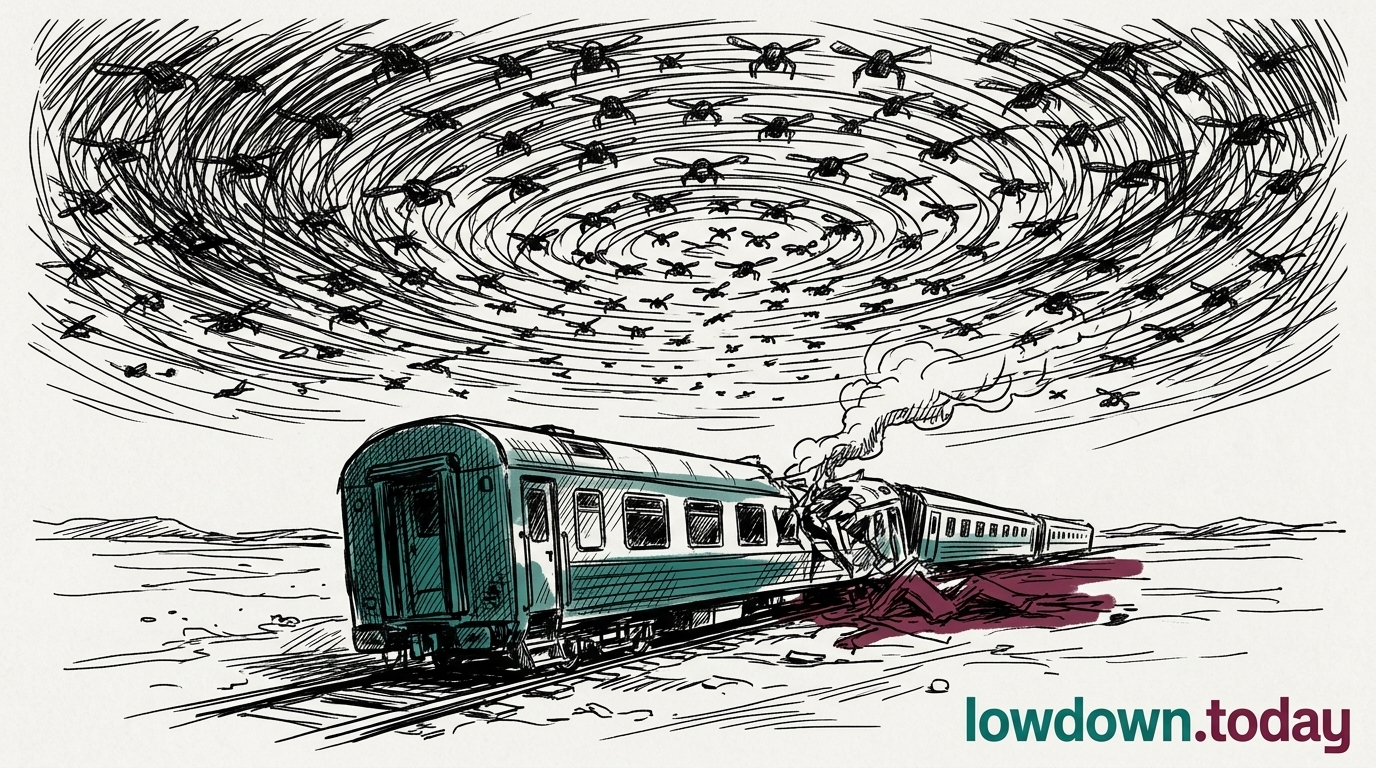
Drone hits train in Dnipropetrovsk

3 min read
09:47UTC

A Russian drone killed one person and wounded ten on a passenger train in Dnipropetrovsk Oblast — the second such strike in five weeks, with no international consequence after the first.

ConflictDeveloping
Key takeaway

Two passenger-train strikes in five weeks establishes a deliberate targeting pattern legally distinct from general rail infrastructure attack.

A Russian drone struck a passenger train in Dnipropetrovsk Oblast on 2 March. One person was killed. Ten were wounded 1.

It was the second attack on an occupied passenger train in five weeks. The first, on 27 January, drew condemnation and nothing more. Russia has systematically targeted Ukrainian rail infrastructure since July 2025 — junctions, freight depots, stations. The target set has widened step by step, and hitting an occupied passenger carriage is not the same act as hitting a rail junction at night. The progression from one to the other has been methodical.

Under International humanitarian law, a passenger train in regular service is a civilian object unless repurposed for military transport — a claim Russia has not made 2. The legal framework is not in dispute. The enforcement framework does not exist in practice. After the January strike, neither the EU nor the UN imposed consequences beyond verbal statements. At the time of writing, neither had issued a response to this second strike.

Ukraine's rail network is the primary means of long-distance civilian movement in a country whose airspace has been closed since 24 February 2022. The 3.7 million internally displaced people documented by UNHCR depend on it. Trains are not optional infrastructure for a population that cannot fly. Striking them twice in five weeks, with no material response after the first, creates an operational reality: the cost Russia pays for targeting civilian rail is, at present, zero. That calculus holds until something changes it.

Deep Analysis

In plain English

International law draws a firm line between attacking a railway line — legally ambiguous because trains carry both troops and civilians — and attacking a train that is actively carrying passengers without any claimed military purpose. Russia has made no claim that either struck train was carrying military personnel or supplies. That matters legally: without that claim, both strikes sit on the wrong side of the Geneva Conventions' civilian object protection rule. One strike can be explained as incidental. Two strikes in five weeks, both on occupied passenger carriages, without any military justification offered, is a pattern. Patterns are how war crimes cases are built.

Deep Analysis
Synthesis

Russia's consistent failure to claim military use of the struck trains is strategically significant. It suggests Moscow has assessed that the political cost of the IHL violation is acceptable — either because it expects no meaningful legal consequence, or because it is testing international tolerance for civilian transport targeting ahead of possible escalation. Unchallenged permissiveness lowers the threshold for subsequent strikes and sets a precedent that will outlast this conflict.

Root Causes

Passenger trains serve a dual psychological function that pure infrastructure targeting does not: they are visible symbols of civilian normality, and their destruction signals that no aspect of ordinary life is protected. This psychological dimension — making civilians feel unsafe in mundane activities — is consistent with Russian coercive signalling strategy documented across the conflict. The rail network's dual civilian-military role also provides Russia with plausible deniability when challenged on targeting intent, even when no military justification is actually advanced.

Escalation

A third strike within the same five-to-six-week cycle would formally cross into what IHL monitoring bodies classify as a campaign, triggering mandatory reporting obligations for UN HRMU and creating a procedural basis for a UN Special Rapporteur investigation. The EU's failure to issue a statement after the second strike in five weeks is notable: it may reflect deliberate restraint ahead of the March Abu Dhabi talks, or institutional paralysis. A third strike will make that restraint politically untenable.

What could happen next?
  • Precedent

    Repeated civilian passenger-train strikes without formal international legal response establish a permissibility norm that actors in future conflicts may cite to justify analogous targeting.

    Long term · Assessed
  • Risk

    Ukraine may reduce civilian rail services in Dnipropetrovsk Oblast to protect passengers, displacing civilian commuters and complicating military logistics routing through the same corridor.

    Short term · Suggested
  • Consequence

    A third strike within six weeks would create procedural grounds for a UN Special Rapporteur investigation and make EU silence politically untenable regardless of Abu Dhabi diplomatic timing.

    Short term · Assessed
  • Opportunity

    Ukraine's documentation of the targeting pattern — including post-strike footage and passenger manifests — strengthens future war crimes proceedings by establishing wilful intent rather than incidental harm.

    Long term · Assessed
First Reported In

Update #1 · Ukraine best month as Russia triples drones

EMPR· 3 Mar 2026
Read original
Different Perspectives
NATO eastern flank (B9 + Nordics)
The B9+Nordic Bucharest joint statement on 13 May reaffirmed Ukraine's sovereignty within internationally recognised borders and backed NATO eastern flank reinforcement; the summit accepted Zelenskyy's bilateral drone deal proposal as a structural alternative to the stalled US export approval pathway, treating it as a European defence architecture question rather than aid delivery.
IAEA / Rafael Grossi
Grossi is still negotiating a sixth ZNPP repair ceasefire with no agreement after 50 days of 750 kV line disconnection; the 3 May ERCL drone strike that destroyed environmental monitoring equipment represents a qualitative escalation in infrastructure degradation that the IAEA has documented but cannot compel either party to halt.
Péter Magyar / Hungary
Magyar's incoming foreign minister pledged on 12 May that Hungary will stop abusing EU veto rights; the pledge is a statement of intent rather than a binding legal commitment, and Magyar's MEPs voted against the €90 billion loan as recently as April, while a planned referendum on Ukraine's EU accession preserves a downstream blocking lever.
EU Council and European Commission
The Magyar cabinet formation on 12 May removes the Hungary veto that had blocked the €9.1 billion first tranche since February; the Commission is now coordinating the three-document disbursement package for an early-June vote. The structural blocker is gone; the disbursement question is now scheduling, not politics.
Donald Trump / White House
Trump announced a 9-11 May three-day ceasefire with a 1,000-for-1,000 prisoner exchange attached, then called peace 'getting very close' on 11-13 May while Russia's 800-drone barrage was under way; his public framing adopted Russian diplomatic language without securing any Russian operational concession or verifying the exchange was agreed.
Vladimir Putin / Kremlin
Putin told reporters on 9 May the war is 'coming to an end' while Peskov confirmed on 13 May that territorial demands are unchanged and Russia requires full Ukrainian withdrawal from all four annexed regions; the verbal accommodation costs Moscow nothing and conditions any summit on a pre-finalised treaty Kyiv cannot accept.
