Skip to content
You can now search across every topic, entity and event.What's new
Iran Conflict 2026
23AUG

Kuwait's water plants burn a fourth day

3 min read
19:02UTC

Statement No. 22 from Kuwait's electricity ministry records a fourth consecutive day of strikes on power and desalination stations, with fires at several of them.

ConflictAssessed
Key takeaway

Four days of strikes on Kuwaiti generating units, and the ministry still asks only for voluntary rationing.

Kuwait's Ministry of Electricity, Water and Renewable Energy published Statement No. 22 on Tuesday 21 July, reporting that several power-generation and water-desalination stations had been struck for the fourth consecutive day, with fires at a number of facilities 1. Statement No. 21, issued two days earlier, had covered a single station. The Oman News Agency carried the text on the wire the same day 2.

Roughly 90% of Kuwait's drinking water comes off those same generating units . Gulf desalination of this generation runs on the steam turbines that produce the electricity, an arrangement chosen because the waste heat is what boils the seawater. A fire in a turbine hall therefore takes the grid and the water together, and Kuwait has almost no fresh groundwater to fall back on.

The Shuaiba complex alone has been hit twice inside two days , , and the ministry asked households to ration voluntarily after the first of those. Repair gets harder with each return. Units already offline for damage assessment cannot absorb a second fire, spare turbine parts are not held in quantity, and there is no lake or river to draw on while a plant is down.

The ministry has still not gone further than a request. Nothing in Statement No. 22 imposes scheduled or mandatory cuts, and that line separates an inconvenience from a rationing regime. Kuwait has fired no shot in this war. It hosts American forces, and its households are the ones now being asked to change their behaviour at the tap, in the hottest month of the Kuwaiti year.

Deep Analysis

In plain English

Kuwait gets almost all of its drinking water from desalination plants, which turn seawater into fresh water using large amounts of electricity. For four days in a row, Kuwait's government says power and water plants have come under attack, with the Shuaiba complex hit twice. This matters because in Kuwait, power stations and desalination plants are often built next to each other and share the same electricity supply. Damage to a power plant can mean people lose electricity and lose access to drinking water at the same time. So far, Kuwait has not told people to cut back on water or power use through official rationing. The government has only confirmed the attacks themselves, not any change to how much water or electricity people can use.

Deep Analysis
Root Causes

Kuwait's Ministry of Electricity, Water and Renewable Energy has confirmed four consecutive days of strikes on generation and desalination stations without issuing any rationing-policy update, only attack-damage statements, indicating officials are managing within existing capacity rather than escalating to mandatory cuts so far.

The deeper structural exposure is that Gulf desalination plants and power-generation stations are typically co-located and share the same grid, because large-scale desalination is energy-intensive; a strike that degrades a power station therefore threatens both the electricity supply and the desalinated water supply that depends on it, which is why repeated hits on the same handful of facilities compound rather than simply repeat the damage.

What could happen next?
  • Risk

    A fifth consecutive day of strikes on the same generation and desalination assets could force Kuwait to move from voluntary conservation messaging to mandatory rationing.

First Reported In

Update #159 · A second strait closes by radio alone

Kuwait Ministry of Electricity, Water and Renewable Energy· 22 Jul 2026
Read original
Different Perspectives
Hizballah
Hizballah
Has not commented on the US Treasury's 20 August designation of ten people, including named couriers, over a cash network Treasury says moved money to it from the IRGC-Qods Force. ACLED recorded a sharp rise in attacks around it the same day.
Kuwait
Kuwait
Kuwait's Chief of the General Staff, Lieutenant General Khaled al-Shriaan, co-chaired the 16th US-Kuwait Joint Military Commission at the Pentagon on 21 August. Kuwait has not published what was agreed; only a summary of the meeting's existence and attendees is sourced.
Qatar
Qatar
Has not commented publicly on the $4.5bn KC-46A tanker Foreign Military Sale notification the State Department approved on 20 August. The notification opens a sale process; Doha has not confirmed whether it will proceed to a signed transfer.
Mohammad Bagher Ghalibaf
Told a Baghdad business meeting on 20 August that Iran will not endure a hungry population regardless of its military strength, against 87.9% point-to-point inflation and 128.1% food inflation for Tir. His fellow Majlis Economic Committee member Samsami separately warned a petrol price rise would ignite unrest.
US Navy
US Navy
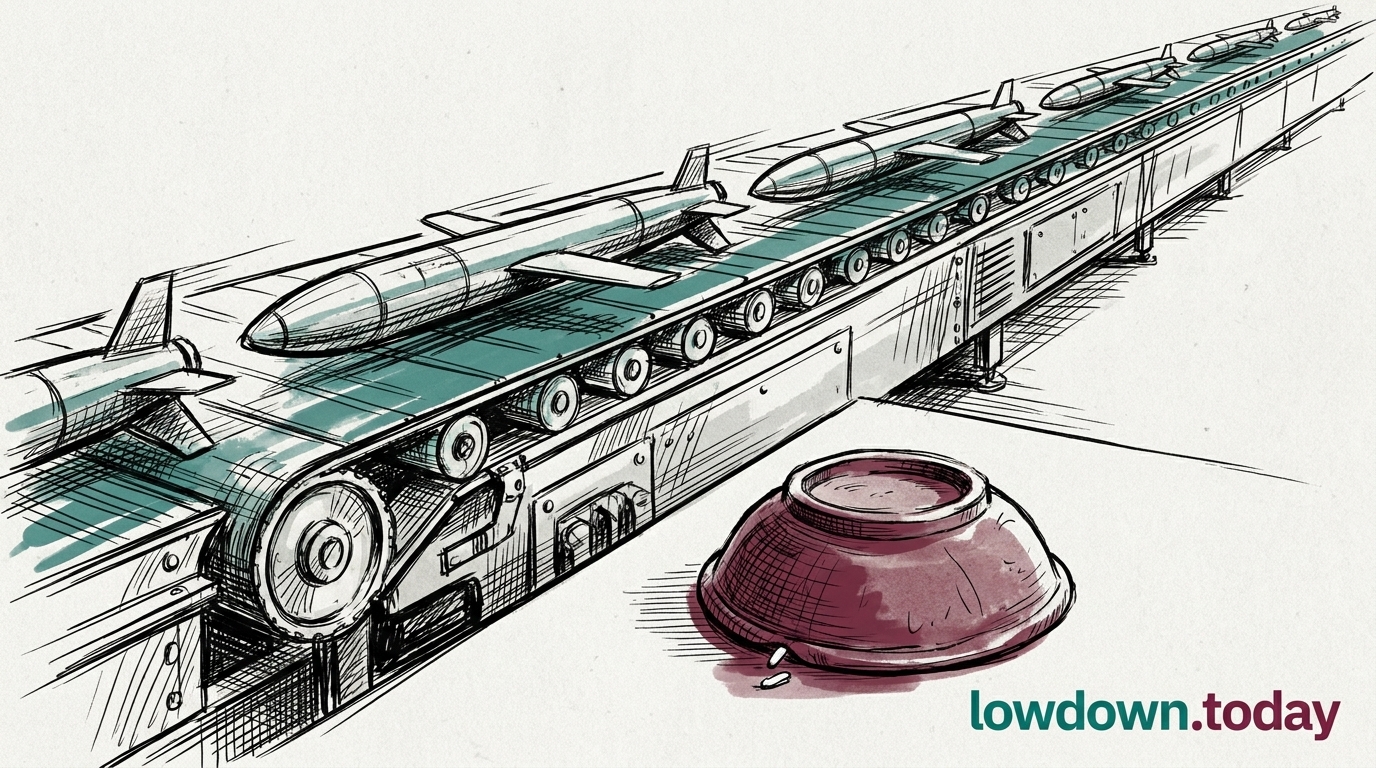
Signed a $22.9bn, seven-year contract with Raytheon on 17 August to raise Tomahawk output from about 60 a year to more than 1,000. The Acting Navy Secretary, quoted via an X post, framed it as the "Arsenal of Freedom" initiative; it replaces the 850 missiles fired by 1 April in about ten months at the new rate.
UK Maritime Trade Operations
UKMTO logged six armed men boarding a tanker 136 nautical miles east of Al Mukalla on 20 August and redirecting it toward Somalia. A vessel steered toward the Somali coast reads as an attempted seizure, a distinct hazard from the stand-off strikes the same lane has seen before.