Skip to content
Briefings are running a touch slower this week while we rebuild the foundations.See roadmap
Iran Conflict 2026
3MAR

Warner saw no evidence of Iran threat

3 min read
15:24UTC

The vice-chairman of the Senate Intelligence Committee says classified briefings contained no evidence of the immediate danger the administration now cites — including its new nuclear justification — for striking Iran.

ConflictDeveloping
Key takeaway

Warner's public dissent, timestamped before the administration introduced its nuclear justification, creates a documented record that the upgraded legal rationale was introduced after Congressional scrutiny found the original insufficient — transforming the nuclear claim from an evidentiary assertion into a demonstrably reactive political construct.

Senator Mark Warner, vice-chairman of the Senate Intelligence Committee, stated publicly that he had seen "no intelligence that showed an immediate, imminent threat" from Iran — directly contradicting The Administration's stated rationale for Operation Epic Fury. Warner's statement, reported by NPR on 1 March, followed a 90-minute classified Pentagon briefing to congressional staff that produced no evidence supporting the White House's imminence claim.

The Administration's rhetorical escalation followed a specific sequence. Defence Secretary Hegseth introduced nuclear capability as justification from the Pentagon podium on Sunday — the first time The Administration framed Iran's missile and drone programme as a "conventional shield for nuclear blackmail ambitions." This came after the classified briefing failed to satisfy the Intelligence Committee on the conventional threat alone. The shift from "imminent conventional danger" to "future nuclear capability" changes the legal category of the claim, not merely its emphasis.

Prof. Marko Milanovic of the University of Reading has argued that preventive action premised on future nuclear capability has no inherent limiting principle. Anticipatory self-defence under the 1837 Caroline doctrine requires a threat that is immediate — "instant, overwhelming, and leaving no choice of means." A nuclear programme that may produce a weapon at some unspecified future date does not meet that threshold. If perceived existential risk suffices, any state gains a standing pretext to strike any adversary with a nuclear programme.

The American precedent is direct. The 2002 National Intelligence Estimate assessed "with high confidence" that Iraq possessed chemical and biological weapons — an assessment the Senate Intelligence Committee's own 2004 review found unsupported by the underlying intelligence. Warner is placing his dissent on the record while the campaign is in its first week, not its aftermath. War powers votes scheduled for this week will almost certainly fail against a presidential veto. But Warner's contradiction establishes something the Iraq debate lacked: a senior intelligence overseer stating, before the justification hardened into policy consensus, that the classified evidence did not match the public claims.

Deep Analysis

In plain English

Senate Intelligence Committee members see classified briefings that the public never reads. When a senior member publicly states that those secret briefings showed no immediate, imminent threat, he is directly contradicting the legal reason given for going to war — and doing so from inside knowledge. This matters because international and domestic law both require an imminent threat as the basis for the kind of military action taken. An insider who saw the classified evidence saying it does not support the stated rationale is the strongest possible form of that challenge short of a full Senate vote.

Deep Analysis
Synthesis

The chronological sequence is now documentable: Warner's dissent citing no imminent-threat intelligence preceded the administration's introduction of the nuclear justification by approximately two days. This sequence establishes that the nuclear framing was introduced in direct response to Congressional scrutiny rather than newly available intelligence — a distinction that converts the justification from an evidentiary claim into a reactive political construct. This sequence, not either element in isolation, will be the central argument in any future War Powers Resolution challenge or Congressional investigation.

Root Causes

The Republican committee chair's silence versus Warner's public dissent reflects a structural feature of the Senate Intelligence Committee's bipartisan composition under partisan pressure: members are interpreting the same classified material through divergent political lenses. This pattern — documented in the lead-up to the 2003 Iraq War — suggests that committee oversight is functioning as a partisan rather than an analytical check, which structurally weakens the institutional constraint on executive war-making.

What could happen next?
  • Consequence

    The War Powers Resolution 60-day clock, if triggered from the operation's first day, expires in late April 2026 — creating a hard legal deadline for Congressional authorisation that Warner's dissent makes politically harder for the administration to obtain on its preferred terms.

    Medium term · Assessed
  • Risk

    Allied governments citing Warner's statement may use it to justify withdrawing intelligence-sharing or basing co-operation, stripping the administration of the allied-endorsement cover that has historically insulated US legal rationales from effective international challenge.

    Short term · Suggested
  • Precedent

    A successful preventive-war operation conducted without credible imminent-threat intelligence would functionally erode the imminence requirement as a practical constraint on future presidential use of force, regardless of the formal legal position remaining unchanged.

    Long term · Assessed
  • Meaning

    The Republican committee chair's silence in contrast to Warner's public dissent signals that Congressional oversight is operating along partisan rather than institutional lines — itself a structural indicator that the WPR's political enforcement mechanism has been neutralised for the duration of the current administration.

    Immediate · Suggested
First Reported In

Update #10 · Friendly fire kills three US jets in Kuwait

NPR· 2 Mar 2026
Read original
Causes and effects
This Event
Warner saw no evidence of Iran threat
Warner's public contradiction creates a formal congressional record challenging the legal basis for war before the rationale has hardened into consensus — a pattern that did not occur during the Iraq War buildup, where senior intelligence overseers did not break publicly until after the invasion.
Different Perspectives
Gulf shipping and insurance markets
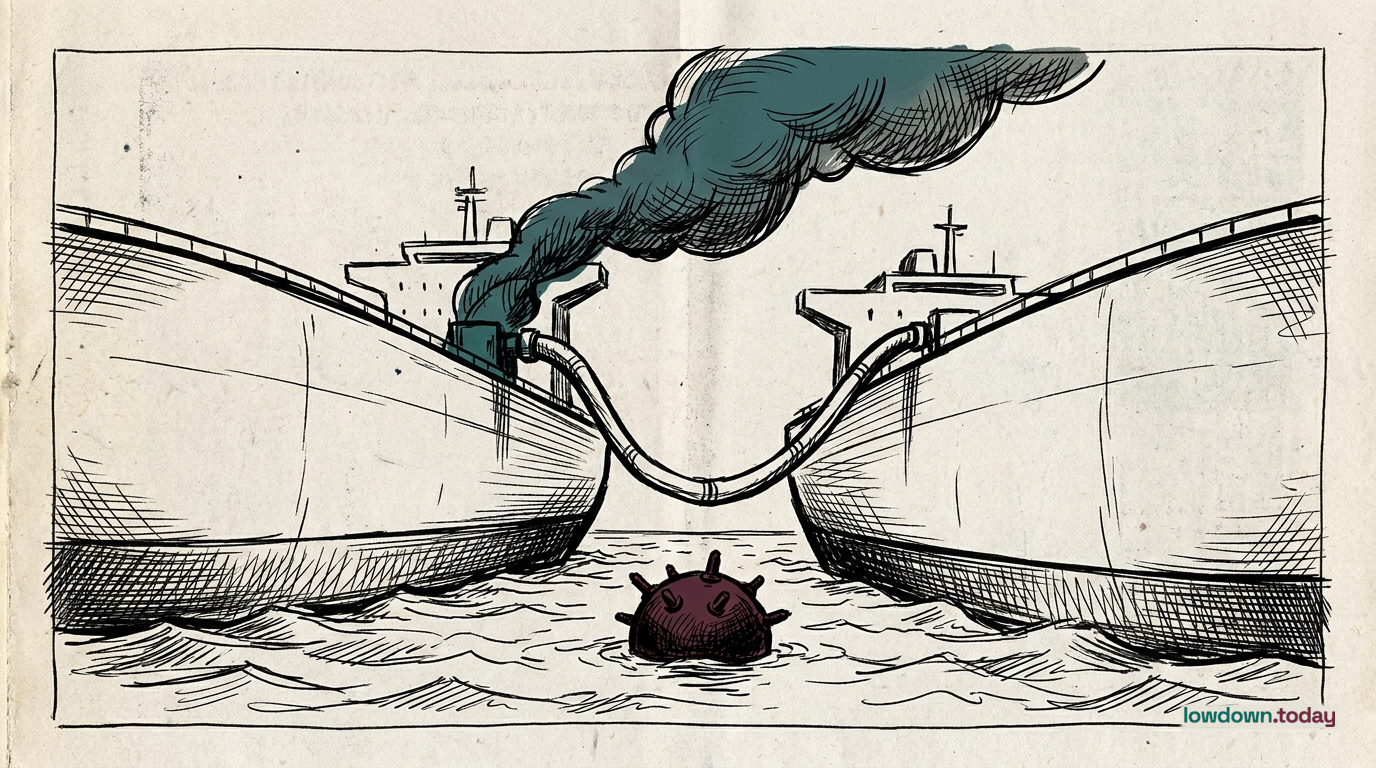
With Hormuz and Bab el-Mandeb both hostile at once, war-risk underwriters face their first dual-chokepoint pricing problem; the rerouting hedge that absorbed one closure is gone for Israeli-linked hulls. Any deal that reopens Hormuz without a Houthi stand-down clause delivers only partial shipping relief.
Russia and China
Russia and China
Russia and China met IAEA chief Grossi jointly in Geneva on 5 June to coordinate an advance blocking position against Washington's censure resolution, the first documented instance of proactive pre-session obstruction rather than reactive post-vote dissent. Beijing's move came four days after OFAC designated Shanghai Qianye Energy under Iran energy sanctions.
Saudi Arabia
Saudi Arabia
Saudi Arabia was left out of the emergency $4.01 billion Patriot waiver Qatar received on 2 May as its own PAC-3 stocks ran near-empty from intercepting Iranian salvoes over Aramco facilities. Riyadh is on a standard 18-month FMS queue behind a production line booked through 2030, with no equivalent priority to Qatar's Al Udeid basing role.
Houthis (Ansar Allah)
The Houthis declared a complete ban on Israeli Red Sea navigation on 8 June and struck Jaffa, their first attack on Israeli territory since April, seven days after the Tasnim authorisation to activate other fronts including Bab el-Mandeb. The declaration put both chokepoints under hostile authority simultaneously.
Iran
Iran
Iran agreed the 9 June mutual halt after the Mahshahr exchange and coordinated with Russia and China to block Washington's IAEA censure resolution, using the Board as a second front while the bilateral pause held on the military one. Tehran's acceptance of the Lebanon carve-out contradicts the linkage position it stated on 1 June.
Benjamin Netanyahu and the IDF
Israel struck the Karun Petrochemical plant at Mahshahr on 8 June over Trump's explicit objection, then agreed a halt with Iran the following day scoped on Israeli terms with Lebanon carved out. Netanyahu's posture is that the IDF will not accept Iranian missile factories as off-limits regardless of US diplomatic timelines.