Skip to content
You can now search across every topic, entity and event.What's new
Iran Conflict 2026
8JUL

Sulyok will propose Magyar as prime minister

2 min read
10:44UTC

Hungary's president completed party consultations on 15 April and will propose Péter Magyar when the new legislature convenes. Target for a new government is 5 May; the constitutional deadline is a week later.

ConflictDeveloping
Key takeaway

Kyiv's disbursement clock now runs on a Budapest government-formation calendar, not a Council vote.

Hungarian President Tamás Sulyok met all three party leaders in Budapest on 15 April and confirmed he will propose Péter Magyar as prime minister when the new legislature convenes. Magyar is targeting 5 May for government formation. The Hungarian constitution requires the inaugural session by 12 May.

That seven-day window between preferred date and legal deadline is the nearest feasible point at which Hungary can vote in the Council to withdraw its veto on the EU loan for Kyiv referenced in event 1. European Commission officials have said funds could flow "within a few days" once the veto lifts , but the Council vote has to be re-staged after Hungary formally changes its position. Analysts place first disbursement in June at the earliest.

The consultation was procedural rather than contested. Orbán's election-night concession on 12 April removed the confrontation most observers expected. Sulyok's role here is narrow: a Hungarian president has no power to refuse a PM nomination from a party holding a two-thirds majority. The interesting variable is Magyar's cabinet composition, which will show whether the Tisza majority delivers EU-friendly ministerial picks or preserves continuity with some of the Orbán-era administrative apparatus.

Deep Analysis

In plain English

Hungary's president met with the leaders of all major parties on 15 April and confirmed he will formally ask Péter Magyar to become prime minister when the new parliament first meets. This is the standard constitutional procedure after a Hungarian election. Magyar has said he wants to form his government by 5 May; the constitutional deadline is 12 May. Once the new government is in place, Hungary can lift its veto on the EU's €90 billion loan to Ukraine, allowing that money to move forward. The gap between when the government forms and when the EU can actually vote on and disburse the loan means the money is unlikely to reach Ukraine before June at the earliest.

Deep Analysis
Root Causes

The 12 May constitutional deadline is fixed by the Hungarian Fundamental Law and cannot be shortened or lengthened by any political actor. The procedural sequence, presidential nomination, parliamentary investiture vote, ministerial appointments, requires at minimum two to three weeks. Magyar's 5 May target implies completing all stages within 23 days of the election result, compared to Poland's 42-day formation in 2023.

The EU loan unblocking adds external urgency that Poland's 2023 formation did not face: Ukraine's resource depletion deadline sits in mid-May, meaning every week of delay between Hungarian government formation and the EU Council vote matters operationally.

What could happen next?
  • Consequence

    Government formation between 5-12 May triggers the EU Council Ukraine loan vote; earliest disbursement remains late May or June.

  • Risk

    Fidesz-aligned committee chairs could delay ministerial confirmation hearings, pushing formation toward the 12 May constitutional limit and compressing the EU vote window.

First Reported In

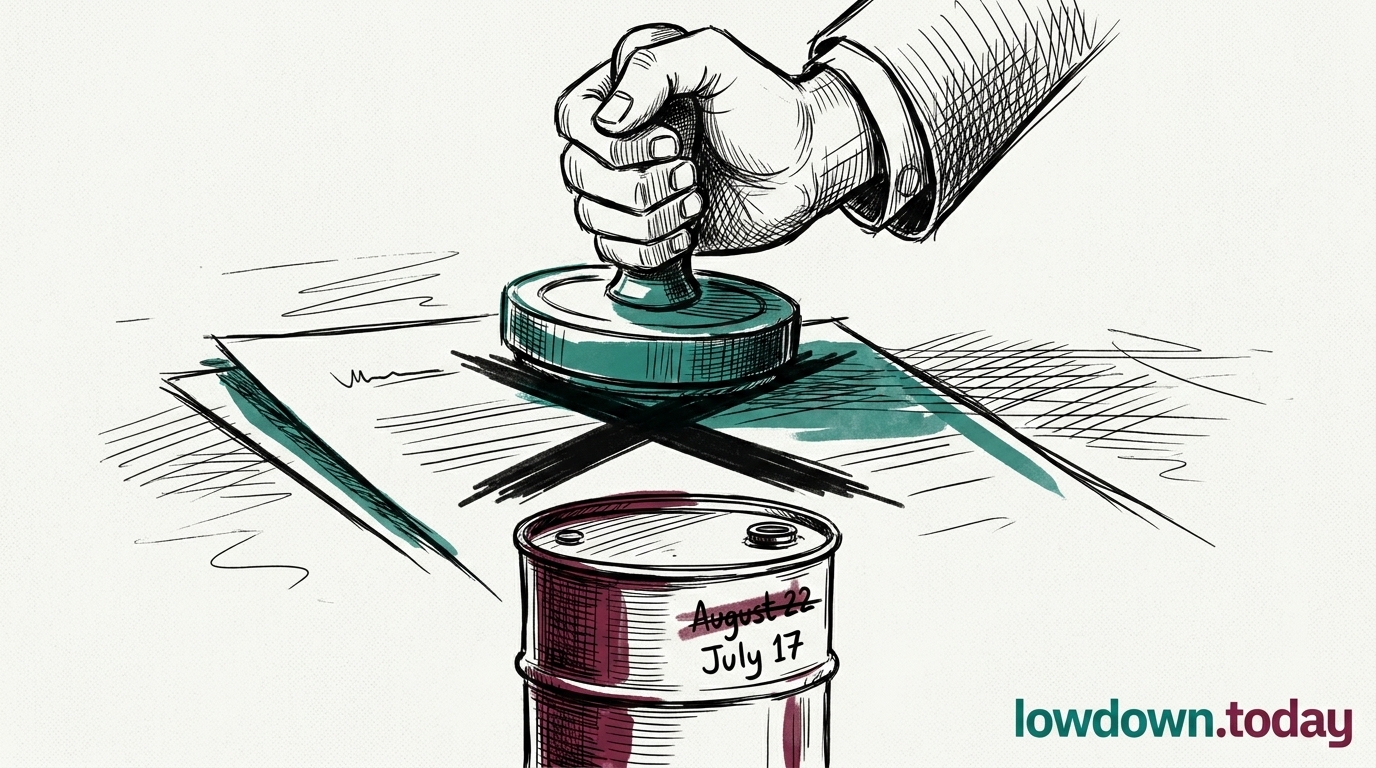
Update #13 · Treasury kills the Russian crude waiver

Hungarian National Election Office (NVI) via Wikipedia aggregation· 16 Apr 2026
Read original
Different Perspectives
Oil market and P&I insurers
Brent cleared $87 intraday only once CENTCOM's blockade became physical rather than declared, even though P&I Clubs had already excluded Hormuz war risk a week earlier on 7 July: capital hedged ahead of enforcement, but prices moved only after it.
UAE reporting
UAE reporting
UAE reporting placed the Omani tanker deaths at one seafarer against the International Maritime Agency's count of two, the first time in this war that a Gulf state's casualty figures have diverged from an international monitor's.
Jordan
Jordan
Iranian strikes reached Jordan again on 14 July as part of the Gulf-wide retaliation for the Hormuz blockade, extending the conflict's geographic footprint to a state with no direct stake in the strait itself.
Bahrain
Bahrain
Bahrain sounded air-raid sirens on 14 July during Iran's Gulf-wide retaliation, the same day CENTCOM's blockade order and fourth night of strikes pushed the conflict's physical reach into the wider Gulf littoral.
Kuwait
Kuwait
Kuwait intercepted Iranian missiles and drones on 14 July as Tehran's blockade retaliation reached Gulf states beyond Iran's immediate shoreline, confirming Kuwaiti airspace now sits inside Iran's retaliatory envelope.
Oman
Oman
Oman absorbed the war's first tanker casualties in its own waters on 14 July, with two supertankers disabled and seafarers killed, putting the sultanate's shipping lanes directly in the path of the blockade fight for the first time.