Skip to content
You can now search across every topic, entity and event.What's new
European Oil Markets
4JUN

Trump drops Hormuz as core war objective

3 min read
10:20UTC

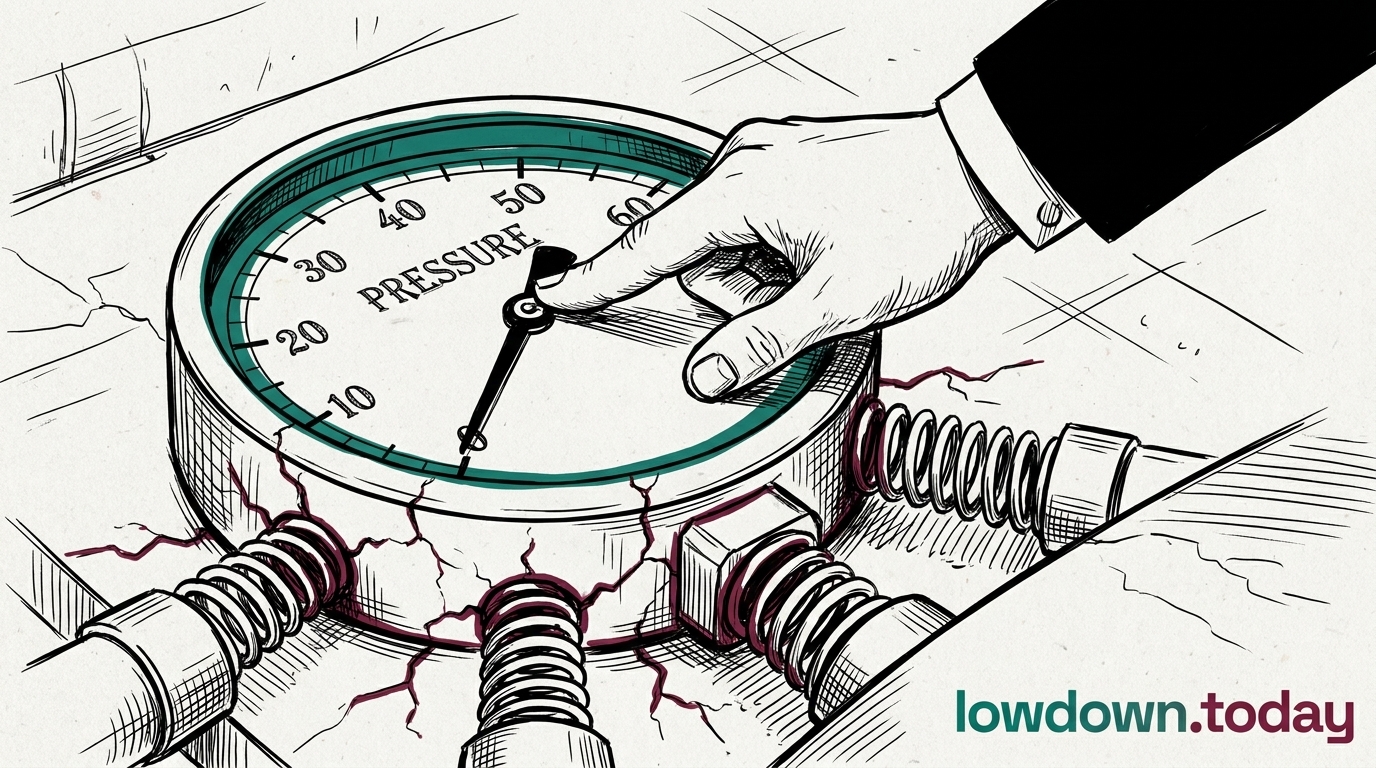
The president whose stated war objective was reopening the Strait of Hormuz now accepts it may end with the Strait still closed.

EconomicDeveloping
Key takeaway

The war's original purpose has been quietly abandoned while the war continues.

President Trump privately told aides on 31 March that he would accept ending military operations even if the Strait of Hormuz remains largely closed. 1 White House press secretary Karoline Leavitt confirmed publicly that reopening Hormuz is "not a core objective."

As recently as 30 March, Trump's Truth Social posts threatened to "destroy every power plant in Iran" if the strait was not "immediately open for business" . By 31 March, he was privately telling aides he would accept ending operations with the strait still largely closed. Privately, Trump told aides the opposite. His administration now defines success as crippling Iran's navy and missile capabilities, objectives that can be declared met on Washington's schedule rather than Tehran's.

Brent Crude fell roughly $3 to $113.20 per barrel on the session, a 3% drop, as markets read the shift as marginally positive for supply. At current levels, UK drivers pay roughly 155p per litre, still 40% above February prices. Brent remains 68% above its pre-war level of $67.41 and on track for a record monthly gain.

Iran's five conditions for ending the war include permanent sovereignty over the Strait . If Trump no longer insists on reopening it, the gap between the two positions narrows to reparations, non-recurrence guarantees, and the nuclear file. None of those are simple. But they are negotiable in ways that sovereignty over an international waterway is not. Six days remain before the 6 April deadline, and the distance between public threats and private concessions has never been wider.


Deep Analysis

In plain English

The US made reopening the Strait of Hormuz a central objective of this war, the narrow waterway through which roughly a fifth of the world's oil flows. Iran blocked it when the war began. President Trump privately told aides on 31 March he would accept ending the war even if the Strait stays closed. His press secretary confirmed it publicly. Six days remain before Trump's self-imposed deadline. While Trump retreats from the original goal, Iran is turning the blockade into permanent law. Ships are paying Iran's toll. Chinese state-backed vessels crossed on 30 March. The war's original purpose is being abandoned while the thing it was meant to prevent becomes a permanent fixture of global trade.

Deep Analysis
Root Causes

The original objective was unachievable through the chosen means. Air power can degrade naval capacity but cannot force open a contested maritime chokepoint while the adversary retains mines, shore-based missiles, and swarm drones.

The administration underestimated Iran's ability to sustain the closure through dispersed platforms and layered threats. Publicly framing Hormuz reopening as the war's purpose created a credibility trap: achieving it required ground forces or a naval clearance operation the administration explicitly ruled out.

Three deadline extensions in 30 days demonstrated that Trump's thresholds were negotiating signals rather than red lines, reducing coercive leverage precisely when it was most needed.

Escalation

De-escalatory on the Hormuz axis specifically. The retreat removes one potential trigger for maximum-force infrastructure strikes. However, if Hormuz is no longer the objective, the remaining rationale of degrading Iran's military has no defined endpoint. Operations can continue without a measurable success condition, paradoxically increasing the risk of a prolonged conflict with no defined off-ramp.

What could happen next?
  • Consequence

    Iran's negotiating position strengthens: its core demand on Hormuz sovereignty is being conceded unilaterally before direct talks begin.

    Immediate · 0.85
  • Risk

    Without a defined success condition, military operations continue without a measurable endpoint, risking an open-ended conflict.

    Short term · 0.75
  • Consequence

    Congressional resistance to the $200 billion supplemental intensifies as the core justification for the war is privately withdrawn.

    Short term · 0.8
  • Precedent

    If the toll becomes permanent while the US accepts closure, it establishes that a state can impose transit fees on an international strait under military cover.

    Long term · 0.7
First Reported In

Update #53 · Trump drops Hormuz goal; toll becomes law

Wall Street Journal / Times of Israel· 31 Mar 2026
Read original
Different Perspectives
Kuwait
Kuwait
Kuwait absorbed the Iranian strike that knocked generating units offline at a combined power-and-desalination plant on 17 July, the event that finally moved freight and insurance in lockstep with Brent. The strike hit essential civilian infrastructure, not a trading desk's benchmark.
Asian buyers (Singapore)
Singapore's middle distillates rose 12% month-to-date to 8.91m barrels and fuel oil passed 19m barrels on a 105% net-import surge, buyers retaining barrels as the East-West arbitrage window narrows. Cargoes are being stockpiled ahead of further Hormuz-driven freight repricing rather than released west.
Austria (Coreper holdout)
Vienna is blocking the same package over roughly EUR 2bn of frozen Russian assets earmarked for Raiffeisen, a domestic banking dispute with no connection to the oil cap racing toward its 23 July expiry. The linkage forces the whole package to wait on a bilateral compensation fight.
Greece (Coreper holdout)
Athens is holding the 21st sanctions package at the 22 July Coreper vote over Russian LNG re-export rights, a condition unrelated to the oil price cap itself, leaving the $44.10 freeze one day from expiry without a deal. Greece's own tanker registry gives it a direct stake in how any shadow-fleet measures are drafted.
Marine underwriters (Gulf war-risk)
Hull war-risk cover for Hormuz transits widened to a 3-10% band on 17 July with 5% the emerging norm, up from a 3-4% baseline set in late June, the first repricing in six weeks to track a flat-price move rather than lag it. Cover resets on actuarial evidence of loss, not on diplomatic or price signals.
Money managers (CFTC-tracked)
The CFTC's week-to-14-July snapshot, released 17 July, showed WTI managed-money net long collapsing 69% to 19,783 contracts and a standalone 60,141-contract net short on Brent Last Day (NYMEX). Both readings predate the Kuwait strike and the 20 July escalation, so any covering since is not yet visible in public data.