Skip to content
You can now search across every topic, entity and event.What's new
European Energy Markets
31JUL

New casualty count backdated to 7 July

2 min read
09:44UTC

The Pentagon's casualty system now records 4 dead and 207 wounded under a category whose start date matches the War Powers notification, with no breakdown by incident.

EconomicAssessed
Key takeaway

The casualty clock now starts on the day Congress was notified, not on the first strike.

The Defense Casualty Analysis System, the Pentagon's public register of American military casualties, has backdated its new Overseas Operations category to 7 July 2026, the date the War Powers notification went to Congress, and records 4 dead and 207 wounded under it with no breakdown by incident 1.

The category itself appeared on 26 July , three days after Congress tried the direct route and lost twice. The War Powers Resolution of 1973 requires a president to notify Congress within two days of introducing forces into hostilities, and to withdraw them within 60 days absent a declaration or specific authorisation. A category whose clock starts at the notification, rather than at the first strike or the first deployment, sets the administration's own answer to the question of when this conflict began.

An incident-level breakdown is what allows an outside reader to connect a death to the operation that caused it, and to the date on which that operation happened. Without it, the 211 figures sit inside a single bucket that begins on a legally convenient day. Nobody outside the department can test whether a casualty recorded there occurred before 7 July, which is precisely the period the 60-day clock would otherwise cover.

Congress ends up in the same position either way, whether the ordering was designed or administrative. A congressional committee asking when hostilities started now has to argue against a government database rather than against a press statement, and databases are harder to cross-examine.


Deep Analysis

In plain English

The US military's official tracker for war deaths, called the Defense Casualty Analysis System, created a new counting category called Overseas Operations. It set the category's start date to 7 July, the day the Pentagon formally notified Congress about the conflict under a law called the War Powers Resolution. Under this new count, 4 troops have died and 207 have been wounded, but the Pentagon has not broken down which specific incidents make up that total.

Deep Analysis
Root Causes

The new Overseas Operations category exists because the Pentagon's prior tracking system, Operation Epic Fury, could not cleanly separate Iran-conflict casualties from broader regional operations, a structural gap that produced the swinging revisions seen over the preceding two weeks .

Backdating to the War Powers notification date creates a defensible administrative anchor: any casualty figure disputed in future Congressional hearings can be traced to a single, legally significant starting point rather than the shifting operational dates used in earlier tallies.

What could happen next?
  • Consequence

    Tying the casualty count to the War Powers notification date could limit Congressional scrutiny to losses recorded only after formal notification, excluding earlier disputed figures.

  • Risk

    A third distinct revision to the casualty count in under two weeks risks further eroding confidence in the Pentagon's public reporting.

First Reported In

Update #164 · The pause ends, and the map moves west

The Peninsula Qatar· 31 Jul 2026
Read original
Causes and effects
This Event
New casualty count backdated to 7 July
A start date tied to a notification rather than an operational milestone gives the administration's legal position a documentary spine.
Different Perspectives
Spain's LNG terminal operators
Spain's 9,145 GWh terminal inventory is the largest single stock in the EU LNG network, an option value that can reroute cargoes wherever the winter strip pays best rather than a cavern gas obligation tied to a fixed date. That flexibility matters more as Germany's cavern shortfall pushes more of the winter security question onto import infrastructure.
European Commission
European Commission
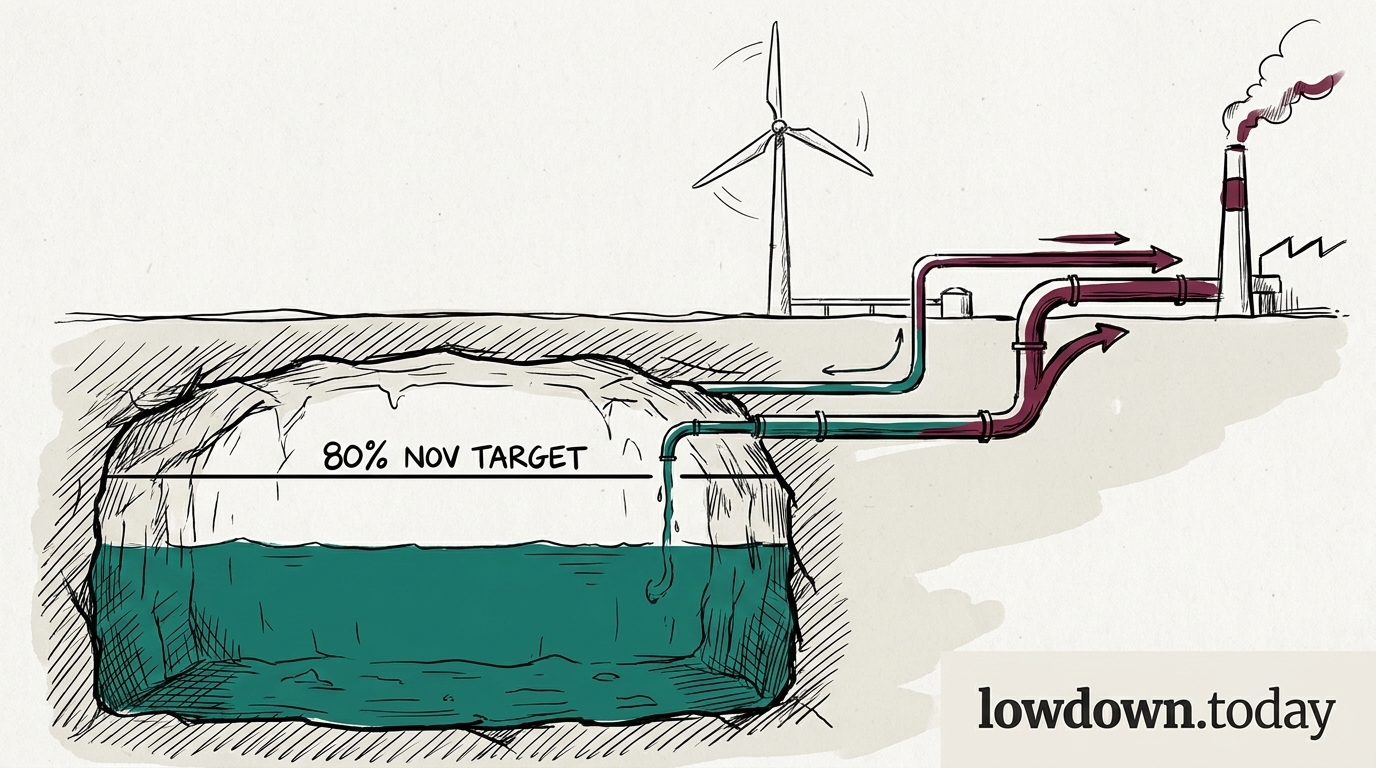
Brussels holds the bloc to 90% on a flexible window while Germany, holding roughly a quarter of EU storage capacity, tracks toward missing its own lower 80% figure by 21 points. A national shortfall this size in the anchor market matters more to bloc security than the flexible timetable alone can absorb.
French power exporters and CRE
French day-ahead rose in step with Germany but by less, reopening a EUR 7-17 premium that makes northward export flows commercially attractive again after the EUR 43.09 discount evaporated in days. CRE separately authorised RTE and Enedis to buy flexibility locally, betting the coming winter's binding constraint is grid congestion rather than a shortage of firm capacity.
TTF trading desk
TTF trading desk
A visible national shortfall like Germany's 21-point gap is a directional signal, not noise, for a desk holding the summer-winter spread. TTF's flat EUR 58-60 range through this week's German price swings says the market has not yet chosen to reprice refill risk into the front of the curve.
German cavern and CCGT operators
German caverns kept buying prompt gas at TTF near EUR 58-60 through the inversion; the wind collapse to 2.4 GW then flipped the spark spread to plus EUR 29 and put turbines back in the same queue. Every day turbines win that bid, injection at a third of the 877 GWh/day pace needed falls further behind.
Slovakia
Slovakia
Slovakia says it dropped its hold-out on the 21st sanctions package only after Ursula von der Leyen personally signed written gas-price and supply guarantees. The Council of the European Union's own 17,238-character release on the package names neither Slovakia nor any guarantee, leaving Bratislava's account unconfirmed by the institutional record.



