Skip to content
You can now search across every topic, entity and event.What's new
European Energy Markets
31JUL

IAEA: no radiation released across Iran

2 min read
09:44UTC

The absence of radiation rules out a contamination disaster across the region. It also means the strikes may not have reached Iran's enriched uranium.

EconomicDeveloping
Key takeaway

No radiation is the floor of bad outcomes, not evidence of mission success — and the absence of a detectable release is mild corroborating evidence that weapons did not reach the underground halls.

The IAEA confirmed that no radiation increase has been detected anywhere in Iran since the air campaign began on 28 February. For Iran's population and for Iraq, The Gulf states, and allied military personnel stationed downwind, this rules out a contamination emergency. Iran has accumulated significant quantities of uranium enriched to 60% purity — within technical reach of weapons-grade — and a breach of containment at Natanz would have carried radiological consequences well beyond Iran's borders.

The same finding carries a second reading. If the underground enrichment halls had been penetrated and their contents destroyed, some radiological signature would likely be detectable — if not by the IAEA's orbital sensors, then by the monitoring stations operated by the Comprehensive Nuclear-Test-Ban Treaty Organisation across the region. The absence of any detected increase is consistent with the enrichment halls remaining sealed and intact, their contents undisturbed behind collapsed entrance buildings rather than destroyed within them.

The IAEA's dual finding — no catastrophe, no confirmed destruction — leaves the administration's stated nuclear objective without independent evidence of success on Day 4. Senator Mark Warner, vice-chairman of the Senate Intelligence Committee, told NPR there 'is and was no imminent, immediate threat from Iran against America' . The radiation data does not resolve whether there will be one in the future. It establishes only that the programme's physical infrastructure has not demonstrably been eliminated.


Deep Analysis

In plain English

Enriched uranium is radioactive. If bombs had cracked open its storage containers or caused a runaway nuclear reaction underground, radiation detectors across the region — operated by the IAEA and the treaty body that monitors nuclear tests — would have spiked within hours, as they did after Chernobyl and Fukushima. They did not. This rules out a catastrophe affecting surrounding populations. What it cannot tell you is whether the enrichment machinery inside the facility was destroyed or merely sealed in.

Deep Analysis
Synthesis

The IAEA's two confirmed findings — entrance damage at Natanz, no radiation anywhere in Iran — are jointly informative in a way neither finding is alone. Weapons that penetrated to the depth of the enrichment halls would likely have breached uranium hexafluoride storage and feed cylinders, producing a detectable radionuclide signature. The clean radiation picture therefore provides inferential support for the interpretation that underground halls were not reached — making the two IAEA data points collectively more useful than either in isolation.

What could happen next?
  • Meaning

    No radiation release confines the humanitarian emergency to conventional strike casualties — there is no radiological contamination requiring evacuation, long-term land remediation, or public health response beyond the strike zones.

    Immediate · Assessed
  • Risk

    If underground halls are later confirmed intact, Iran can cite the clean radiation record as evidence of programme survival in diplomatic negotiations, undermining the administration's claimed mission success.

    Medium term · Suggested
  • Consequence

    A clean radiological bill weakens the catastrophic humanitarian argument for ceasefire, potentially reducing international pressure for rapid conflict termination.

    Short term · Suggested
First Reported In

Update #14 · Natanz unverified; Hormuz sealed

India TV News· 3 Mar 2026
Read original
Causes and effects
This Event
IAEA: no radiation released across Iran
The absence of any radiological increase eliminates the worst-case environmental catastrophe for Iran and its neighbours but simultaneously provides indirect evidence that Iran's underground enrichment halls — where centrifuges and enriched uranium are housed — were not penetrated by the strikes.
Different Perspectives
Spain's LNG terminal operators
Spain's 9,145 GWh terminal inventory is the largest single stock in the EU LNG network, an option value that can reroute cargoes wherever the winter strip pays best rather than a cavern gas obligation tied to a fixed date. That flexibility matters more as Germany's cavern shortfall pushes more of the winter security question onto import infrastructure.
European Commission
European Commission
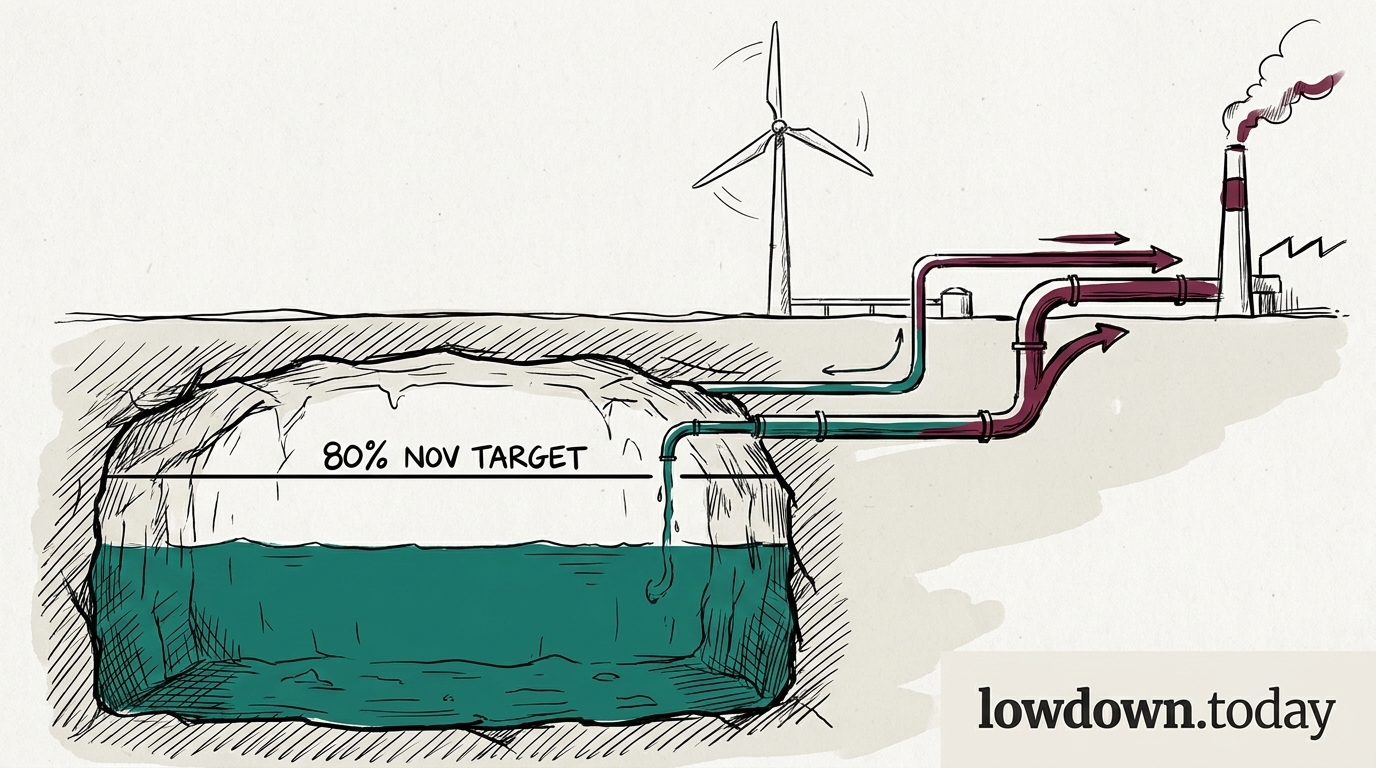
Brussels holds the bloc to 90% on a flexible window while Germany, holding roughly a quarter of EU storage capacity, tracks toward missing its own lower 80% figure by 21 points. A national shortfall this size in the anchor market matters more to bloc security than the flexible timetable alone can absorb.
French power exporters and CRE
French day-ahead rose in step with Germany but by less, reopening a EUR 7-17 premium that makes northward export flows commercially attractive again after the EUR 43.09 discount evaporated in days. CRE separately authorised RTE and Enedis to buy flexibility locally, betting the coming winter's binding constraint is grid congestion rather than a shortage of firm capacity.
TTF trading desk
TTF trading desk
A visible national shortfall like Germany's 21-point gap is a directional signal, not noise, for a desk holding the summer-winter spread. TTF's flat EUR 58-60 range through this week's German price swings says the market has not yet chosen to reprice refill risk into the front of the curve.
German cavern and CCGT operators
German caverns kept buying prompt gas at TTF near EUR 58-60 through the inversion; the wind collapse to 2.4 GW then flipped the spark spread to plus EUR 29 and put turbines back in the same queue. Every day turbines win that bid, injection at a third of the 877 GWh/day pace needed falls further behind.
Slovakia
Slovakia
Slovakia says it dropped its hold-out on the 21st sanctions package only after Ursula von der Leyen personally signed written gas-price and supply guarantees. The Council of the European Union's own 17,238-character release on the package names neither Slovakia nor any guarantee, leaving Bratislava's account unconfirmed by the institutional record.



