Skip to content
You can now search across every topic, entity and event.What's new
European Energy Markets
31JUL

Budapest blocks two of Ukraine's clusters

2 min read
09:44UTC

Hungary refused to back opening EU accession Clusters 2 and 3 for Ukraine at a Brussels working party on 17 July, offering to open Cluster 3 for Moldova alone.

EconomicDeveloping
Key takeaway

A working party that never votes in public can cost Kyiv a summer without anyone casting a veto.

Hungary refused to back the opening of EU accession negotiating Clusters 2 and 3 for Ukraine at COELA, the Council's enlargement working party, on 17 July, offering instead to open Cluster 3 for Moldova on its own 1. Most member states rejected decoupling the two candidates, so nothing was decided. The question returns to COELA on Wednesday 22 July, the last meeting before the summer recess.

Péter Magyar's Tisza government came to power partly by ending Viktor Orbán's blanket veto on the EUR 90bn loan to Ukraine, and Kyiv's accession conference opened in June on that basis . Budapest has released the money and kept the procedure, which is a narrower obstruction than Orbán's but sits at a more awkward point. Clusters 2 and 3 carry the rule-of-law and territorial chapters, and an EU-friendly Hungarian government's enthusiasm for Ukrainian accession runs into its own electorate precisely there.

Accession clusters open by unanimity in a working party most voters have never heard of, which is what makes the block durable. No summit vote is needed, no veto has to be announced, and a single delegation withholding agreement in a room in Brussels is enough to stop a candidate's file moving. Miss 22 July and nothing reconvenes until September, so a procedural hesitation lasting an afternoon costs Ukraine roughly two months.


Deep Analysis

In plain English

The European Union is negotiating Ukraine's membership in stages, called "clusters", each covering a group of policy areas Ukraine has to align with EU rules on before moving forward. Hungary refused to back opening two of these clusters, covering rule of law and territorial issues, for Ukraine at a meeting in Brussels on 17 July. It offered instead to open one of the two clusters for Moldova alone, but most other EU countries rejected splitting the two candidate countries apart. The issue will come back for another vote on 22 July, the last EU meeting before the summer break. This matters because Hungary's government changed earlier this year, and its new leader had promised to stop blocking Ukraine, which makes this block notable even though it is procedural rather than a return to Hungary's old blanket veto.

Deep Analysis
Root Causes

Clusters 2 and 3 carry the rule-of-law and territorial chapters, precisely where a Hungarian government campaigning on EU-friendliness runs into its own electorate's sensitivities on those issues. The constraint here is domestic political cost, not alignment with Moscow as under Orbán, a structurally different source of friction from the loan veto it replaced.

Hungary's offer to open Cluster 3 for Moldova alone, while withholding it from Ukraine, is a split-track manoeuvre most member states have already rejected; pairing the two countries' accession tracks was itself a prior EU decision Budapest is now trying to unpick procedurally rather than reopen as a formal proposal.

First Reported In

Update #24 · Fedorov sacked as the front stands still

Ukrainska Pravda· 19 Jul 2026
Read original
Different Perspectives
Spain's LNG terminal operators
Spain's 9,145 GWh terminal inventory is the largest single stock in the EU LNG network, an option value that can reroute cargoes wherever the winter strip pays best rather than a cavern gas obligation tied to a fixed date. That flexibility matters more as Germany's cavern shortfall pushes more of the winter security question onto import infrastructure.
European Commission
European Commission
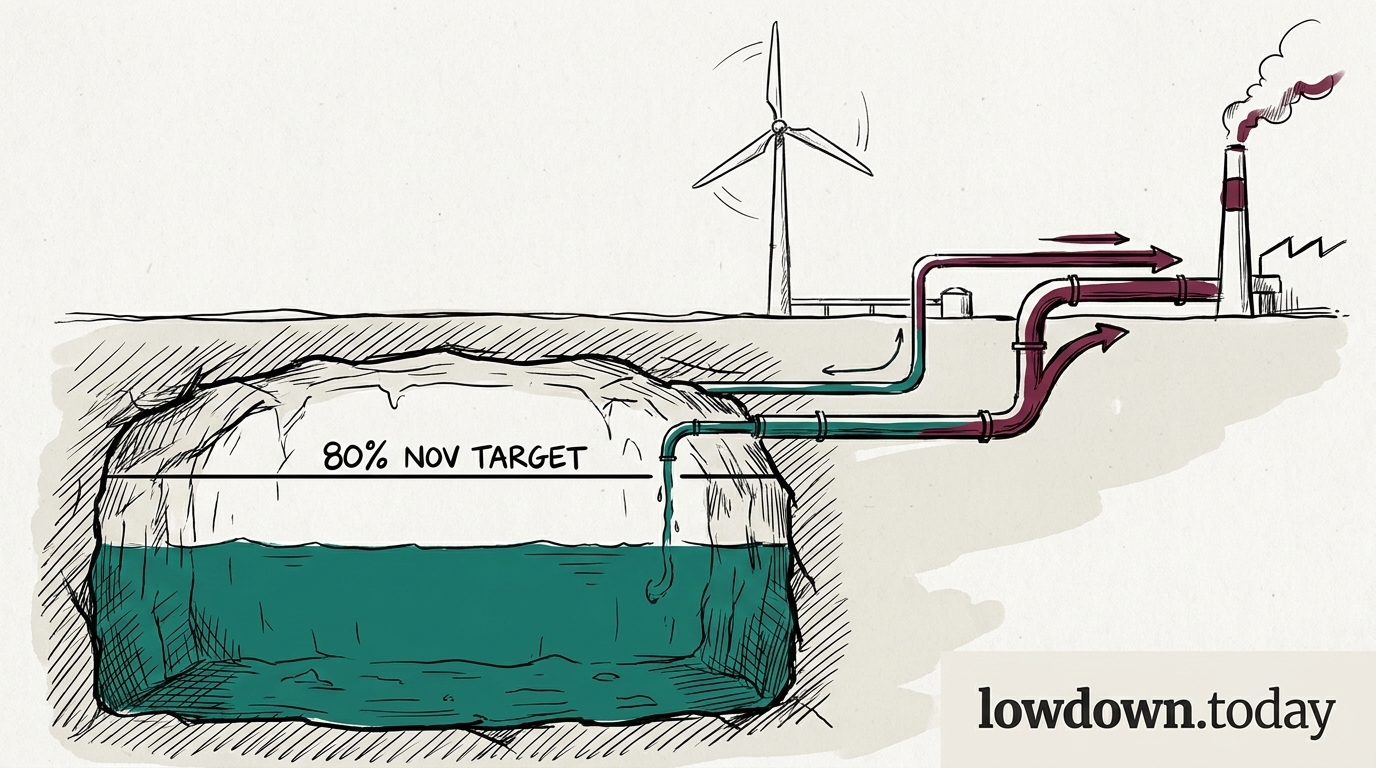
Brussels holds the bloc to 90% on a flexible window while Germany, holding roughly a quarter of EU storage capacity, tracks toward missing its own lower 80% figure by 21 points. A national shortfall this size in the anchor market matters more to bloc security than the flexible timetable alone can absorb.
French power exporters and CRE
French day-ahead rose in step with Germany but by less, reopening a EUR 7-17 premium that makes northward export flows commercially attractive again after the EUR 43.09 discount evaporated in days. CRE separately authorised RTE and Enedis to buy flexibility locally, betting the coming winter's binding constraint is grid congestion rather than a shortage of firm capacity.
TTF trading desk
TTF trading desk
A visible national shortfall like Germany's 21-point gap is a directional signal, not noise, for a desk holding the summer-winter spread. TTF's flat EUR 58-60 range through this week's German price swings says the market has not yet chosen to reprice refill risk into the front of the curve.
German cavern and CCGT operators
German caverns kept buying prompt gas at TTF near EUR 58-60 through the inversion; the wind collapse to 2.4 GW then flipped the spark spread to plus EUR 29 and put turbines back in the same queue. Every day turbines win that bid, injection at a third of the 877 GWh/day pace needed falls further behind.
Slovakia
Slovakia
Slovakia says it dropped its hold-out on the 21st sanctions package only after Ursula von der Leyen personally signed written gas-price and supply guarantees. The Council of the European Union's own 17,238-character release on the package names neither Slovakia nor any guarantee, leaving Bratislava's account unconfirmed by the institutional record.



