Skip to content
You can now search across every topic, entity and event.What's new
European Energy Markets
16JUL

Capacity law faces 24 June hearing

4 min read
09:48UTC

Germany's StromVKG capacity-market law goes to a public expert hearing on 24 June, with a Greens motion and Federal Cartel Office concerns in play before the first 4.5 GW auction targeted for 1 September.

EconomicDeveloping
Key takeaway

The 24 June hearing decides whether the 1 September capacity auction date holds.

The StromVKG, Germany's electricity capacity-market law, goes to a public expert Anhoerung (hearing) at the Paul-Loebe-Haus on 24 June 1. A capacity market pays plants to be available rather than for the power they sell, the instrument Germany is using to keep dispatchable gas capacity on the system as renewables grow.

The Greens motion 21/6369 demands technology-neutral auction criteria and clarity on how the levy is financed , carrying forward the hydrogen-conversion push the group raised in committee on 17 June. The Federal Cartel Office, Germany's competition authority, has flagged market-concentration concerns in the design. The bill reached this stage after the Bundestag's first reading and committee referral advanced it under accelerated procedure .

The first 4.5 GW long-duration auction is targeted for 1 September, a second 4.5 GW for 8 December, with a ten-hour continuous-output rule that excludes batteries from the opening tranche. That rule is the design choice with the sharpest market consequence: it hands the first auctions to long-duration thermal plant and shuts storage out of the initial capacity payments.

The hearing is where the 1 September date either holds or slips. The timing connects directly to the spark: CCGTs that have just turned profitable to run are the same plants the capacity auctions are meant to underwrite, so any delay leaves their forward economics resting on the spread alone.


Deep Analysis

In plain English

Germany is creating a capacity market: a system to pay gas power stations to stay available as a backup for when wind and solar are not generating enough electricity. The law establishing it, the StromVKG, passed its first parliamentary reading in June 2026. On 24 June, the German parliament held a public hearing on the StromVKG design. The Greens party wants the rules to be technology-neutral, asking that batteries and other clean technologies also be eligible for capacity payments, rather than gas stations alone. Second, Germany's competition watchdog, the Federal Cartel Office, is worried that the programme would mostly pay money to a small number of big energy companies that already own most of the gas power stations. The first auction is planned for 1 September 2026, with a second in December. Whether those dates hold depends on what comes out of the hearing on 24 June.

What could happen next?
  • Risk

    A successful legal challenge to the ten-hour battery exclusion rule, via either a Cartel Office formal proceeding or an EU Commission state-aid opening, would delay the September auction and leave Germany without the capacity mechanism framework through the current heating season.

    Short term · Suggested
  • Consequence

    If the September auction proceeds on schedule and awards contracts to existing CCGT plant, the gas power stations currently generating at +EUR 30 spark spread receive both a market margin and a capacity payment; double compensation that the Cartel Office's concentration concern addresses.

    Medium term · Assessed
  • Precedent

    Germany's battery exclusion replicates the UK T-4 2014 design error; the EU Commission is likely to require technology-neutral admission within two to three years as occurred in the UK.

    Long term · Assessed
First Reported In

Update #20 · Spark spread now feeds the winter deficit

Deutscher Bundestag· 22 Jun 2026
Read original
Different Perspectives
LNG spreads desk
LNG spreads desk
The JKM-TTF arb flipped to a TTF premium of roughly USD 0.6/MMBtu on 15 July, the first time this cycle Europe has outbid Asia, yet no Atlantic cargo has rerouted west. Until a cargo actually moves, the desk reads the Hormuz premium as unconfirmed and the EUR 55 print as vulnerable to a fast reversal.
United States
United States
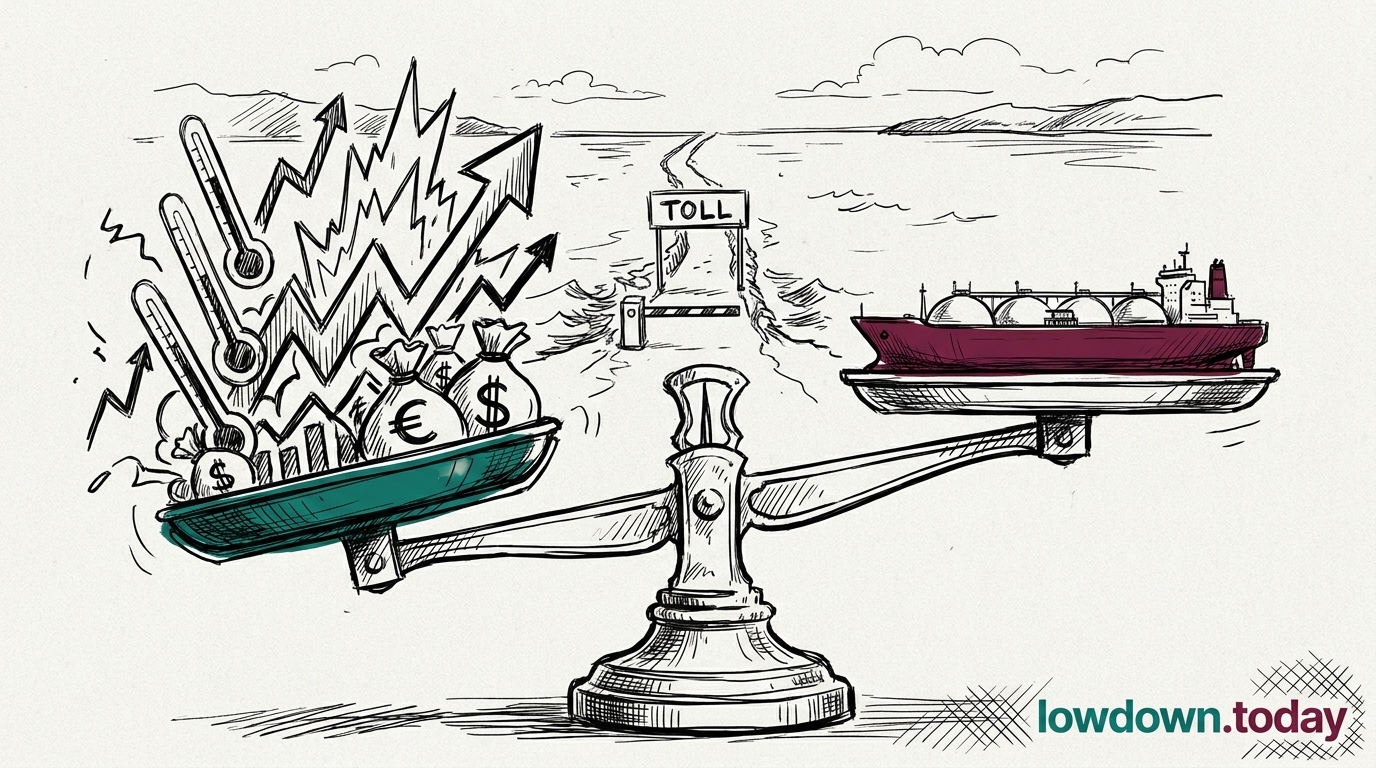
Washington reimposed a blockade on Iranian ports and a 20% Strait of Hormuz cargo toll on 13 July, driving TTF's 9% two-session rally to EUR 54.995/MWh. The posture is again setting Europe's gas benchmark by sentiment rather than by any confirmed change in cargo flows.
EDF
EDF
EDF slipped the Bugey 3, Golfech 2 and Chooz 2 restarts to 19, 22 and 25 July, pushing all three past the 20 July Bugey heat exemption, after river-cooling limits on the Rhone, Garonne and Meuse forced the cuts. The same thermal ceiling has capped the fleet in every major heatwave since 2003, and this cycle is no exception.
German power desk
German power desk
German day-ahead power climbed from EUR 126 to EUR 156/MWh over 14-16 July as the heat dome held, flipping the clean spark spread positive for the first time since 14 July. Gas-for-power demand is now back in competition with mandate storage injection right as the injection margin itself is thinning.
EU carbon and storage regulators
EUA carbon broke EUR 81/tonne on 13 July as the ETS Market Stability Reserve's scheduled withdrawals met fresh fuel-switching demand from France's nuclear curtailment. Brussels' mandatory storage-fill rule kept German and French injection running regardless of the TTF swings, the mechanism working as designed four years after the 2022 shock.
Equinor
Equinor
Equinor returned its Asgard field from maintenance on 11 July, lifting Gassco's exit nominations to 319.8 mcm/day just as TTF round-tripped on Hormuz risk. The restart gave Norway spare pipeline capacity to help Europe absorb the gas rally without drawing down storage, reinforcing its role as the post-2022 swing supplier.
