Skip to content
You can now search across every topic, entity and event.What's new
European Energy Markets
16JUL

ACER lifts price cap to EUR 99,999

3 min read
09:48UTC

ACER will widen cross-border marginal-price limits to plus or minus EUR 99,999/MWh after July, opening a REMIT reporting consultation on 16 July as a Danish hoarding fine sets the enforcement tone.

EconomicDeveloping
Key takeaway

A higher cross-border cap sharpens winter tail risk as REMIT enforcement nears.

ACER, the EU agency that coordinates national energy regulators, will widen cross-border marginal-price limits from plus or minus EUR 15,000 to plus or minus EUR 99,999/MWh after July, removing the transitional cap on cross-zonal clearing extremes 1. The cap sets how high a price can clear when capacity is allocated across borders; lifting it lets scarcity register at its true level rather than being truncated.

The timing matters against a market already tracking a wider winter balance. A higher ceiling does nothing on a normal day, but in a genuine scarcity event it lets cross-border prices spike to levels the old cap suppressed, sharpening the tail risk on any winter position.

A second strand runs in parallel. ACER's REMIT transaction-reporting Annex consultation opens on 16 July, covering energy derivatives . REMIT is the EU's wholesale market-integrity regulation, and the agency gained direct cross-border investigatory powers under its 2024 revision; those powers are due to activate in the fourth quarter of 2026.

No ACER cross-border enforcement case exists yet, so the Danish regulator's capacity-hoarding fine functions as the national curtain-raiser, a REMIT-style action that signals the enforcement posture ahead of ACER taking the cross-border lead 2. Desks should treat the fine as the template for how the agency's own first case is likely to look.


Deep Analysis

In plain English

ACER is the EU's energy regulator; the body that oversees electricity and gas markets across European borders. When electricity is traded across countries, there are rules about how high or low prices can go. Currently, the maximum price for cross-border electricity trades is EUR 15,000 per unit. After July, ACER is raising that ceiling to EUR 99,999 per unit. This sounds alarming, but the reasoning is technical: in an extreme shortage, prices need to rise very high to ration the limited supply and signal where it should go. If the cap is too low, the market cannot clear; meaning trades cannot be settled; which is actually worse than an extreme price. The concern is that this rule change takes effect before ACER's ability to detect price manipulation at the new levels is fully operational. REMIT is the EU's market-integrity regulation for energy trading; broadly similar to financial markets regulation. ACER opened a consultation on 16 July to update REMIT's reporting requirements to cover energy derivatives, but that consultation will not produce binding rules until 2027.

What could happen next?
  • Risk

    The EUR 99,999 cap takes effect in August, months before the REMIT Annex consultation produces binding derivative-reporting rules; a scarcity event in October or November 2026 would occur under the new cap but without the full enforcement coverage the consultation is designed to create.

    Short term · Assessed
  • Precedent

    The Danish capacity-hoarding fine establishes national REMIT enforcement as a live regulatory instrument ahead of ACER's Q4 cross-border activation, providing a deterrence signal to generators across the EU single energy market.

    Immediate · Assessed
  • Consequence

    The REMIT Annex consultation covering energy derivatives from 16 July will require trading counterparties to report a wider set of financial instruments; compliance costs for energy traders are estimated at EUR 2-5 million per firm for system updates.

    Medium term · Assessed
First Reported In

Update #20 · Spark spread now feeds the winter deficit

ACER· 22 Jun 2026
Read original
Different Perspectives
LNG spreads desk
LNG spreads desk
The JKM-TTF arb flipped to a TTF premium of roughly USD 0.6/MMBtu on 15 July, the first time this cycle Europe has outbid Asia, yet no Atlantic cargo has rerouted west. Until a cargo actually moves, the desk reads the Hormuz premium as unconfirmed and the EUR 55 print as vulnerable to a fast reversal.
United States
United States
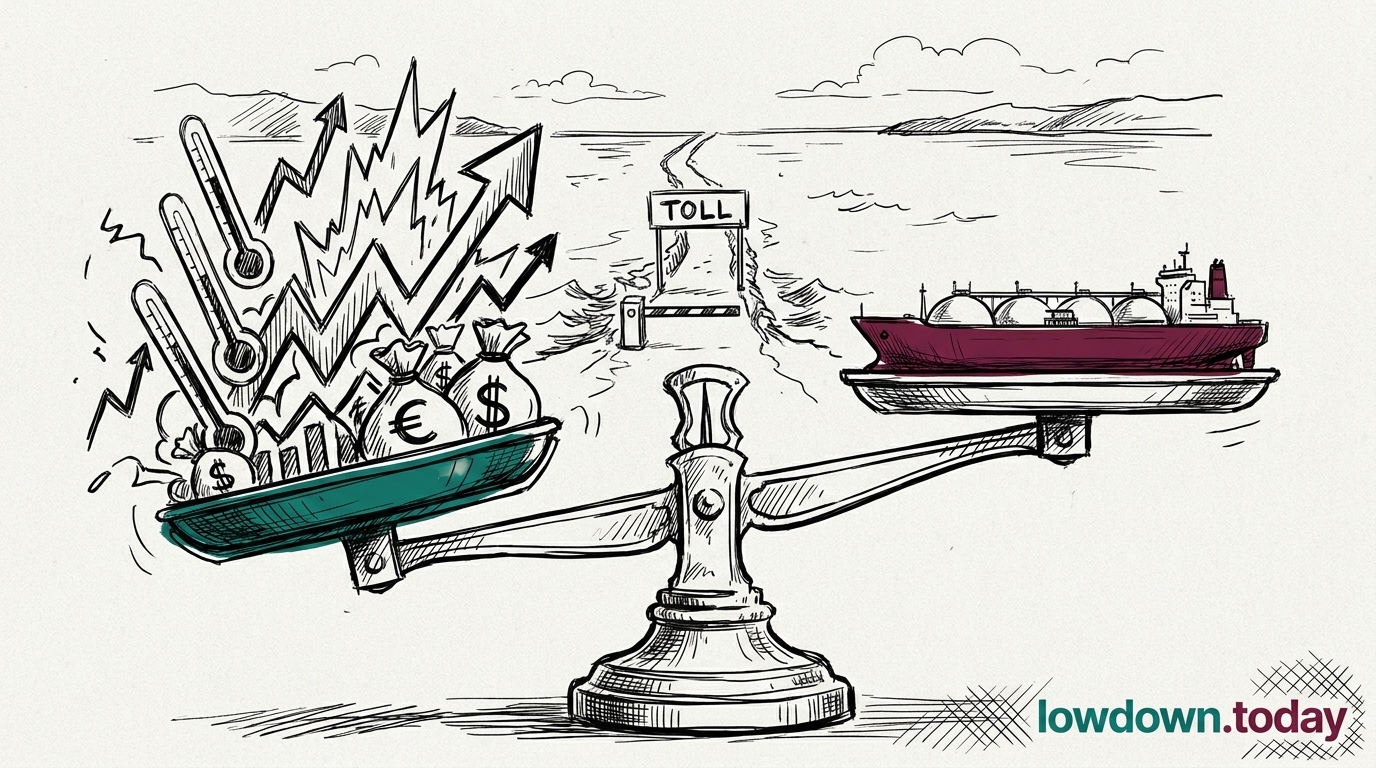
Washington reimposed a blockade on Iranian ports and a 20% Strait of Hormuz cargo toll on 13 July, driving TTF's 9% two-session rally to EUR 54.995/MWh. The posture is again setting Europe's gas benchmark by sentiment rather than by any confirmed change in cargo flows.
EDF
EDF
EDF slipped the Bugey 3, Golfech 2 and Chooz 2 restarts to 19, 22 and 25 July, pushing all three past the 20 July Bugey heat exemption, after river-cooling limits on the Rhone, Garonne and Meuse forced the cuts. The same thermal ceiling has capped the fleet in every major heatwave since 2003, and this cycle is no exception.
German power desk
German power desk
German day-ahead power climbed from EUR 126 to EUR 156/MWh over 14-16 July as the heat dome held, flipping the clean spark spread positive for the first time since 14 July. Gas-for-power demand is now back in competition with mandate storage injection right as the injection margin itself is thinning.
EU carbon and storage regulators
EUA carbon broke EUR 81/tonne on 13 July as the ETS Market Stability Reserve's scheduled withdrawals met fresh fuel-switching demand from France's nuclear curtailment. Brussels' mandatory storage-fill rule kept German and French injection running regardless of the TTF swings, the mechanism working as designed four years after the 2022 shock.
Equinor
Equinor
Equinor returned its Asgard field from maintenance on 11 July, lifting Gassco's exit nominations to 319.8 mcm/day just as TTF round-tripped on Hormuz risk. The restart gave Norway spare pipeline capacity to help Europe absorb the gas rally without drawing down storage, reinforcing its role as the post-2022 swing supplier.
