Skip to content
You can now search across every topic, entity and event.What's new
European Energy Markets
16JUL

ACER dates its cross-border powers switch-on

3 min read
09:48UTC

ACER set the second half of 2026 for its expanded cross-border investigatory powers at the 11 June REMIT workshop; the reporting-guidance consultation closed 12 June with the final text held to October.

EconomicDeveloping
Key takeaway

ACER's cross-border enforcement goes live in H2 2026 while its reporting rulebook stays provisional until October.

ACER and the European Commission held their annual REMIT workshop on 11 June 2026, and the agency confirmed that its expanded cross-border investigatory powers activate in the second half of 2026 1. REMIT is the EU wholesale market-integrity regime, the horizontal rulebook covering manipulation and insider trading across gas and power. The transaction-reporting guidance consultation closed 12 June, with the final guideline not expected until October 2026 2.

That sequence locks the reporting rulebook this month while the powers that act on it switch on next quarter. The paradox has run since REMIT's recast entered force on 29 April : firms have reported under a framework whose consultation only closed now and whose final text lands in October, leaving roughly six months of binding obligation measured against interim guidance. For a compliance desk that means live exposure on every cross-border trade from H2, scored against rules still open to revision.

ACER logged 204 STORs, suspicious transaction and order reports, in 2025, double the 2024 count, before the new powers even existed. That doubling came from national regulators escalating ahead of the cross-border activation, which signals where the surveillance posture is heading once ACER can open its own investigations.

The workshop was not a storage-policy venue, as the agency had made clear in flagging it . It marked the handover into the surveillance regime's first full enforcement cycle. The reporting rulebook locks this month; the powers that act on it go live next quarter, and that interval is the exposure window desks have to manage.


Deep Analysis

In plain English

REMIT is the EU's rulebook for policing energy market manipulation, the equivalent of insider-trading and market-abuse law but applied to gas and electricity. It covers anyone buying or selling wholesale energy across European borders. ACER (the EU Agency for the Cooperation of Energy Regulators) gained new powers in 2024 to run its own cross-border investigations rather than referring cases to national regulators. Those powers switch on in the second half of 2026. The unusual part is that firms already had to follow the new reporting rules from 29 April, but the final version of the rulebook setting out exactly what to report is not due until October 2026. From 29 April to October, energy trading desks across the EU reported under guidance that was still open to revision.

Deep Analysis
Root Causes

The compliance-before-rulebook gap at REMIT has a structural cause: the 2024 REMIT amendment gave ACER cross-border powers on an accelerated legislative timeline driven by the 2022-23 energy crisis, compressing the secondary-legislation drafting schedule.

The Commission chose to bring the primary powers into force by April 2026 (meeting a political commitment) while accepting that transaction-reporting guidance would follow in October. For ACER to wait for the October guideline would mean six months of enhanced investigatory capacity held in abeyance, which is why H2 2026 enforcement timing is genuinely contested rather than settled.

The STOR doubling from 2024 to 2025 (102 to 204 reports) predates both the new powers and the REMIT 2.0 recast, suggesting that national regulators have already been escalating cases they previously closed at national level, pre-loading the enforcement queue in anticipation of ACER's cross-border activation.

What could happen next?
  • Risk

    A first ACER cross-border enforcement action before October 2026 will face immediate EFET-backed legal challenge on notice grounds, potentially creating a test case that delays effective enforcement by 12-18 months while setting the boundary conditions for the whole REMIT 2.0 enforcement regime.

    Short term · Suggested
  • Consequence

    The 204 STOR pipeline, double the 2024 count, represents a backlog of referred cases that ACER will assess against its new cross-border mandate from H2 2026; firms whose STORs were filed in 2025 now face potential cross-border investigation on conduct they may have treated as closed at national level.

    Short term · Assessed
  • Precedent

    ACER's first formal cross-border enforcement action will set the standard for what constitutes manipulative hub-spread behaviour under REMIT 2.0, defining the compliance perimeter for the EUR 50-plus TTF prompt-window trading that characterised H1 2026.

    Medium term · Assessed
First Reported In

Update #17 · The 17 June ban is priced as paperwork

ACER· 11 Jun 2026
Read original
Different Perspectives
LNG spreads desk
LNG spreads desk
The JKM-TTF arb flipped to a TTF premium of roughly USD 0.6/MMBtu on 15 July, the first time this cycle Europe has outbid Asia, yet no Atlantic cargo has rerouted west. Until a cargo actually moves, the desk reads the Hormuz premium as unconfirmed and the EUR 55 print as vulnerable to a fast reversal.
United States
United States
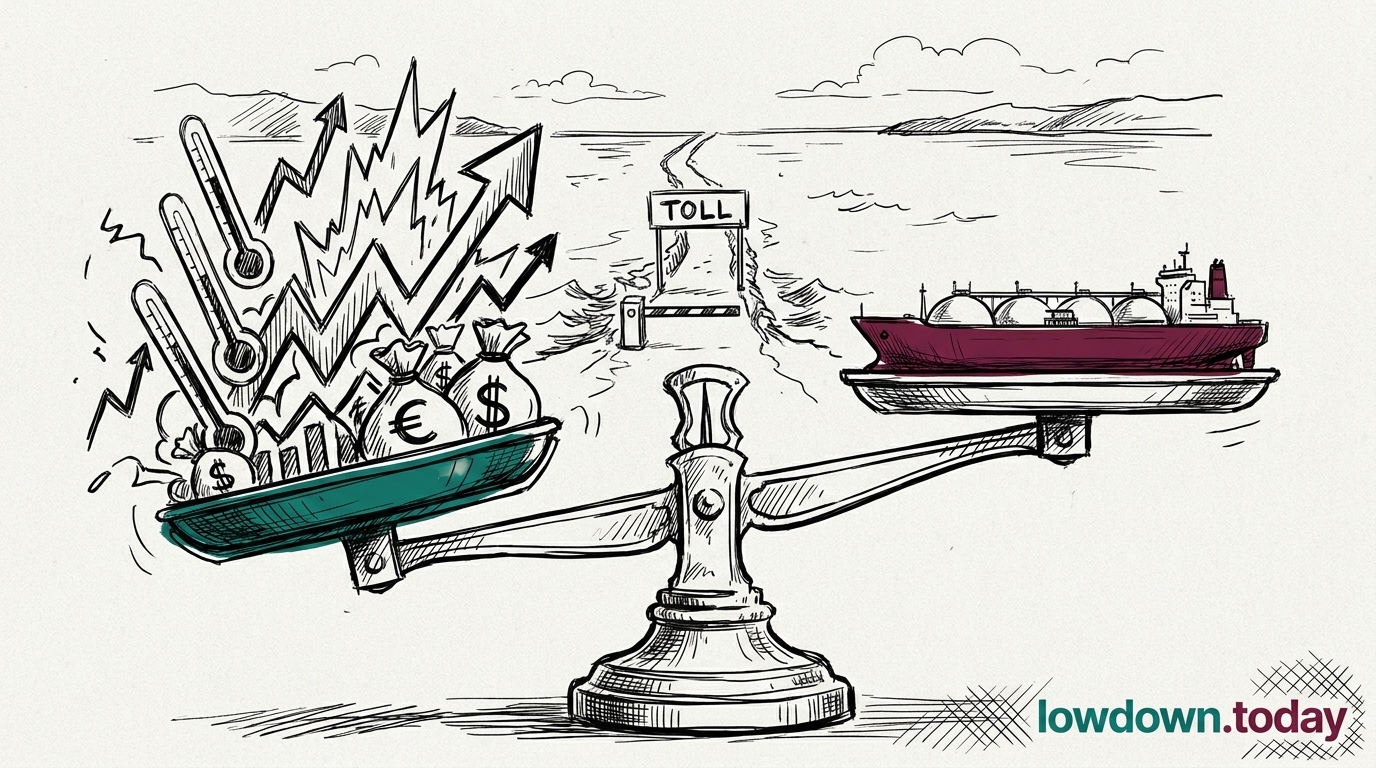
Washington reimposed a blockade on Iranian ports and a 20% Strait of Hormuz cargo toll on 13 July, driving TTF's 9% two-session rally to EUR 54.995/MWh. The posture is again setting Europe's gas benchmark by sentiment rather than by any confirmed change in cargo flows.
EDF
EDF
EDF slipped the Bugey 3, Golfech 2 and Chooz 2 restarts to 19, 22 and 25 July, pushing all three past the 20 July Bugey heat exemption, after river-cooling limits on the Rhone, Garonne and Meuse forced the cuts. The same thermal ceiling has capped the fleet in every major heatwave since 2003, and this cycle is no exception.
German power desk
German power desk
German day-ahead power climbed from EUR 126 to EUR 156/MWh over 14-16 July as the heat dome held, flipping the clean spark spread positive for the first time since 14 July. Gas-for-power demand is now back in competition with mandate storage injection right as the injection margin itself is thinning.
EU carbon and storage regulators
EUA carbon broke EUR 81/tonne on 13 July as the ETS Market Stability Reserve's scheduled withdrawals met fresh fuel-switching demand from France's nuclear curtailment. Brussels' mandatory storage-fill rule kept German and French injection running regardless of the TTF swings, the mechanism working as designed four years after the 2022 shock.
Equinor
Equinor
Equinor returned its Asgard field from maintenance on 11 July, lifting Gassco's exit nominations to 319.8 mcm/day just as TTF round-tripped on Hormuz risk. The restart gave Norway spare pipeline capacity to help Europe absorb the gas rally without drawing down storage, reinforcing its role as the post-2022 swing supplier.
