Skip to content
You can now search across every topic, entity and event.What's new
European Energy Markets
4JUN

Greens push H2 clause in StromVKG

2 min read
10:45UTC

The Greens demanded a hydrogen-conversion pathway in the StromVKG capacity auctions at the Bundestag economic affairs committee, with the September 2026 first auction still live and no slip confirmed.

EconomicDeveloping
Key takeaway

The Greens want a hydrogen-conversion clause in StromVKG, with the September capacity auction still on schedule.

On 17 June The Greens demanded a hydrogen-conversion pathway in the capacity auctions under StromVKG, Germany's power supply-security bill, at the Bundestag economic affairs committee (Wirtschaftsausschuss) 1. StromVKG, the Stromversorgungssicherungsgesetz, establishes capacity remuneration auctions to pay new and hydrogen-capable gas plants for being available; the committee stage is where the technology conditions on those auctions are set. The Greens want plants to commit to a route to running on hydrogen as a condition of the subsidy.

The bill reached this point through the Bundestag's accelerated procedure: cabinet approved the capacity-payment subsidy and referred it to parliament, and the first reading was sent to committee on 11 June . The hydrogen-conversion demand is the committee-stage escalation of that referral, not a new bill. The September 2026 first auction remains live with no slip confirmed, so the legislative timetable still points at a Q3 capacity-market open; the open question is which plants the final technology conditions let bid into it.


Deep Analysis

In plain English

Germany is planning to pay private companies to build new backup gas-fired power plants that can generate electricity when solar and wind are not producing enough. A law called the StromVKG sets up competitive auctions where companies bid for long-term payments in exchange for having this backup generation available. The first auction is planned for September 2026. Germany's Green Party is demanding that only power plants which have a credible plan to switch from gas to hydrogen can win auction contracts. Hydrogen can be made from renewable electricity and burns without carbon emissions. The Greens argue that new gas plants without a hydrogen pathway lock Germany into fossil fuel use for decades. The ruling CDU-led coalition disagrees and wants the September auction to proceed as planned, but the Greens' demands must be worked through the parliamentary committee before the bill becomes law.

Deep Analysis
Root Causes

The Greens' demand reflects a structural tension in Germany's capacity-market design: the StromVKG was conceived to guarantee dispatchable backup for periods of low renewable output, but the Greens argue that locking in CCGT contracts through the 2030s without H2-conversion requirements embeds fossil infrastructure that contradicts Germany's 2045 climate neutrality target.

The September 2026 date creates urgency because the spark-spread recovery to +EUR 15 on 17 June confirms that CCGTs can earn positive margins at current input prices; investors are watching the legislative outcome to decide whether to bid into the auction or wait for a cleaner policy signal. The Greens' amendment threat adds a technology risk premium to CCGT investment decisions, potentially reducing the bid pool below the volume needed to clear both the September and December 2026 tranches.

What could happen next?
  • Risk

    If the Greens' H2-conversion criteria are accepted without narrowing, the September 2026 auction bid pool may be too thin to clear the full 4.5 GW first tranche, delaying the capacity mechanism Germany's storage and generation security plans depend on.

  • Opportunity

    CCGT developers with credible hydrogen conversion plans, including turbo-machinery OEMs already offering H2-ready turbine variants, gain a competitive gate advantage if the Greens' language enters the statute.

First Reported In

Update #19 · German spark spread flips +EUR 15 in 48hrs

euenergy.live· 18 Jun 2026
Read original
Different Perspectives
Marine insurers and AIS trackers covering Hormuz
AIS data shows severe curtailment on 20 July, 479 vessels anchored, 36 dark, 123 still broadcasting inside the strait, not the closure the IRGC claims. War-risk premiums move on the unresolved CENTCOM-IRGC contest itself, since underwriters price the dispute as much as the count.
QatarEnergy
QatarEnergy
Ras Laffan has run at minimum output under force majeure into August since 9 July, a constraint already priced before this week's claim. The 17-20 July move is risk premium stacked on that standing loss, not a new physical loss at the plant.
ACER and the European Commission
ACER opened the REMIT reporting consultation on schedule on 16 July, giving firms to 11 September before a quarter to build systems against Regulation 648/2012. Brussels' separate silence on StromVKG state-aid clearance leaves Berlin's own capacity mechanism without legal authorisation.
EDF and French grid operator RTE
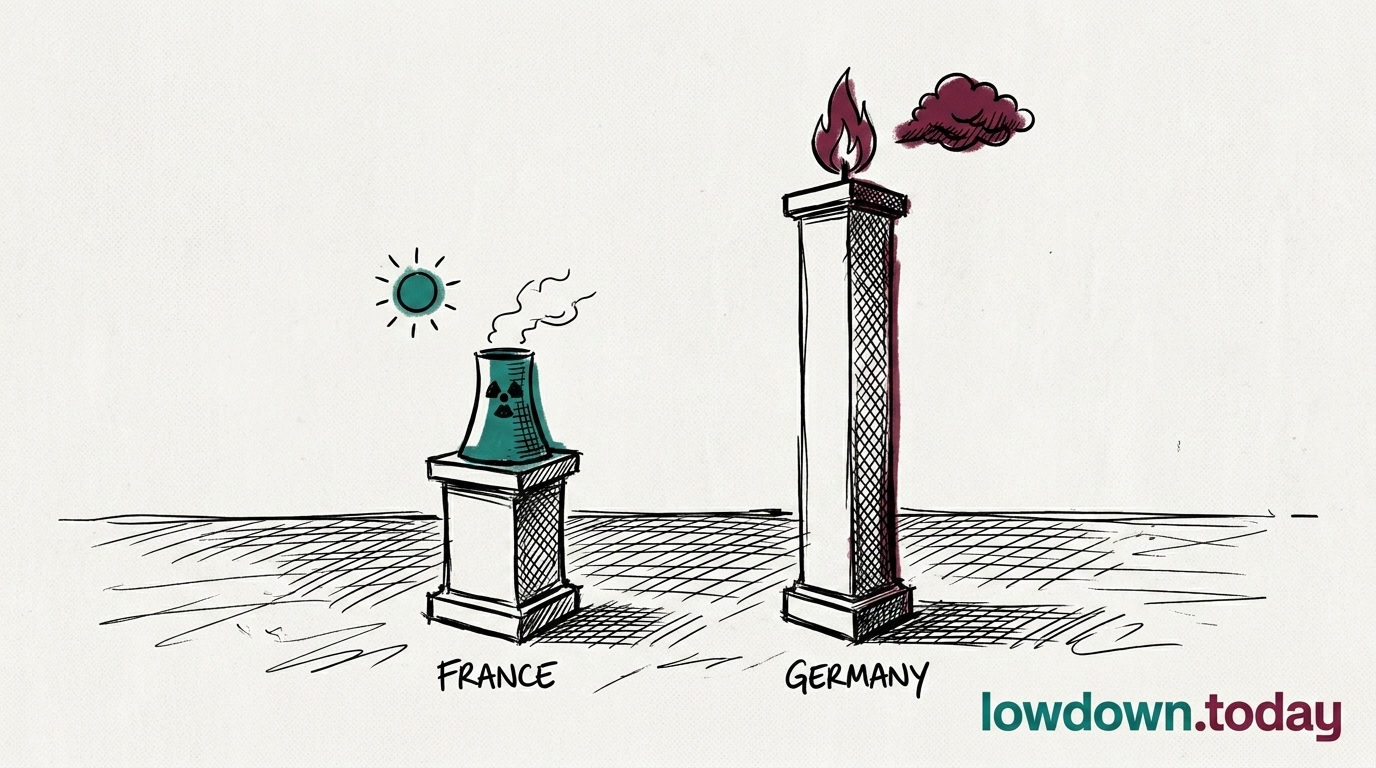
France's discount to Germany rests on an ASNR derogation from the 28C river-cooling limit at Bugey that expires today, not on a nuclear recovery; Chooz, Golfech and Bugey restarts run to 25 July. The cheap leg holds only as long as regulators keep waiving the limit each heatwave.
German CCGT operators and grid balancers
German gas plants went off-merit on 20 July as the clean spark spread inverted to minus EUR 15 to minus EUR 21/MWh, sidelining the flexible capacity storage injection needs. Operators are pricing 2027-28 capacity revenue against Bundesnetzagentur's own admission that Brussels has not cleared the 9 GW StromVKG auctions.
LNG spreads desk
LNG spreads desk
The JKM-TTF arb flipped to a TTF premium of roughly USD 0.6/MMBtu on 15 July, the first time this cycle Europe has outbid Asia, yet no Atlantic cargo has rerouted west. Until a cargo actually moves, the desk reads the Hormuz premium as unconfirmed and the EUR 55 print as vulnerable to a fast reversal.
