Skip to content
Briefings are running a touch slower this week while we rebuild the foundations.See roadmap
Drones: Industry & Defence
7JUN

UK buys Skyhammer from unproven startup

2 min read
11:27UTC

Defence Secretary Healey announced procurement of Skyhammer counter-drone interceptors from Cambridge Aerospace, a British startup with no prior production record, with first deliveries expected May.

TechnologyDeveloping
Key takeaway

UK procurement urgency is compressing startup-to-delivery timelines from years to weeks.

Defence Secretary John Healey announced on 10 April the procurement of Skyhammer interceptor missiles from Cambridge Aerospace, a British startup. The subsonic turbojet interceptor has a 30km range and an active X-band radar seeker designed to counter Shahed-class drones. First deliveries are expected as early as May.

Cambridge Aerospace has no prior production track record at scale. The May delivery expectation represents extraordinary risk tolerance by the Ministry of Defence, a signal of how urgently Gulf attrition rates have compressed procurement timelines. The cumulative UAE intercept data has turned counter-drone acquisition from a future requirement into an immediate operational demand.

Skyhammer addresses the threat Britain can detect: radar-visible, subsonic attack drones of the Shahed class. It does not address the fibre-optic gap that UKDI acknowledged the same week (see Event 6). The UK is buying kinetic solutions for threats it can see while simultaneously admitting it cannot see an entire class of drone already in the operational theatre.

For Cambridge Aerospace, the contract is transformative. A startup that delivers to MOD production schedules becomes a credible Tier 1 supplier overnight. The UKDI rapid investment tranche is distributing £140 million across British SMEs; Skyhammer is now the highest-profile programme in that pipeline. The company's entire commercial trajectory depends on the May delivery schedule.

Deep Analysis

In plain English

The UK government has ordered counter-drone missiles from Cambridge Aerospace, a British startup that has never produced missiles at scale before. First deliveries are expected in May, which is weeks away from the announcement. Skyhammer is a missile with a range of 30km designed specifically to shoot down Shahed-type drones, the kind Iran is firing at Gulf states. It locks onto the drone using radar and intercepts it. The challenge is that Cambridge Aerospace has to go from announcement to delivering working missiles to the military in a matter of weeks. That is the drone industry equivalent of being asked to finish your dissertation tomorrow.

What could happen next?
  • Precedent

    A startup-to-MoD delivery timeline of weeks, if achieved, permanently changes the procurement model for British SMEs; every future competitive tendering process will be measured against the Cambridge Aerospace benchmark.

  • Risk

    Single-source dependency on an unproven startup for a critical counter-drone capability means that any production failure at Cambridge Aerospace leaves the UK with no alternative in the near term.

First Reported In

Update #5 · Gulf drone war rewrites procurement

UK Defence Journal· 13 Apr 2026
Read original
Different Perspectives
Denmark (host nation)
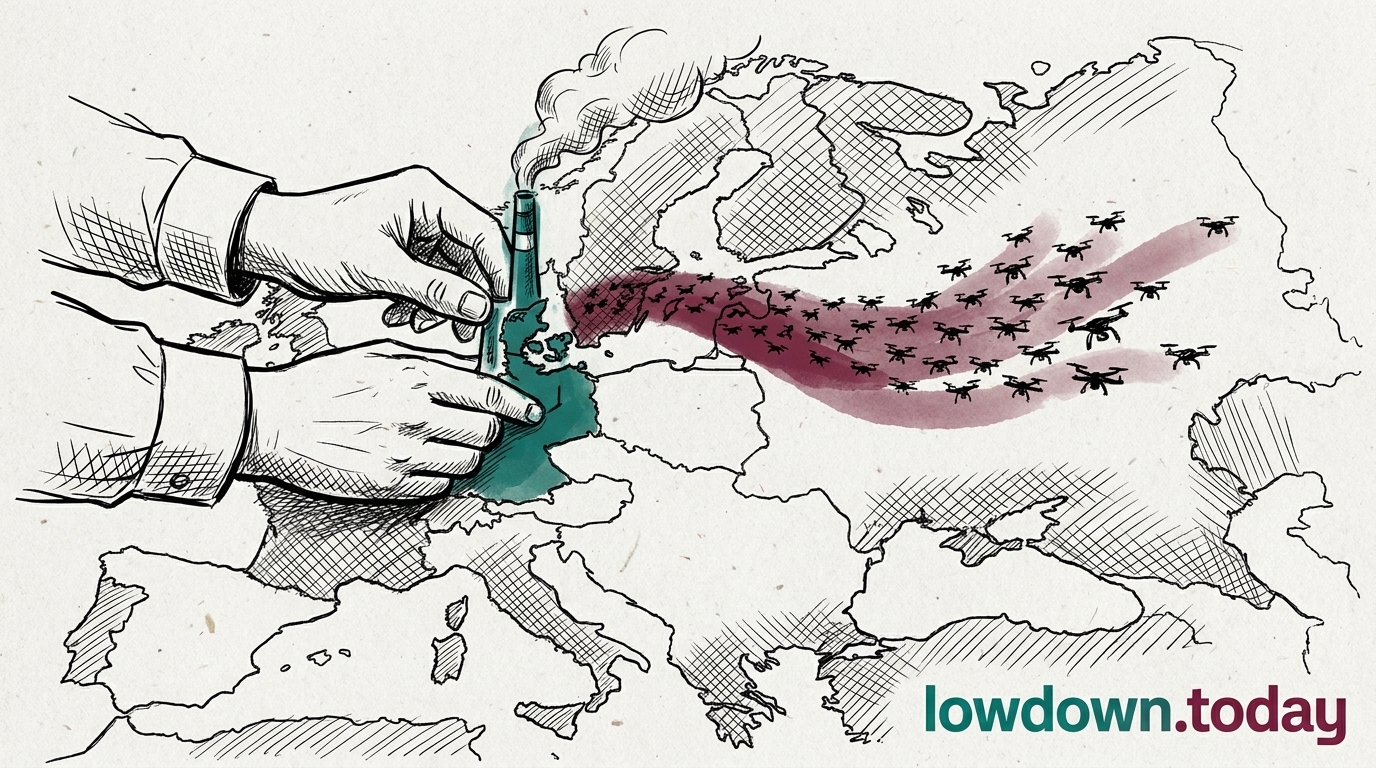
Denmark accepted Fire Point's Skrydstrup plant after committing to bilateral defence co-production at the B9 Nordic summit in May; the facility sits beside a Danish F-35 base, sharing security perimeters. NATO has published no legal guidance on whether hosting Ukrainian weapons production converts Denmark into a co-belligerent, leaving the host-state obligation unresolved.
Russian Ministry of Defence
Russia's 117% YoY drone-output rise in April, accelerating from a 68% full-year 2025 baseline, validates the FPV mass-production doctrine and hands Moscow a cleaner targeting argument for the Skrydstrup plant than any hidden production line offered; a Ukrainian weapons facility on NATO sovereign territory is a legitimate military target under the laws of armed conflict.
Baltic NATO states (Latvia, Estonia, Lithuania)
Latvia deployed mobile drone-intercept teams on 29 May using domestic Origin Robotics and Eraser interceptors, the first kinetic Baltic border response to Russia's 117% output surge. The Baltic states are the primary target market for Ukraine's ten EU export offices, giving them direct commercial access to combat-tested interceptors their own manufacturers have not yet matched.
Pentagon / Joint Interagency Task Force 401
Two Ukrainian entrants in Drone Dominance Phase 2 and Red Cat's SEC-filed STE partnership bring combat-iterated Ukrainian designs into US procurement without triggering Foreign Military Sale approvals; the programme's performance-scoring methodology does not require US-origin hardware. Northrop holding the Common UAS Payload standard means a heritage prime captures interface revenue regardless of which startup airframe wins.
Ukrainian defence industry (Fire Point / Spetstechnoexport)
Fire Point's Skrydstrup construction start and Spetstechnoexport's Red Cat partnership execute Zelensky's 13 May Bucharest proposal: converting wartime production surplus into a state export apparatus, independent of US approval chains. For Ukraine, embedded manufacturing on NATO soil protects propellant supply from Russian strikes while generating hard currency the war effort needs.
Chinese drone manufacturers (DJI, Autel)
Autel's Ralls Corp Fifth Amendment filing and DJI's Ninth Circuit quantification of USD 1.56 billion in 2026 losses are parallel constitutional attacks on a classified-evidence exclusion mechanism; neither company can contest the intelligence allegations directly, so both are betting on due-process doctrine to reopen the FCC authorisation route.
