Skip to content
You can now search across every topic, entity and event.What's new
Data Centres: Boom and Backlash
4AUG

Amazon's $137.2bn of leases it hasn't opened

2 min read
10:53UTC

Amazon's 10-Q for the June quarter discloses $137.2bn of leases not yet commenced, a number more than 60 per cent larger than the capex guidance figure the market actually tracks.

IndustryDeveloping
Key takeaway

Amazon has signed $137.2bn of data-centre leases on buildings that have not yet been delivered.

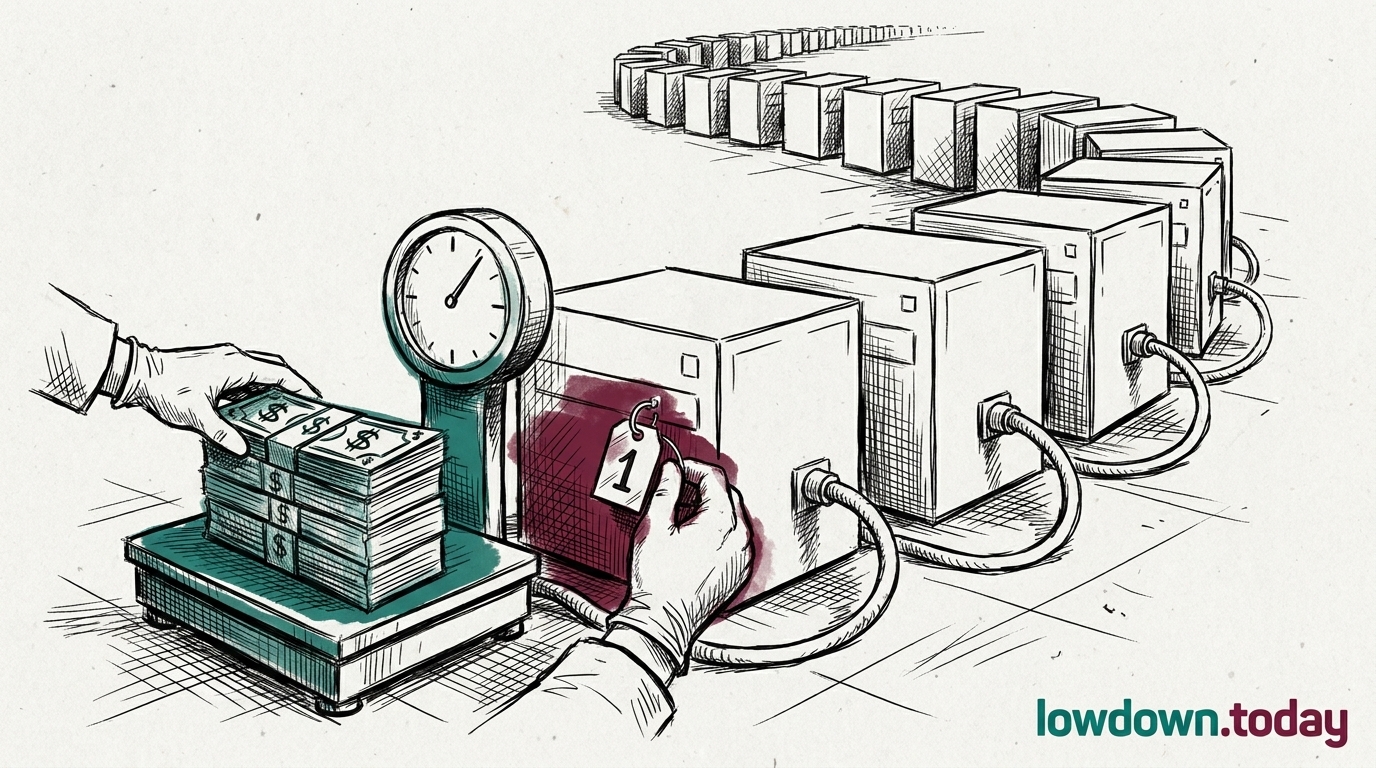
Amazon filed its Form 10-Q for the quarter ended 30 June with the US Securities and Exchange Commission on Friday 31 July, disclosing $650.0bn of total contractual commitments 1. One line inside that table appeared in no earnings-call commentary: $137.2bn of leases not yet commenced, meaning buildings Amazon has signed for where the facility has not yet been delivered, overwhelmingly data-centre and power infrastructure. Unconditional purchase obligations, which the filing says include long-term energy procurement, add a further $130.1bn 2.

Cash capital expenditure, the money actually spent on physical assets in the period, ran to $53.1bn in the quarter against $31.4bn a year earlier, a rise of 69 per cent, and $96.3bn across the first half 3. Amazon raised full-year 2026 guidance to roughly $220bn, citing memory costs and continued cloud investment. That figure counts only the cash it expects to lay out this year.

Guidance and the lease line measure different things, and the gap between them is where the planning problem sits. A lease not yet commenced is a building somewhere that a landlord is contracted to deliver and Amazon is contracted to take, with a grid connection behind it that some system operator has to find. None of that shows up in the number quoted when a campus goes before a planning committee.

Virginia's regulator issued Amazon's Lake Anna cooling-water discharge permit on 21 July , assessed as one campus drawing on one river. The pipeline sitting in the 10-Q is a portfolio-scale commitment being permitted one site at a time, by bodies that see only the site in front of them.


Deep Analysis

In plain English

When a company files its quarterly results with US financial regulators, it has to list what it spent this year and, separately, what it has already promised to spend in future, even on buildings that are not finished yet. Amazon's filing shows it has signed $137.2bn worth of data-centre leases for facilities that have not opened, which is more money than its entire announced budget for building data centres this year. That gap matters because most headlines about Amazon's spending only report the smaller, current-year figure.

Deep Analysis
Root Causes

The structural cause is that data-centre leasing separates the signing of a long-term contract from the physical delivery of the building, unlike direct capital expenditure which Amazon records as spending occurs. A hyperscaler can lock in years of future capacity with a lease commitment long before construction finishes, which lets its balance sheet carry contracted growth that its published capex guidance, a cash-flow figure for the current year only, does not capture.

A second structural driver is Amazon's own disclosure that unconditional purchase obligations, including long-term energy procurement agreements, total $130.1bn, reflecting that securing future power supply now requires the same kind of multi-year contractual commitment as securing the buildings themselves.

What could happen next?
  • Meaning

    Headline hyperscaler capex guidance understates the true scale of contracted future data-centre capacity by tens of billions of dollars.

  • Consequence

    Communities and regulators debating local moratoria may be assessing a materially smaller pipeline than the one Amazon has already committed to build.

First Reported In

Update #12 · Ofgem prices the grid queue by the megawatt

US Securities and Exchange Commission· 4 Aug 2026
Read original
Different Perspectives
Government of Odisha
Odisha signed a $1.5bn agreement with HCLTech and Sarvam AI on 24 July for a sovereign AI data centre in Bhubaneswar, targeting 2028 operations. While regulators elsewhere price developers out of the queue, Odisha is bidding state financial assistance to bring capacity in, betting the AI infrastructure boom is worth courting rather than rationing.
Switch Datacenters and Uithoorn
The developer, the municipality, Liander and dozens of greenhouse growers signed a waste-heat agreement letting a 60 MVA facility proceed under a provincial rule that bans sites above 5 MVA. The public-interest exception argues the site relieves rather than adds to grid congestion, working around a standing ban from inside rather than waiting for it to change.
Iskandar Puteri residents
Residents protested in February over falling water pressure they attribute to ZDATA's 300 MW construction; ZDATA disputes causation and has not yet resolved the dispute with its wastewater-only pivot. The complaint sits unadjudicated while the operator advertises compliance to state authorities the residents cannot address directly.
Microsoft
Microsoft
DC Byte reports Microsoft looking to the Nordics for new capacity while Dublin's regional share falls to 15 per cent, though this is a market-intelligence inference rather than a company statement. Microsoft keeps its existing Dublin cloud region, which is costly to relocate, while directing new investment where power is cheaper and the queue is shorter.
ISO New England
ISO New England
ISO-NE proposed excluding new large loads from its Installed Capacity Requirement entirely, forcing data centres to bring their own generation or accept curtailment, even though New England's demand has been flat or falling for a decade. The reform is pre-emptive, written before the region has felt the strain PJM and MISO already report.
Ofgem
Ofgem
Ofgem opened its Data Centre Commitment Fee consultation on 29 July, arguing that free options on grid capacity let developers bank places on ten sites and abandon nine, crowding out projects that would build. It expects the deposit to filter the queue before the rule even takes final form.