Skip to content
You can now search across every topic, entity and event.What's new
Autonomous Systems: Land & Sea
12AUG

UK buys Skyhammer from unproven startup

2 min read
14:17UTC

Defence Secretary Healey announced procurement of Skyhammer counter-drone interceptors from Cambridge Aerospace, a British startup with no prior production record, with first deliveries expected May.

TechnologyDeveloping
Key takeaway

UK procurement urgency is compressing startup-to-delivery timelines from years to weeks.

Defence Secretary John Healey announced on 10 April the procurement of Skyhammer interceptor missiles from Cambridge Aerospace, a British startup. The subsonic turbojet interceptor has a 30km range and an active X-band radar seeker designed to counter Shahed-class drones. First deliveries are expected as early as May.

Cambridge Aerospace has no prior production track record at scale. The May delivery expectation represents extraordinary risk tolerance by the Ministry of Defence, a signal of how urgently Gulf attrition rates have compressed procurement timelines. The cumulative UAE intercept data has turned counter-drone acquisition from a future requirement into an immediate operational demand.

Skyhammer addresses the threat Britain can detect: radar-visible, subsonic attack drones of the Shahed class. It does not address the fibre-optic gap that UKDI acknowledged the same week (see Event 6). The UK is buying kinetic solutions for threats it can see while simultaneously admitting it cannot see an entire class of drone already in the operational theatre.

For Cambridge Aerospace, the contract is transformative. A startup that delivers to MoD production schedules becomes a credible Tier 1 supplier overnight. The UKDI rapid investment tranche is distributing £140 million across British SMEs; Skyhammer is now the highest-profile programme in that pipeline. The company's entire commercial trajectory depends on the May delivery schedule.

Deep Analysis

In plain English

The UK government has ordered counter-drone missiles from Cambridge Aerospace, a British startup that has never produced missiles at scale before. First deliveries are expected in May, which is weeks away from the announcement. Skyhammer is a missile with a range of 30km designed specifically to shoot down Shahed-type drones, the kind Iran is firing at Gulf states. It locks onto the drone using radar and intercepts it. The challenge is that Cambridge Aerospace has to go from announcement to delivering working missiles to the military in a matter of weeks. That is the drone industry equivalent of being asked to finish your dissertation tomorrow.

What could happen next?
  • Precedent

    A startup-to-MoD delivery timeline of weeks, if achieved, permanently changes the procurement model for British SMEs; every future competitive tendering process will be measured against the Cambridge Aerospace benchmark.

  • Risk

    Single-source dependency on an unproven startup for a critical counter-drone capability means that any production failure at Cambridge Aerospace leaves the UK with no alternative in the near term.

First Reported In

Update #5 · Gulf drone war rewrites procurement

UK Defence Journal· 13 Apr 2026
Read original
Different Perspectives
Conservative opposition
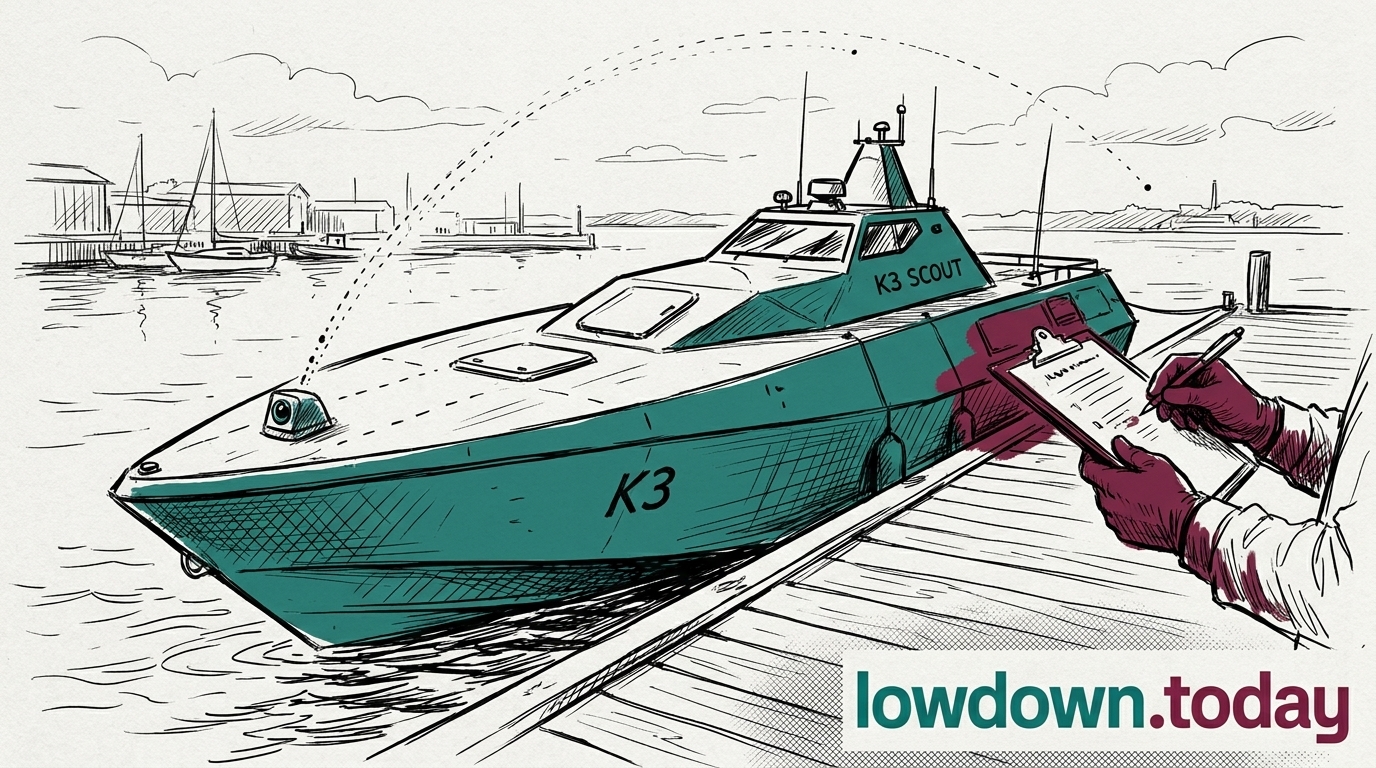
The Conservative opposition called on the Government on 9 August to 'urgently audit' equipment for hidden Chinese components, after the Telegraph's K3 SCOUT report. No named MP has been quoted on the record; the call came at party level, alongside the Ministry of Defence's own 10 August statement that no data had been compromised.
Netherlands Ministry of Defence
The Netherlands Ministry of Defence authorised Dutch Naval Design on 4 August to design 12-metre anti-submarine warfare uncrewed vessels for the Dutch-Belgian frigate programme, and to buy an adapted Compact FLASH dipping sonar from Thales Underwater Systems France. The order commits money and a named supplier while Britain's own certification body remains at the market-engagement stage.
Kraken Technology Group
Kraken Technology Group is a UK maritime-defence company based in Portsmouth that builds the K3 SCOUT, and crossed a $1bn valuation in July on a single-sourced $175m raise. The camera components reached the fleet under a third party's written security assurance, which the Platform Authority, which does not yet exist, was never positioned to check.
Navy Commercial
Navy Commercial
Navy Commercial at Whale Island published two notices on 5 August: 074032-2026, asking industry how to build a Platform Authority to certify uncrewed vessels, and 074351-2026, a GBP10m multi-role USV testbed for the Defence Chief Technology Officer. Responses on the Platform Authority close 19 August, ten days after the cameras were found transmitting to China.
Ministry of Defence
Ministry of Defence
The Ministry of Defence said on 10 August that a routine cyber vulnerability assessment found the camera fault, and a thorough investigation found no evidence that MoD data or systems had been accessed, compromised or transmitted externally. It stripped the cameras of internet connectivity but did not say whether it acted against the supplier.
Thales
Thales
Thales converted its 6 July engaging accord with Exail into a definitive combination agreement on 30-31 July, but the tender offer for Exail's remaining shares now closes by early 2028, later than July's timetable implied. Thales integrates its new undersea prime while still bidding against Kongsberg and DRASS's 2027 target for the AUKUS Pillar II contest.
