Skip to content
Briefings are running a touch slower this week while we rebuild the foundations.See roadmap
AI: Jobs, Power & Money
23APR

AI now leads all US layoff reasons

3 min read
14:51UTC

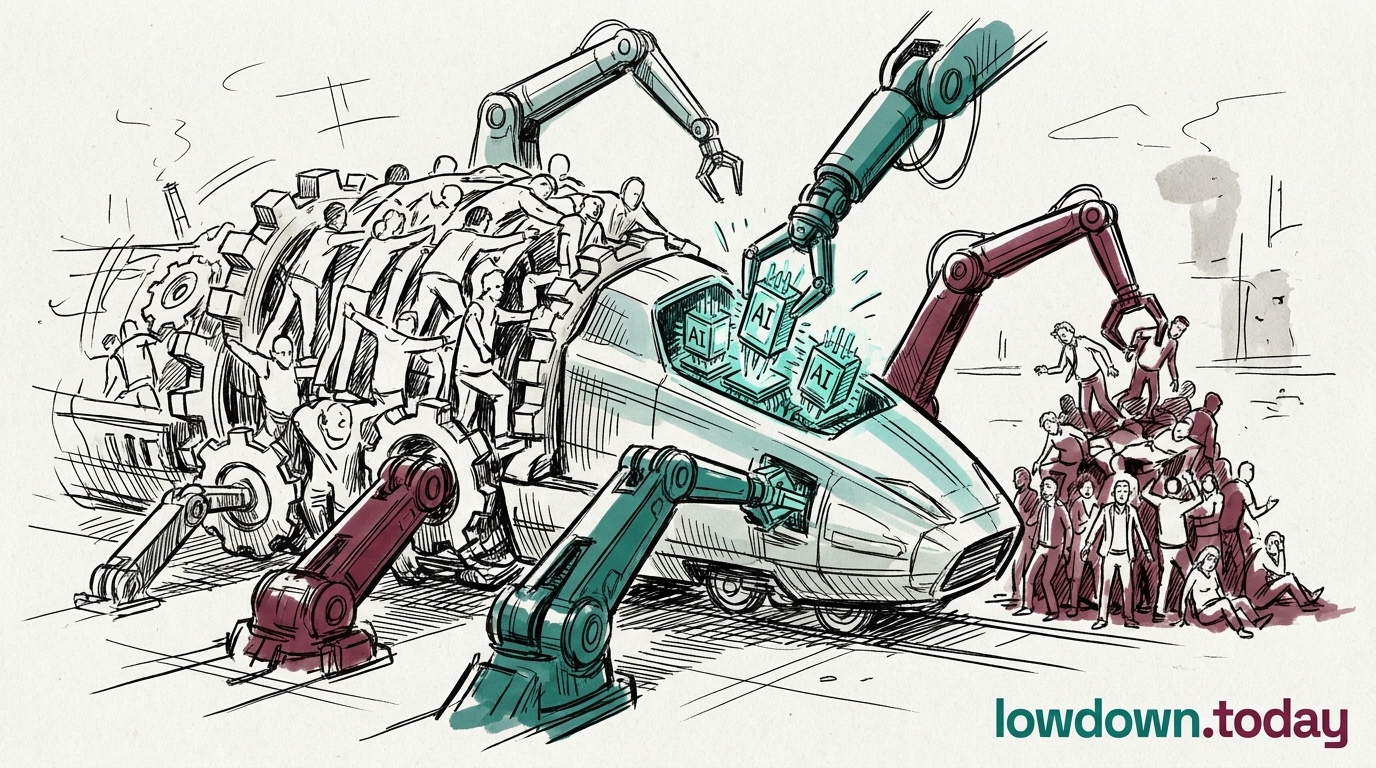
For the first time on record, AI topped every stated reason for American job cuts in a single month.

EconomicAssessed
Key takeaway

AI now leads all stated reasons for US layoffs, with cumulative cuts approaching 100,000.

Challenger, Gray & Christmas counted 15,341 AI-cited layoffs in March. That is one quarter of all announced US reductions, and the first month AI has led every stated reason since tracking began in 2023 1. The cumulative total since 2023 now stands at 99,470, roughly the workforce of Goldman Sachs, and within weeks of crossing 100,000.

Tech sector cuts for Q1 reached 52,050, up 40% year on year . Andy Challenger noted that "AI replacing coding functions in technology companies is where the actual role replacement is visible." The attribution share jumped from roughly 10% in February to 25% in March. That is not incremental. It suggests either a genuine acceleration or a normalisation of corporate candour about replacing workers with machines.

If attribution is normalising, the silence of the previous months understated reality. If it reflects acceleration, Q2 figures could approach 40%. Either reading is significant.

Deep Analysis

In plain English

Every month, a US firm called Challenger, Gray & Christmas counts all the job cuts companies announce publicly and asks why they did it. For the first time since they started asking that question in 2023, AI came top of the list in March 2026. One in four of all announced American job cuts that month named AI as the reason. The total since tracking began is approaching 100,000. That is roughly the number of people who work for Goldman Sachs worldwide. The important thing is not just the number. It is that companies are now saying it openly. Previously, most AI-related cuts were labelled as restructuring or cost savings. Something changed in March.

Deep Analysis
Root Causes

Large language models reached a capability threshold in 2024-2025 where coding assistance tools could handle routine development tasks that previously required junior engineer time. This made a workforce reduction economically logical before AI capabilities are fully exploited, compressing the adoption-to-displacement timeline.

The five largest US tech companies committed $650-690 billion in capital expenditure to AI infrastructure. That capital must be serviced from operating margins. Reducing payroll is the fastest available lever. Salary savings fund hardware. The displacement is therefore partly a financing decision, not purely a capability one.

Corporate attribution behaviour changed in early 2026 as the reputational cost of naming AI as a layoff driver fell. Once Oracle and Salesforce cited AI explicitly at scale, stating the same reason became lower-risk for smaller firms. Attribution normalisation creates a feedback loop: as more companies cite AI, the social licence for AI-attributed cuts widens further.

What could happen next?
  • Q2 2026 AI-attributed cuts could approach 30-40% of all announced US layoffs if the March attribution trend continues, implying 180,000 or more AI-cited positions by mid-year.

    3 months · Possible
  • Cumulative AI-attributed cuts will cross 100,000 in April 2026, the first hard six-figure milestone in displacement tracking history, likely prompting intensified Congressional and media scrutiny.

    1 month · Likely
  • Wage growth compression to 3.5% annually, combined with rising tech unemployment, will reduce consumer spending power among the highest-earning quintile of workers, potentially dampening demand for premium goods and services.

    6 months · Possible
First Reported In

Update #4 · AI leads US layoffs as cuts go uncounted

Challenger, Gray & Christmas· 4 Apr 2026
Read original
Different Perspectives
UK financial regulators (BoE FPC / FCA)
The Bank of England's April FPC directive on agentic AI in payments was scoped around one frontier model; AISI confirmed a second model cleared the same 32-step threshold on 1 May. The supervisory architecture is one model behind the capability it was built to contain.
Indian IT sector workers (TCS, Infosys, Wipro)
TCS posted its first annual revenue decline in the modern era, Infosys shed 8,400 workers in a quarter, and Wipro hit its zero-fresher target. Western Big Tech's AI automation is cannibalising the offshored-services model that employs roughly five million Indian IT workers.
Chinese workers (Hangzhou and Beijing plaintiffs)
Workers Zhou and Liu won cases that established a two-court doctrinal chain: AI adoption is the employer's deliberate strategy, placing the cost of displacement on the employer rather than the worker. Any Chinese employee facing AI-driven dismissal now has a citable legal route that American, British, and European counterparts do not.
Chinese government, courts, and domestic employers
The Hangzhou rulings were released on Workers' Day eve alongside the Ministry of Human Resources' recognition of 42 new AI occupations. Domestic firms now face mandatory retraining obligations; the Orgvue estimate of 8-14 months added to displacement timelines will feature in employer compliance briefings throughout 2026.
EU regulators and European Parliament
The second Digital Omnibus trilogue collapsed without agreement on 28 April; the third is scheduled for 13 May with the binding employer AI-literacy obligation still contested. Brussels is arguing over a non-binding encouragement clause while Beijing's courts have already bound employers.
US legislators (Warner, Rounds, Hawley, Sanders)
Warner and Rounds produced the Economy of the Future Commission Act, the most concrete federal vehicle still moving, endorsed by the companies it would notionally regulate. The Sanders-AOC moratorium was killed by Democratic senators; the Hawley-Warner disclosure bill remains in committee with no floor date.
