Skip to content
You can now search across every topic, entity and event.What's new
AI: Jobs, Power & Money
17JUL

Jobs open, hires fall, training cut

3 min read
14:01UTC

US job openings jumped to 7.6 million in April while actual hires fell to 5.1 million, the signature of a labour market where employers want workers they cannot find.

EconomicDeveloping
Key takeaway

US openings hit 7.6 million while hires fell to 5.1 million, the mark of a skills mismatch.

US job openings jumped to 7.6 million in April, the highest since May 2024, while actual hires fell to 5.1 million, the Bureau of Labor Statistics reported in its Job Openings and Labour Turnover Survey 1. The survey, known as JOLTS, tracks how many posts employers advertise against how many they actually fill. Posts sitting open and unfilled are what a skills mismatch looks like when employers rewrite what they want faster than the labour pool can follow.

LinkedIn's 2026 workplace learning data shows the share of firms offering AI upskilling fell from 35% to 26% year-on-year 2, so the training that would close that mismatch is shrinking just as the gap widens. Companies are pushing workers to adapt to AI while cutting the instruction that would let them, even as capital pours into data centres. Cut staff for AI, spend on AI, teach the remaining workers less about it.

Fed Governor Lisa Cook named the displacement risk directly in late May, citing widening software-sector bond spreads . Bond spreads widen when investors demand more to lend to a sector they judge riskier, so a central banker pointing at software borrowing costs is reading the same signal the openings data shows: the corner of the economy most exposed to AI is the one where hiring has stalled and credit has tightened first.

Deep Analysis

In plain English

In April 2026, US employers posted 7.6 million job openings; the highest since early 2024. Actual hires fell to 5.1 million in the same month. The gap exists because companies are rewriting job descriptions to require AI skills that most applicants do not yet have, then waiting. LinkedIn's 2026 data shows the share of firms offering formal AI upskilling fell from 35% to 26% in one year. Employers are raising the bar, cutting the ladder, and blaming the resulting vacancies on a skills shortage that they are partly creating.

Deep Analysis
Root Causes

Two structural forces explain the April 2026 mismatch.

First, AI tools have accelerated the rate at which firms can rewrite job descriptions to incorporate new technical requirements; effectively raising the floor faster than the training market responds.

LinkedIn's finding that firms cut formal AI training by 9 percentage points (35% to 26%) while simultaneously rewriting job ads to require AI literacy is contradictory only if firms intend to close the gap through hiring; it is coherent if firms intend to let the gap filter out candidates who have not self-trained.

Second, Fed Governor Lisa Cook's specific framing; widening software-sector bond spreads; points to a credit-market feedback loop. As AI compresses expected revenue growth in software-as-a-service, bond investors demand higher yields, which raises financing costs, which causes firms to stretch headcount further to preserve margins. The 7.6 million to 5.1 million openings-to-hires gap reflects that dynamic: posted jobs are aspirational, not budgeted.

What could happen next?
  • Consequence

    If formal AI training continues to fall while job requirements rise, the skills gap becomes self-reinforcing: only workers who can afford self-funded upskilling clear the hiring bar, concentrating AI-era employment gains in higher-income cohorts.

  • Risk

    Fed Governor Cook's citation of widening software-sector bond spreads suggests credit markets are already pricing an AI-driven revenue contraction in software, which would further suppress hiring budgets in the sector most responsible for AI adoption.

First Reported In

Update #14 · The AI layoffs nobody is counting

Bureau of Labor Statistics· 20 Jun 2026
Read original
Causes and effects
This Event
Jobs open, hires fall, training cut
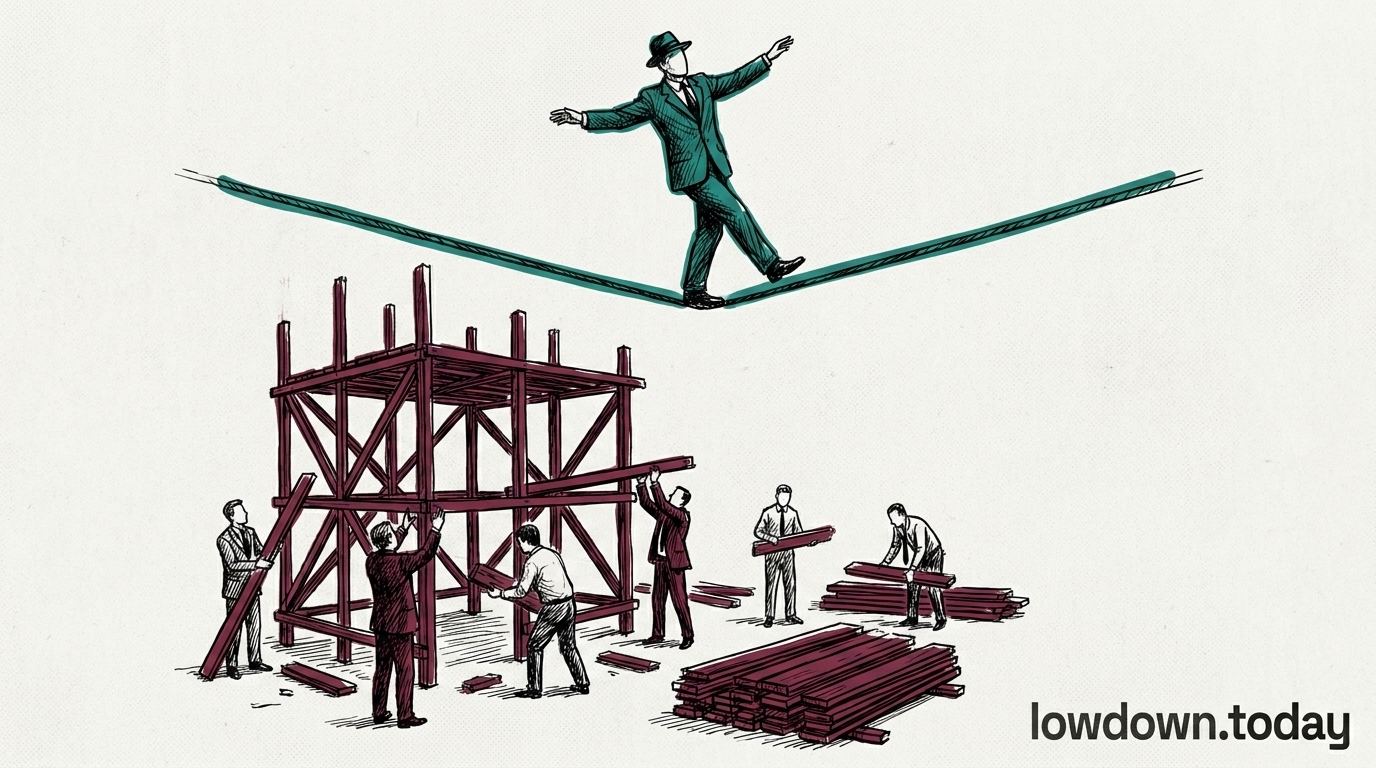
An openings surge alongside falling hires is what a skills mismatch looks like, and it is precisely the channel a declared-layoff count cannot capture.
Different Perspectives
Stanford's 'We Must Act Now' signatories
More than 200 academics, including 16 Nobel laureates, published a 13 July letter warning of AI-driven labour disruption, citing Daron Acemoglu's NBER estimate that AI's total factor productivity gain stays under 0.66% over ten years. The letter's own cited economics sit well below Goldman Sachs Research's 1.5-percentage-point estimate published the same week.
Germany / the Bundesrat
Germany's Bundesrat acted on the EU AI Act's employment provisions on 10 July, more than a year ahead of the Act's 2 December 2027 enforcement deadline. Germany is moving on statutory AI-employment disclosure while the US Congress and Federal Reserve have no equivalent instrument.
Indian IT services sector (TCS, HCLTech, Wipro)
TCS cut 19,271 roles and HCLTech cut 3,292 in the same reporting week that Wipro's headcount rose by 888 under its own zero-fresher-hiring pledge for FY27. The divergence shows attrition, not layoffs, is how India's outsourcers absorb AI-driven project compression while their net headcount numbers stay ambiguous.
Federal Reserve
Federal Reserve
Barr said on 14 July there is little evidence of AI displacement, citing a 43-versus-10 adoption gap by education; Cook said the next day the dire predictions have not come to fruition, her text carrying none of the bond-spread language she used in May. The Fed reads AI's labour effect through national aggregates, where four banks' cuts remain statistically invisible.
Barclays
Barclays
Barclays economist Pooja Sriram flagged a 28,000-a-month bleed in finance and information roles the same week Microsoft disputed that AI drove its own 4,800 cuts. The bank treats Challenger's AI-attribution share as a lagging indicator against faster erosion visible in raw labour-market data.
European Commission
European Commission
Brussels deferred the Digital Omnibus's Annex III employment-compliance deadline from 2 August 2026 to December 2027, even as California advanced three binding AI-hiring bills the same week. The 17-month delay leaves EU workers without the algorithmic-hiring safeguards the regulation already promises.
