Skip to content
You can now search across every topic, entity and event.What's new
AI: Jobs, Power & Money
1JUL

Intuit cuts 3,000, licenses its data

4 min read
11:00UTC

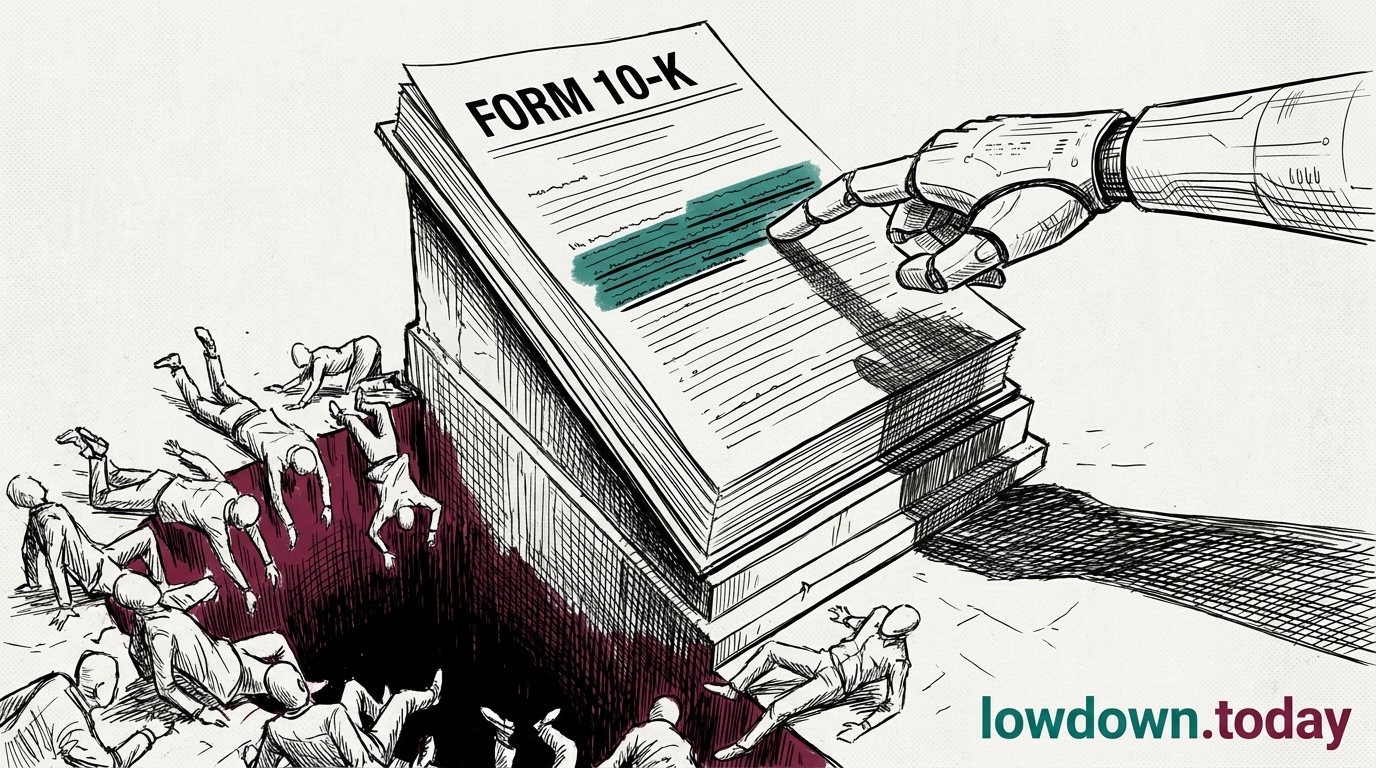
Intuit cut 17% of staff and, in the same announcement, agreed to feed its tax and finance data into Anthropic and OpenAI, turning displaced workers' expertise into training signal for their replacement.

EconomicDeveloping
Key takeaway

Each licensing-plus-layoff round widens the data moat of the firm supplying the replacement.

Intuit cut about 3,000 staff, 17% of its workforce, on 20 May 2026, with chief executive Sasan Goodarzi citing a refocus on AI across TurboTax, QuickBooks and Credit Karma. 1 Affected US employees leave on 31 July with 16 weeks' severance, and the company is closing its Reno, Nevada operation.

The same memo signed the loop shut. Intuit struck multi-year deals to feed its specialised tax and financial data into Anthropic's Claude and OpenAI's models. 2 The institutional knowledge those workers built, years of processing returns and reconciling accounts, becomes the training signal for the systems taking over the work. A worker who lands a new job has helped train the model that closed the door behind them.

This is the sharpest version of a pattern the topic has tracked loosely. Anthropic's Project Glasswing established the template of frontier firms accumulating proprietary sector data under privileged-access deals ; the Intuit arrangement extends that hoard to consumer tax and financial records. Anthropic is the recurring beneficiary, also the firm at the centre of News Corp's anticipated $1.5bn settlement.

A general model cannot file a US tax return well; one trained on Intuit's reconciled filings can, which is why the data is worth more than the headcount. Each licensing-plus-layoff round narrows the set of firms that hold sector-specific expertise and widens the lead of the one supplying the replacement, so displacement and data concentration are the same movement seen from two sides.

Deep Analysis

In plain English

Intuit makes TurboTax (for filing personal tax returns), QuickBooks (for small-business accounting), and Credit Karma (a personal finance app). These products handle sensitive, specialised financial data: tax returns, business cash flows, credit histories. Anthropic and OpenAI pay premium prices for this data because it is exactly what an AI model needs to answer financial and tax questions competently. On 20 May 2026, Intuit's chief executive Sasan Goodarzi announced the company was cutting about 3,000 workers, 17% of everyone it employs. On the same day, he announced multi-year licensing deals to feed Intuit's proprietary data into Anthropic's Claude (an AI assistant made by Anthropic, an AI safety company) and OpenAI's models (the company behind ChatGPT). This matters because the workers being cut spent years building and refining the knowledge base that makes Intuit's products useful. A tax specialist at Intuit knows which edge cases trip people up, which return errors are common, how to explain complex rules in plain English. That expertise, encoded into Intuit's historical data and product interactions, is now being licensed to train the AI systems that will handle those same tasks. The displaced workers helped create the training material for the systems replacing them. Anthropom has similar deals with News Corp (a media company anticipating a $1.5bn settlement for using its content) and financial sector partners through a programme called Project Glasswing. Each deal gives Anthropic proprietary data from a sector it could not scrape from the open web.

Deep Analysis
Root Causes

Two structural incentives intersected when Intuit closed the deal: AI model companies pay premium prices for proprietary domain-specific datasets, and Intuit's institutional knowledge was at peak transferability before the human workflow closed.

First, AI model companies are paying premium prices for proprietary, high-quality domain-specific datasets that cannot be assembled from public internet data; tax and financial records are the highest-value category. Second, Intuit's workforce displacement was planned on a timeline that coincides with the AI refocus, meaning the institutional knowledge those workers carry is at peak transferability before the human workflow is replaced.

The absence of any legal obligation for Intuit to share licensing proceeds with affected workers reflects a gap in employment and intellectual property law that predates the AI transition: US employment contracts routinely vest all work-product IP in the employer, and collective bargaining agreements have historically not addressed data-licensing proceeds.

Dario Amodei's January 2026 essay called on AI companies to 'steer customers away from firing workers' , but Anthropic then signed the Intuit deal, suggesting the voluntary framing is insufficient against commercial incentives.

What could happen next?
  • Consequence

    Anthropic and OpenAI gain proprietary tax and financial training data that strengthens their models' financial-advisory capability, widening the competitive gap with model companies that lack such domain-specific datasets.

    Short term · Assessed
  • Risk

    The Intuit structure, simultaneous displacement and data licensing, may become a template for financial services, healthcare and legal-sector employers seeking to convert workforce transitions into model-training assets.

    Medium term · Assessed
  • Precedent

    No legal challenge to the data-licensing component has been filed; without a WGA-style union claim or regulatory intervention, the Intuit structure sets a legally unchallenged precedent for labour-knowledge transfer.

    Long term · Assessed
First Reported In

Update #10 · Rival studies split on AI's hit to jobs

NASSCOM· 24 May 2026
Read original
Different Perspectives
Barclays
Barclays
Barclays economist Pooja Sriram flagged a 28,000-a-month bleed in finance and information roles the same week Microsoft disputed that AI drove its own 4,800 cuts. The bank treats Challenger's AI-attribution share as a lagging indicator against faster erosion visible in raw labour-market data.
European Commission
European Commission
Brussels deferred the Digital Omnibus's Annex III employment-compliance deadline from 2 August 2026 to December 2027, even as California advanced three binding AI-hiring bills the same week. The 17-month delay leaves EU workers without the algorithmic-hiring safeguards the regulation already promises.
OpenAI
OpenAI
OpenAI proposed a 5% US government equity stake worth $42.6bn, structured as a public wealth fund modelled on the Alaska Permanent Fund, with Sam Altman pitching it directly to Trump, Bessent and Lutnick. The offer pre-empts Sanders' rival one-time 50% AI-stock tax, which has not yet reached committee.
India's IT and outsourcing sector
BAT's transfer of 3,500 roles to Accenture on 29 June fits a delivery model Indian IT firms increasingly run: consultancies win Western contracts, then execute through offshore centres. The sector expects more Fit2Win-style transfers, not straight redundancies, as employers absorb AI without cutting outsourced headcount.
European Trade Union Confederation
ETUC says the Council's shift from 'ensure' to 'support' in the AI-literacy duty, confirmed in the Digital Omnibus's final adoption on 29 June, is a collapse of the legal threshold, not a drafting tidy-up. It expects EU workers to face AI-driven hiring and monitoring decisions with a statutory right to explanation that exists in name only.
British American Tobacco's Fit2Win workforce
BAT is cutting 9,000 roles under Fit2Win, transferring 3,500 to Accenture rather than making them redundant, to reach roughly £500m in AI-driven savings by 2027. For affected staff, that distinction decides whether they keep a job at all, just not at BAT.
