Skip to content
Welcome, thoughtbot's Giant Robots listeners!Start here
AI: Jobs, Power & Money
1JUN

New York Fed: adoption up, sackings rare

3 min read
09:18UTC

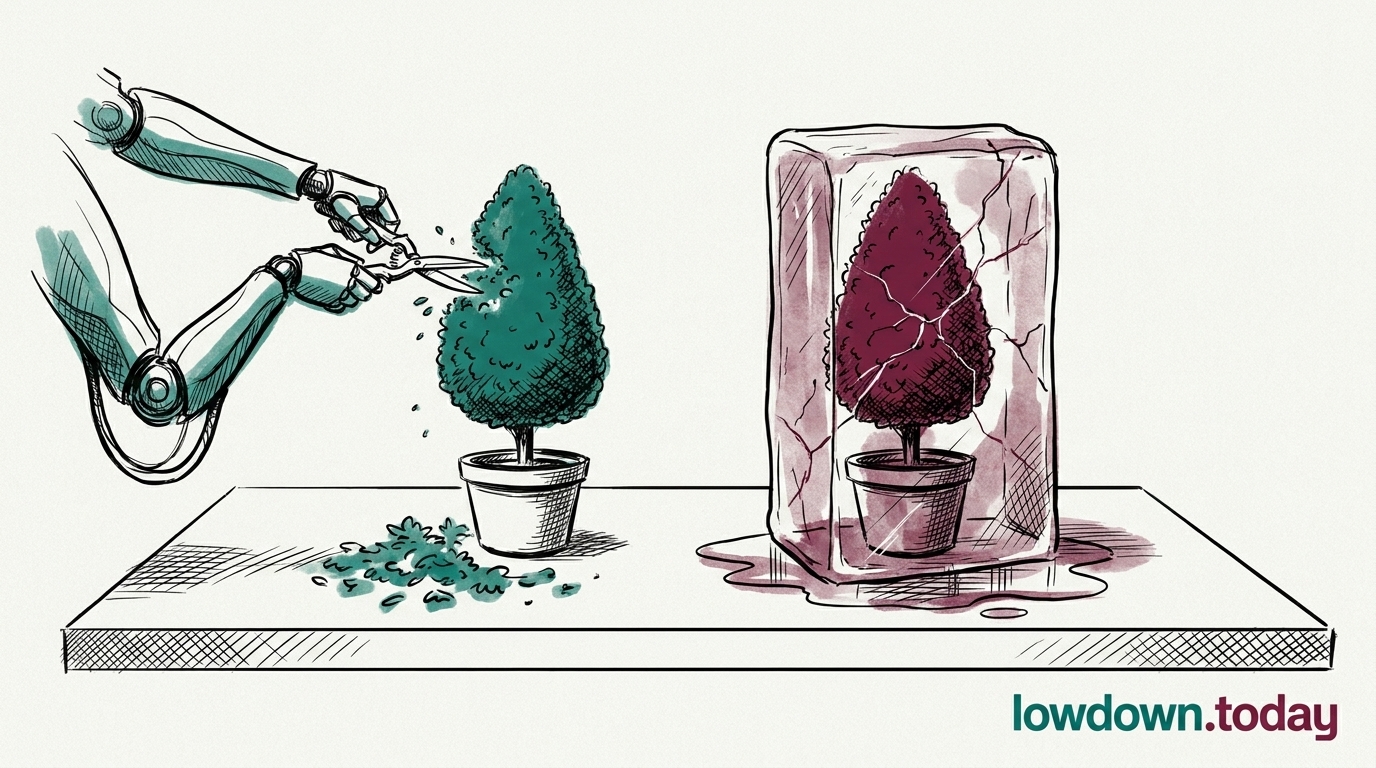
Service-firm AI use jumped from 25% to 40% in a year, yet the same firms told the New York Fed they are barely firing anyone. What they are doing is not hiring graduates.

EconomicDeveloping
Key takeaway

Firms are adopting AI and not firing, but graduates are the ones no longer being hired.

The Federal Reserve Bank of New York published firm-level survey work on 5 August finding that AI use among service firms in its district rose from 25% in August 2024 to 40% a year later, while those same firms reported very few AI-driven layoffs and said they intend to retrain staff rather than dismiss them.⁠1 The regional Fed banks run these surveys of local employers every month, which makes them one of the few instruments that asks companies directly rather than inferring from filings or announcements.

What the survey does find is hiring suppression aimed at college-educated applicants. That is a different mechanism from redundancy and it leaves a different trace: no notice, no severance, no filing, no press release, just a vacancy that never opens. SAP chief executive Christian Klein told investors in July that the company's research headcount will not grow for a year, which is the same decision described from the employer's side.

Stanford's Digital Economy Lab put the ratio at roughly 34 suppressed hires for every declared AI layoff. Federal Reserve governor Michael Barr said in July that the central bank had found little evidence of economy-wide displacement. Both statements survive the New York Fed's result intact, because an adjustment that runs through unopened vacancies will not show up in dismissal counts and will not move an aggregate unemployment rate quickly.

The reading matters for how the rest of the evidence on this beat should be weighed. A survey of firms sees intentions and dismissals; a pension register sees entries and exits. Where the two disagree about severity, the gap is likely to be sitting in the cohort that was never hired in the first place, and no instrument in wide use counts that group directly.


Deep Analysis

In plain English

The Federal Reserve Bank of New York surveys service-sector firms about how they use technology. It found firms said they were adopting AI tools quickly, but very few said they were actually laying staff off because of it. Instead, the effect showed up mostly in hiring: firms became more cautious about bringing in new graduates and other college-educated applicants, even while keeping existing staff on.

Deep Analysis
Root Causes

AI tools that automate first-draft writing, research summarisation and junior analytical tasks substitute most directly for exactly the tasks new graduates are hired to do, rather than for the judgement-based work of experienced staff, so hiring suppression concentrating on the college-educated may reflect which tasks AI reaches, not a preference for non-graduate labour generally.

Firms facing uncertain AI-driven productivity gains have an incentive to hold headcount steady rather than announce layoffs that would be read as an admission the technology already works, making 'adoption up, redundancies rare' a plausible near-term equilibrium even where hiring plans have already been cut.

What could happen next?
  • Meaning

    AI's near-term labour effect in US services is showing up as a hiring slowdown for graduates rather than as visible layoffs.

  • Consequence

    A slowdown concentrated in hiring rather than firing will not appear in headline layoff trackers such as Challenger, Gray & Christmas, understating the effect if hiring suppression is the dominant channel.

First Reported In

Update #19 · Four methods, one answer on AI and jobs

Federal Reserve Bank of New York· 24 Aug 2026
Read original →
Different Perspectives
Competition and Consumer Commission of Singapore
The regulator found on 27 November that businesses can still choose and switch between cloud providers and AI models. It named dominant firms blocking rival AI agents as a risk, but answered with eight voluntary principles rather than rules.
La Poste
La Poste
France's state-owned postal group signed its first AI accord with four union confederations on 19 November, setting up a joint committee to oversee AI use. The announcement gives the unions a say, but no job security and no training hours for its 227,000 staff.
Nascent Information Technology Employees Senate (NITES)
The IT workers' union asked India's central government on 26 November for a mandatory national policy on AI layoffs, with every automated job cut logged in public. It expects to meet Labour Ministry officials; no government response has been reported.
China State Council
China State Council
Beijing's cabinet told local governments to pace AI in labour-intensive industries and to screen large AI projects for job losses. It keeps backing AI but wants the replacement of workers slowed, and it set no numeric targets.
SAP
SAP
SAP answered Bloomberg's report of at least 10,000 planned job cuts by telling CNBC that nothing is settled. In Germany a cut on that scale goes through works councils, and its 2024 round of about 10,000 ended mostly in voluntary departures.
Nvidia's board of directors
The board reinstated Jensen Huang on 22 November after input from senior levels of the US government, while its committee of independent directors keeps investigating. Its confidence rests, by its own account, on Washington's input, and the company says it will keep cooperating with government inquiries.

Written with AI from Lowdown's published reporting. Not individually reviewed by an editor. Editorial standards.
