Skip to content
Foundations rebuilt, and the first new thing is here: search across every topic, entity, and event.Try search
2026 FIFA World Cup
11JUN

Azteca passes final tech tests

3 min read
09:02UTC

Estadio Azteca passed its audio and video infrastructure tests on 23 March, resolving the uncertainty that followed owner Emilio Azcárraga's admission he was 'not sure' renovation deadlines would be met.

SportAssessed
Key takeaway

Azteca's technical clearance on 23 March puts the opening-match venue on schedule, but the 28 March friendly is the only full-capacity test of infrastructure before FIFA takes possession in May, with ten weeks to fix anything that fails.

Estadio Azteca passed its final audio and video tests on 23 March. 2,200 square metres of LED screens and 1,200 connectivity antennas are confirmed operational 1, putting the stadium on schedule for its 28 March reopening with a MexicoPortugal friendly.

The clearance ends the uncertainty that followed owner Emilio Azcárraga's admission that he was "not sure" renovation deadlines would be met . Workers had been fitting seats and installing the red membrane roof around the clock. The renovation — the most extensive in Azteca's 60-year history — has transformed the stadium's interior while preserving the structure of a ground that hosted both the 1970 and 1986 World Cup finals.

Azteca is the only stadium that will have hosted three World Cup editions: 1970, 1986 and 2026. It is scheduled for the tournament's opening match — Mexico against South Africa — on 11 June. FIFA takes full possession of all venues in early May, leaving roughly five weeks between the 28 March friendly and the handover. The match is the last full-capacity public test of broadcast infrastructure, crowd flow and stadium operations before the tournament begins.

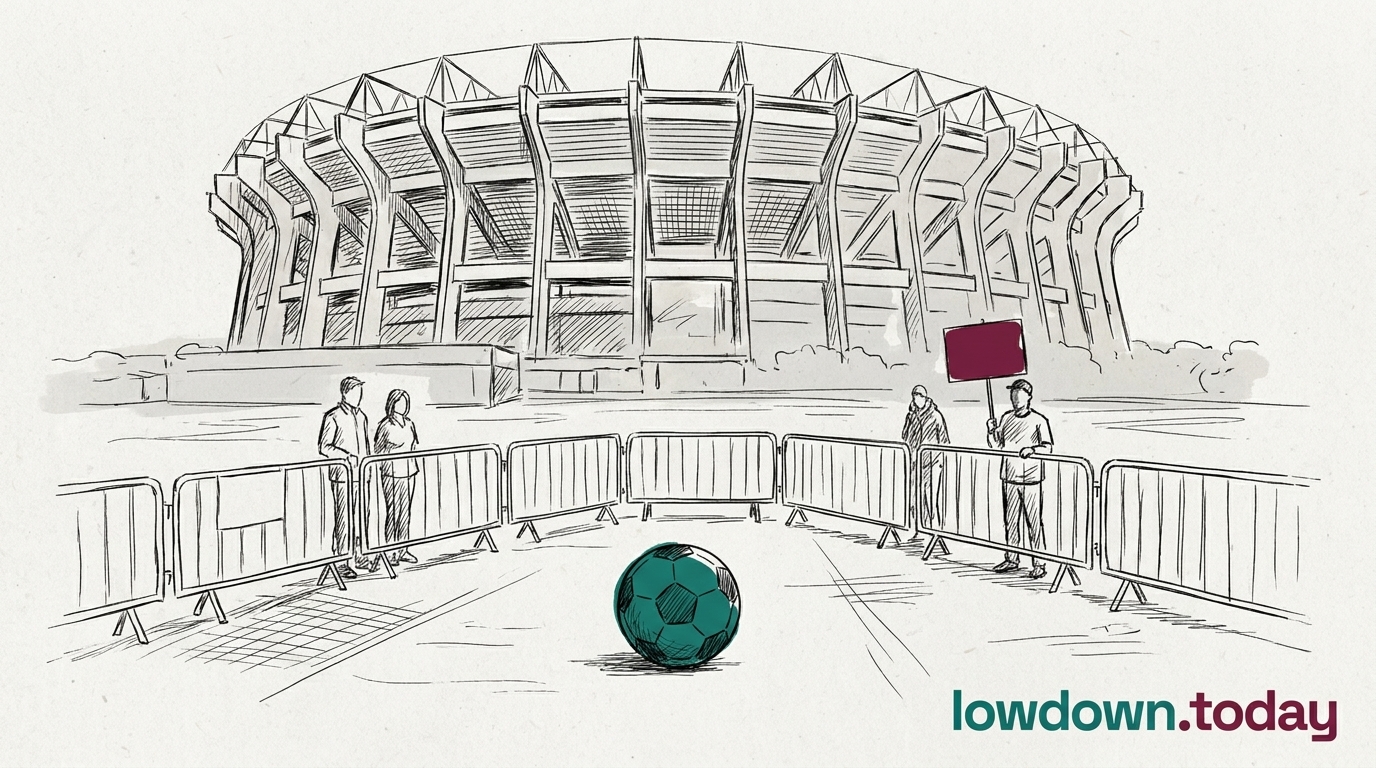
The timeline has no margin. If the friendly exposes problems in connectivity or crowd management, ten weeks remain to address them before the opening ceremony. Protest organisers from the Neighbourhood Assembly Against Megaprojects plan to demonstrate at the reopening over water scarcity and privatisation linked to the renovation works 2, adding a crowd-management variable to a day FIFA and the Mexican federation need to run without disruption.


Deep Analysis

In plain English

Estadio Azteca is the only football stadium in the world to have hosted three separate World Cups. It was renovated for 2026 by its private owner — a major Mexican media company — which publicly acknowledged uncertainty about meeting the 28 March deadline. It passed technical tests on 23 March, confirming screens and connectivity systems are operational. The stadium reopens with a Mexico–Portugal friendly on 28 March. Local residents are planning protests, arguing the renovation worsened water scarcity in surrounding neighbourhoods and that a newly built Water Garden feature was constructed to deflect public attention from the underlying resource problem rather than solve it.

Deep Analysis
Synthesis

Azteca's technical clearance resolves the operational uncertainty but introduces a separate reputational risk track that FIFA cannot manage through engineering. The combination of private ownership, community resource grievances, and the stadium's global symbolic status creates conditions where protest visibility may significantly exceed protest scale — particularly given Azteca's position as the world's most historically significant football venue and its owner's simultaneous role as a major Latin American broadcaster.

Root Causes

The water-scarcity complaint reflects a pattern documented across multiple World Cup host cities: infrastructure investment concentrates around venues while surrounding communities bear costs — disruption, resource competition, policing — without proportionate benefit. The Water Garden accusation, that it functions as a bargaining instrument rather than a genuine remedy, is consistent with community-benefit schemes in Qatar, Brazil, and South Africa that were used to manage opposition rather than address structural harms.

Escalation

The protest movement's water-scarcity complaint is structurally durable because it is verifiable and ongoing — unlike a one-off construction grievance. However, the 28 March event is a commercial friendly rather than a FIFA tournament match, limiting international media amplification. If protesters successfully disrupt fan access to the friendly, they establish a proven tactic for group-stage match days when the global media footprint is orders of magnitude larger.

What could happen next?
  • Meaning

  • Meaning

First Reported In

Update #2 · Fans file EU antitrust case against FIFA

Inside World Football· 24 Mar 2026
Read original
Causes and effects
Different Perspectives
FIFA
FIFA
FIFA's 48-team format, projecting $13.1 billion in 2026-cycle revenue against $7.5 billion for 2019-2022, opened on 11 June despite simultaneous legal, labour and security crises. Expanding to 48 sides structurally reduced the stakes of individual group results, which is both its commercial logic and the mechanism that let the build-up machinery run without cancellation.
Brazil
Brazil
Brazil open Group C against Morocco on 13 June missing Neymar, Rodrygo, Estevao and Militao; Ancelotti expressed no regrets carrying an injured Neymar and targets the Haiti fixture on 20 June for his return. Morocco's full-strength XI is rated higher by performance index than Brazil's depleted opener lineup, making this the most awkward first fixture any pre-tournament favourite has drawn.
United States
United States
The co-host avoided its most damaging opening image when UNITE HERE Local 11 reached a tentative deal with Legends on 9 June, pulling a threatened strike off the table days before Pochettino's 4-3-3 faces Paraguay. The agreement requires a ratification vote this week; rejection returns the threat before the first US match.
South Africa
South Africa
Bafana Bafana returned to the World Cup after a 16-year absence in Hugo Broos's final tournament before retirement, arriving at the Azteca opener with a counter-attacking shape to exploit possession-heavy hosts at altitude. Broos told his players to silence the Mexican crowd; his pace through Appollis and Mofokeng sets the tone for Group A.
Mexico
Mexico
Mexico opened the tournament at home on 11 June carrying a 0W-5L-2D opener record and a sold-out Azteca, while the official Zocalo fan zone was occupied by teachers and families of the disappeared on the same morning. Sheinbaum's offer of 18 alternative venues rather than a clearance order reflects her calculation that force produces worse headlines than co-existence.
Norwegian Football Federation
NFF president Lise Klaveness sent a letter of support backing FairSquare's Article 15 ethics complaint against Infantino, explicitly noting Norway was acting alone as a deliberate signal. The filing converted an external NGO campaign into the first internal federation action against the FIFA president, arriving in the same fortnight as Platini's Paris criminal complaint.


