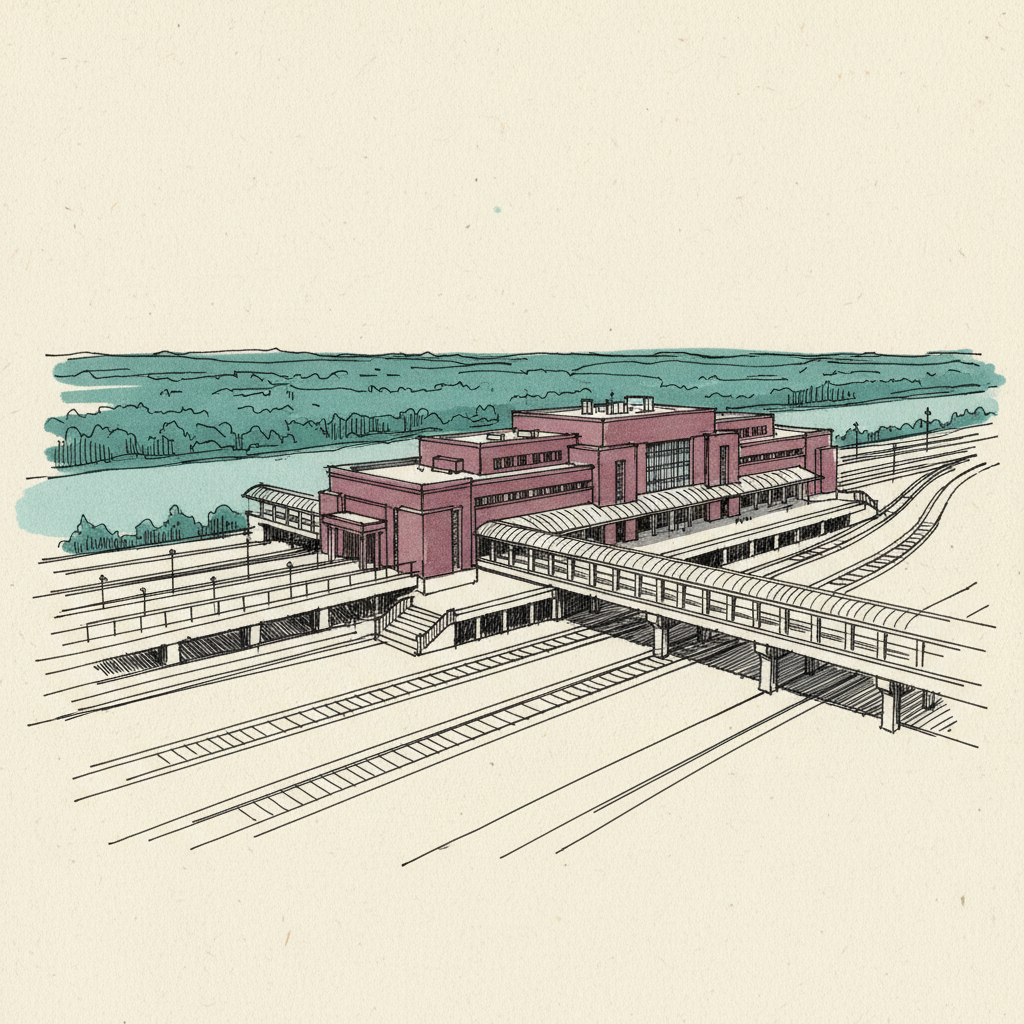
Secaucus Junction
NJ Transit's Hudson County interchange, the primary transfer point between Penn Station and New Jersey.
Secaucus Junction is NJ Transit's Hudson County interchange, the principal transfer point between New York Penn Station and the wider New Jersey rail network, opened in 2003.
Last refreshed: 28 July 2026 · Appears in 1 active topic
Can Secaucus Junction handle 80,000 World Cup fans while 650,000 commuters are diverted?
Timeline for Secaucus Junction
Mentioned in: New Jersey sets a passenger ceiling
2026 FIFA World CupMetLife: $150 rail, four-hour Penn shutdown
2026 FIFA World CupMentioned in: No parking, no tailgating at MetLife
2026 FIFA World CupMentioned in: New bus terminal for MetLife due in May
2026 FIFA World CupBackground
Secaucus Junction is an NJ Transit railway interchange in Secaucus, Hudson County, New Jersey, connecting the Northeast Corridor with the Morris & Essex, Main/Bergen County and Port Jervis lines. Opened in 2003 as the Frank R. Lautenberg Station at Secaucus Junction, it is the principal transfer point between New York Penn Station and the wider New Jersey rail network, handling well over 1,000 weekday trains in ordinary service.
That standing role as the region's key interchange was tested during the 2026 FIFA World Cup, when Penn Station to Secaucus services were reserved for ticket holders during four-hour windows before each of MetLife Stadium's eight matches. A 21 July 2026 after-action report recorded over 370,000 event passengers through the route across the tournament and set a 20,000-passenger planning ceiling for future events, down from the original 40,000-seat projection.
The episode was a stress test of existing infrastructure rather than a change to what Secaucus Junction is: its function as Penn Station's gateway to New Jersey predates the tournament and continues unchanged once match-day scheduling ends.