PUE
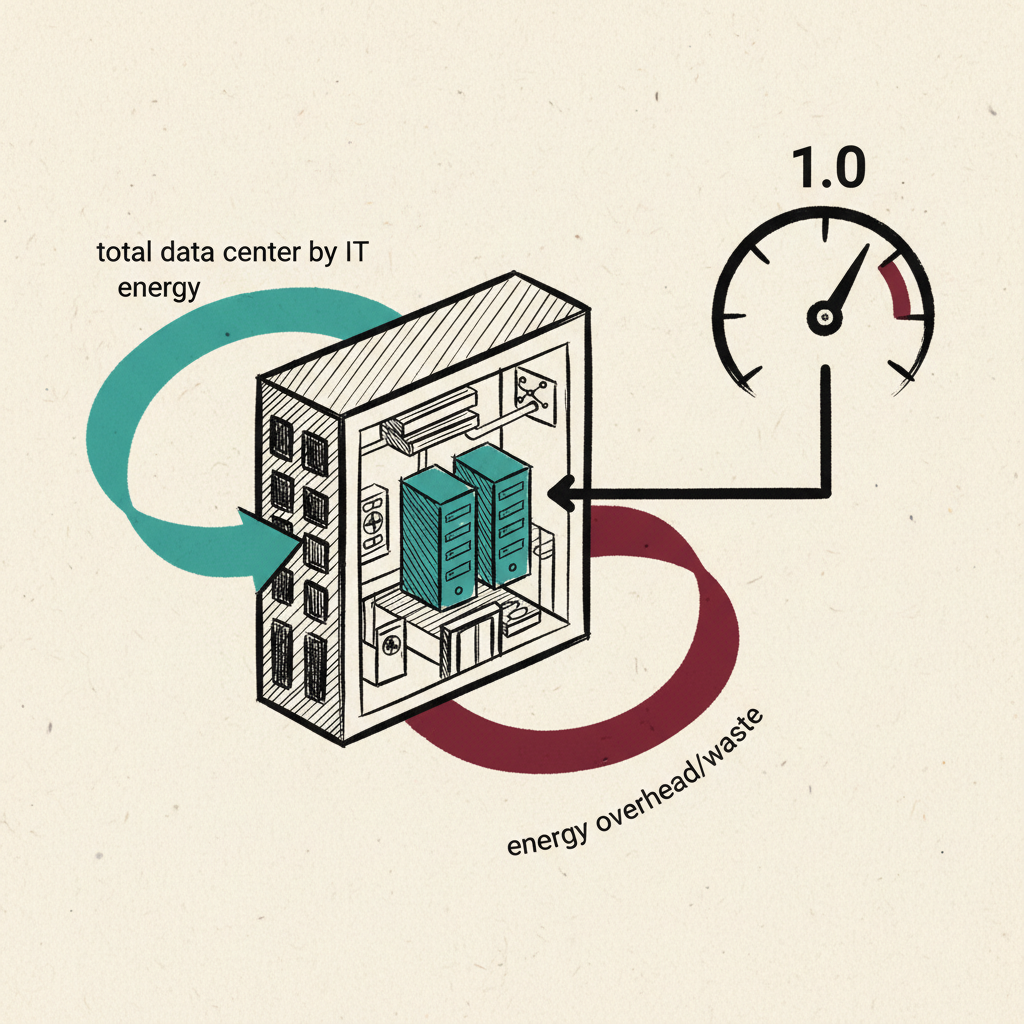
power usage effectiveness: the ratio of total data centre energy to the energy used by IT equipment; 1.0 is perfect efficiency.
Last refreshed: 14 September 2026 · Appears in 1 active topic
Is a 1.1 PUE actually sustainable when the facility drawing it pulls 500 MW?
Timeline for PUE
Mentioned in: Singapore prices its conditions up front
Data Centres: Boom and BacklashMentioned in: Finland tops 2026 data centre siting ranking
Data Centres: Boom and BacklashBackground
power usage effectiveness (PUE) is the standard metric for measuring data centre energy efficiency. Calculated as total facility power divided by IT equipment power, a PUE of 1.0 would mean all electricity goes to servers with no overhead; Uptime Institute's 2026 Global Data Center Survey puts the industry-wide average at 1.52, down from 1.58 in 2023. A capacity-weighted average, which counts larger facilities more heavily, is lower still at 1.36. hyperscale facilities typically achieve PUEs of 1.1 to 1.2 through purpose-built cooling and advanced heat management.
AI training workloads are creating pressure on PUE in two directions. High-density GPU server racks generate substantially more heat per unit of floor space than traditional servers, requiring more aggressive cooling that can raise PUE. Simultaneously, some hyperscalers are achieving very low PUEs in custom AI campuses by integrating liquid cooling directly at the chip level. Uptime Institute's 2024-2025 research found AI infrastructure is widening the efficiency gap between leading-edge and average facilities.
PUE is widely reported in operator sustainability disclosures but critics note it measures only relative efficiency, not absolute energy consumption. A 1.1 PUE at a 1 GW facility consumes FAR more energy than a 1.5 PUE at a 10 MW facility. Regulators in Ireland and Spain have begun incorporating PUE thresholds into data centre planning conditions.