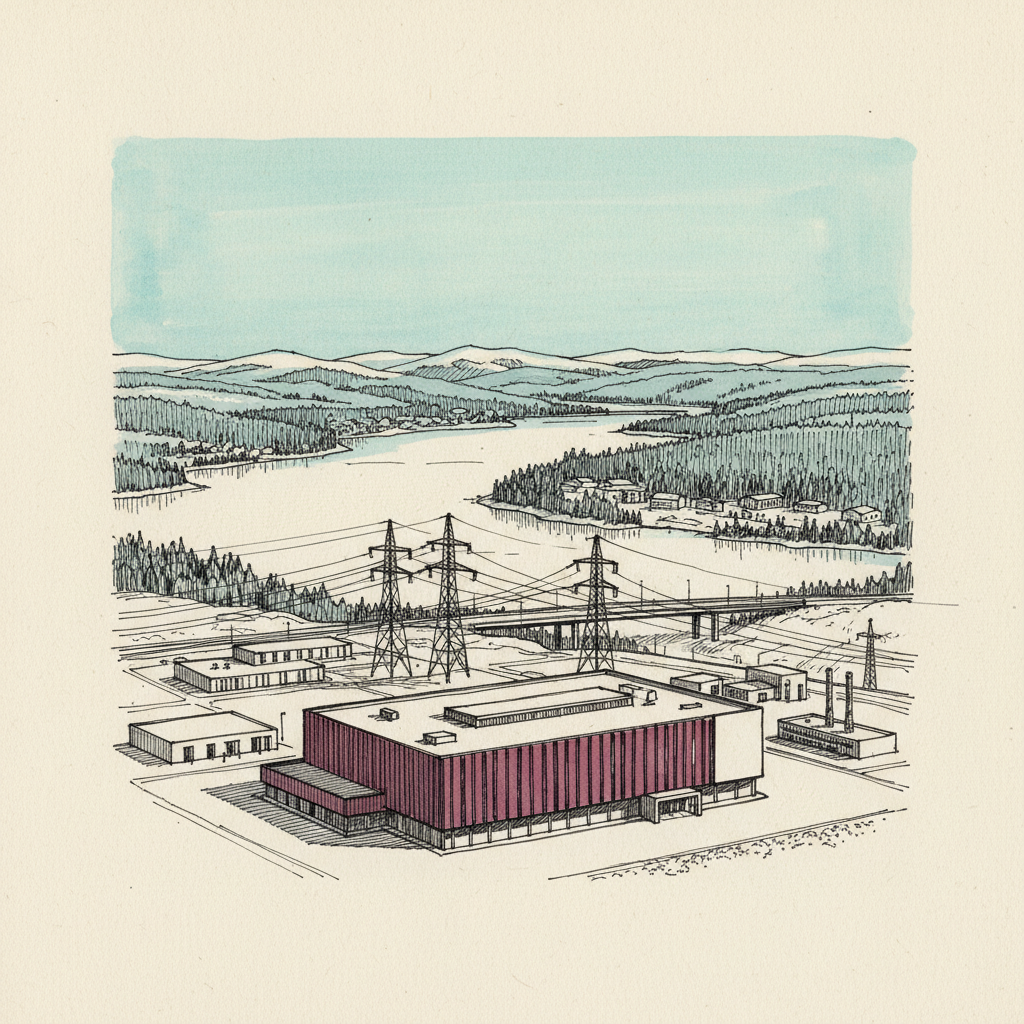
Kajaani
Finnish city ranking first globally for new data-centre siting: fast grid connections, sub-0.10 water stress, 8,000+ free-cooling hours per year.
Kajaani, a Finnish city of roughly 35,000 people 550km north of Helsinki, topped a May 2026 global ranking of greenfield data-centre sites, ahead of West Texas and Aragon, on grid headroom, water stress and free-cooling hours.
Last refreshed: 4 August 2026 · Appears in 1 active topic
If Kajaani is the ideal data-centre location, why aren't more hyperscalers there?
Timeline for Kajaani
Mentioned in: EuroHPC signs €387.8m LUMI-AI deal
European Tech SovereigntyMentioned in: Dublin slips to 15% as growth heads north
Data Centres: Boom and BacklashRanked first on fast Fingrid connection, free cooling, and low water stress
Data Centres: Boom and Backlash: Finland tops 2026 data centre siting rankingBackground
Kajaani is a city of approximately 35,000 people in the Kainuu region of north-central Finland, roughly 550km north of Helsinki. It hosts a Microsoft Azure campus operating since 2011, one of the company's oldest and largest European data-centre sites, and its former pulp and paper industry left brownfield land with existing heavy-power infrastructure that makes new development faster and cheaper than in land-constrained coastal markets.
The city's advantages for data-centre siting are structural rather than incidental: Fingrid's connection queue moves faster than comparable operators elsewhere, Finnish baseline water stress is effectively negligible, and the arctic climate cuts cooling costs sharply relative to equatorial or desert sites.
The binding constraints are not consent or power supply but rural transmission capacity, since the existing 400kV backbone does not pass directly through the city, and a small specialised operations-talent pool, both of which make Kajaani harder to scale than its site-selection ranking alone suggests.
Kajaani tops the data-centre shortlist
A May 2026 ranking placed Kajaani and Tampere first for new greenfield data-centre builds, ahead of West Texas, Aragon, Abu Dhabi and Mesa, Arizona, scoring on grid headroom, renewable surplus, water stress and consent maturity. Fingrid offers connections without the years-long queues seen at NESO or ERCOT, WRI Aqueduct rates Finnish water stress at under 0.10, and the arctic climate provides more than 8,000 free-cooling hours a year.
The ranking landed two months before DC Byte reported hyperscalers looking to the Nordics as Dublin's data-centre share slipped to 15%, a shift that lands squarely on a site already scored first rather than on undeveloped ground.