IPCEI ME/CT
EU state-aid instrument (Important Project of Common European Interest) co-financing cross-border microelectronics projects.
Last refreshed: 8 July 2026 · Appears in 1 active topic
Why does Germany's Dresden chip cluster rely on two separate EU funding mechanisms?
Timeline for IPCEI ME/CT
Co-financed the Dresden site's roughly €1bn public funding
European Tech Sovereignty: Infineon opens €5bn Dresden fab earlyWhat is IPCEI ME/CT?
How does the EU fund chip factories through IPCEI?
Did IPCEI funding help build Infineon's Dresden fab?
Background
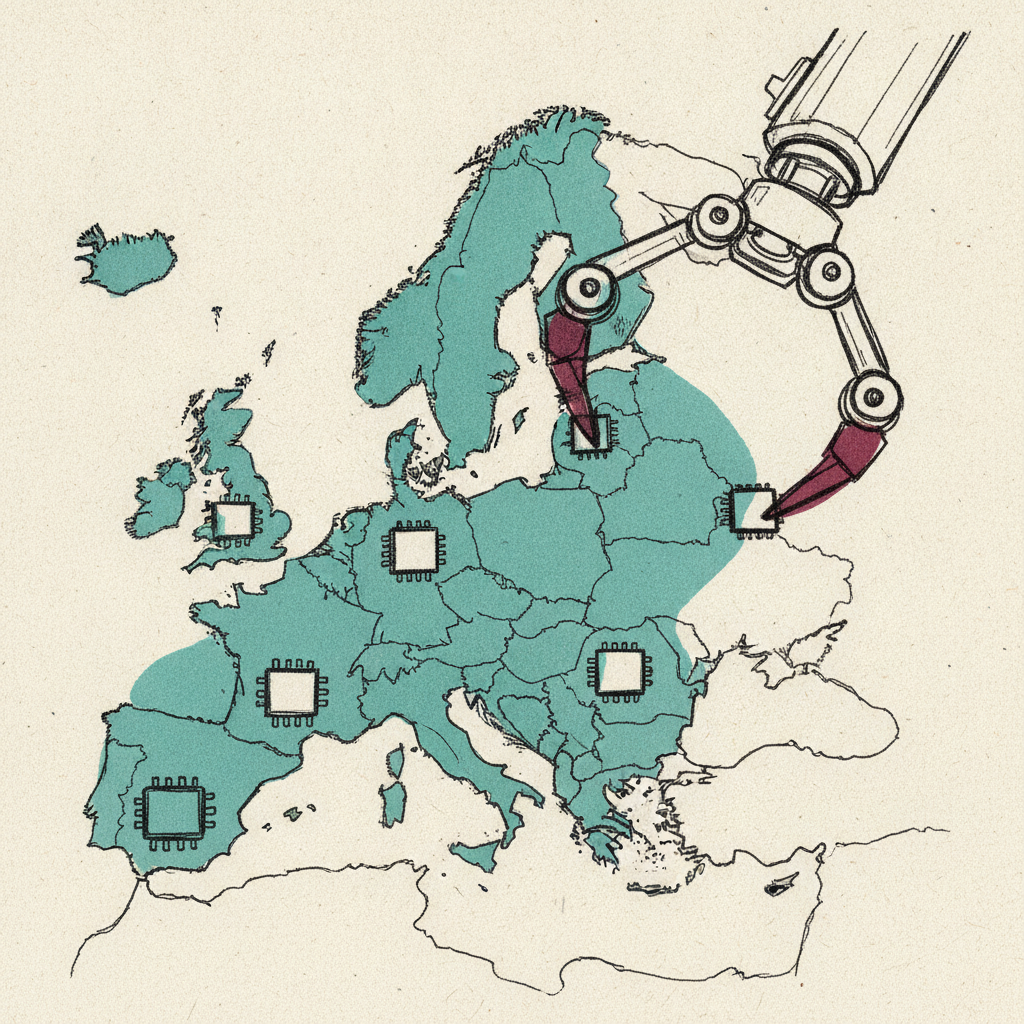
The Important Project of Common European Interest on Microelectronics and Communication Technologies (IPCEI ME/CT) is an EU state-aid vehicle that relaxes normal state-aid limits so member states can jointly fund cross-border industrial projects that would not otherwise happen under market forces alone. The European Commission approved this second microelectronics IPCEI on 8 June 2023. Fourteen member states, including Germany, France, and Italy, notified up to 8.1bn euro in public funding, expected to unlock a further 13.7bn euro in private investment across 56 companies and 68 projects. The projects span the whole value chain, from materials and chip design to manufacturing processes, targeting sectors including 5G and 6G communications, autonomous driving, artificial intelligence, and Quantum computing.
Within Germany's allocation, IPCEI ME/CT funding has co-financed the Dresden semiconductor cluster alongside the EU Chips Act. Public reporting has linked roughly 1bn euro of German IPCEI site funding to Infineon's Dresden expansion, though the precise breakdown between IPCEI and Chips Act contributions has not been itemised in public sources. Infineon opened the 5bn euro Smart Power Fab, Module 4, at the site on 2 July 2026, several months ahead of schedule, doubling Dresden capacity and creating around 1,000 jobs. The pairing illustrates how Europe's semiconductor sovereignty push routes through two parallel funding instruments, the Chips Act's fast-track designations and IPCEI's relaxed state-aid ceiling, rather than a single mechanism.


