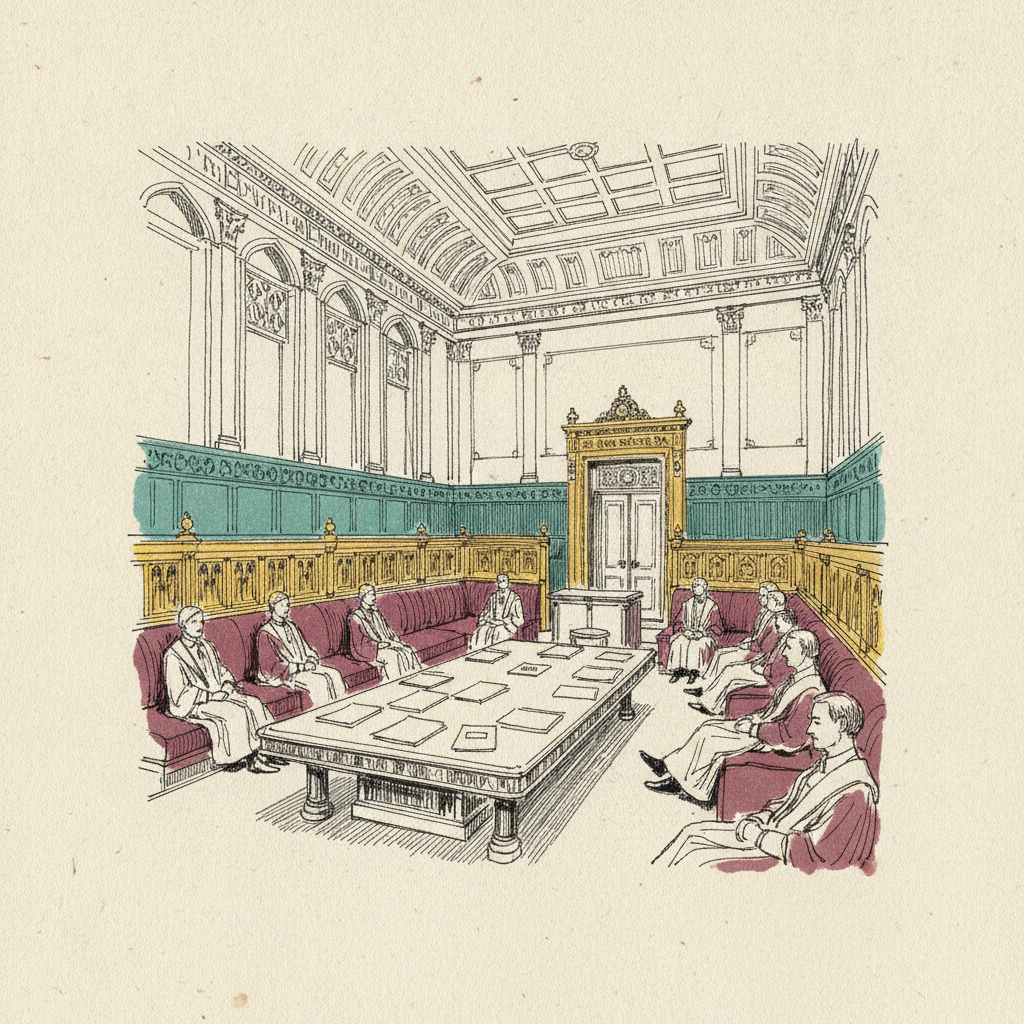
House of Lords
UK Parliament's unelected upper chamber; scrutinises, revises, and can delay but not permanently block legislation.
House of Lords committee scrutiny of the Cyber Security and Resilience Bill was under way by 23 July 2026, its amendment paper carrying a transnational-repression proposal from Lord Alton whose fate the public record leaves open.
Last refreshed: 3 August 2026 · Appears in 2 active topics
Can the House of Lords block the Cyber Security and Resilience Bill?
Timeline for House of Lords
Rayner's finance Bill goes to the Lords
UK Local Elections 2026Mentioned in: Scottish Labour opens a contest Sarwar left early
UK Local Elections 2026Mentioned in: Physics loses 2.7% as STFC holds flat
UK Startups and InnovationHosted the bill's committee stage and its running amendment paper
Cybersecurity: Threats and Defences: Cyber resilience bill at Lords committeeMentioned in: UK cyber bill hits Lords with £17m cap
Cybersecurity: Threats and DefencesBackground
The House of Lords is the upper chamber of the UK Parliament, composed of approximately 800 life peers, 26 Lords Spiritual (Church of England bishops), and 92 hereditary peers retained under the 1999 reform. Unlike the elected House of Commons, the Lords exercises its legislative role primarily through detailed scrutiny and amendment rather than veto: the Parliament Acts of 1911 and 1949 limit it to delaying non-money bills by one year, and by convention (the Salisbury Convention) the chamber does not obstruct manifesto commitments.
The Lords performs functions distinct from the Commons: extended committee scrutiny of complex technical legislation, especially significant for bills covering emerging technology and regulated industries where specialist expertise among peers is concentrated. Its crossbench membership, peers with no party affiliation often drawn from scientific, legal and business backgrounds, means government bills regularly face substantive revision, with industry lobbying on technical detail typically most effective at this stage.
Beyond legislation, the Lords Science and Technology Committee and the Lords Communications and Digital Committee both cover cybersecurity and digital regulation, and their reports carry weight with ministers and regulators even without a resulting legislative amendment.
Lords began scrutinising the cyber bill
The Cyber Security and Resilience Bill had its House of Lords second reading on 14 July 2026, entering a chamber that can revise but not veto the legislation. It would bring managed service providers and data centres into critical-infrastructure scope, with fines up to £17m or 4% of global turnover, and adds a duty to report near-miss incidents alongside successful breaches . By 23 July, the committee's amendment paper had grown to include a transnational-repression proposal from Lord Alton, unrelated to the Bill's cyber-reporting focus; the chamber's own procedural record does not show whether peers reached it in debate .
Under the Parliament Acts, the Lords can delay the bill by at most a year, so its influence runs through amendment rather than blockage; the fine ceiling and scope definitions are exactly the kind of technical detail where crossbench expertise typically reshapes government bills at this stage.
Commons sent the cyber bill onward
The Cyber Security and Resilience Bill passed its Commons third reading on 10 June 2026 and moved to the Lords, having dropped a proposed ransomware-payment disclosure requirement from the published text while keeping fines of up to £17m or 4% of global turnover .
The bill's arrival in the Lords coincided with NCSC chief executive Richard Horne telling the RUSI conference on 17 June that the agency had handled more than 200 infrastructure incidents in the past year, three-quarters traced to state actors, giving peers a concrete incident count to frame their scrutiny of the bill's reporting duties .
What happens to the Cyber Security and Resilience Bill in the House of Lords?
How many members does the House of Lords have?
What powers does the House of Lords have over legislation?
Can the House of Lords block a bill it disagrees with?

