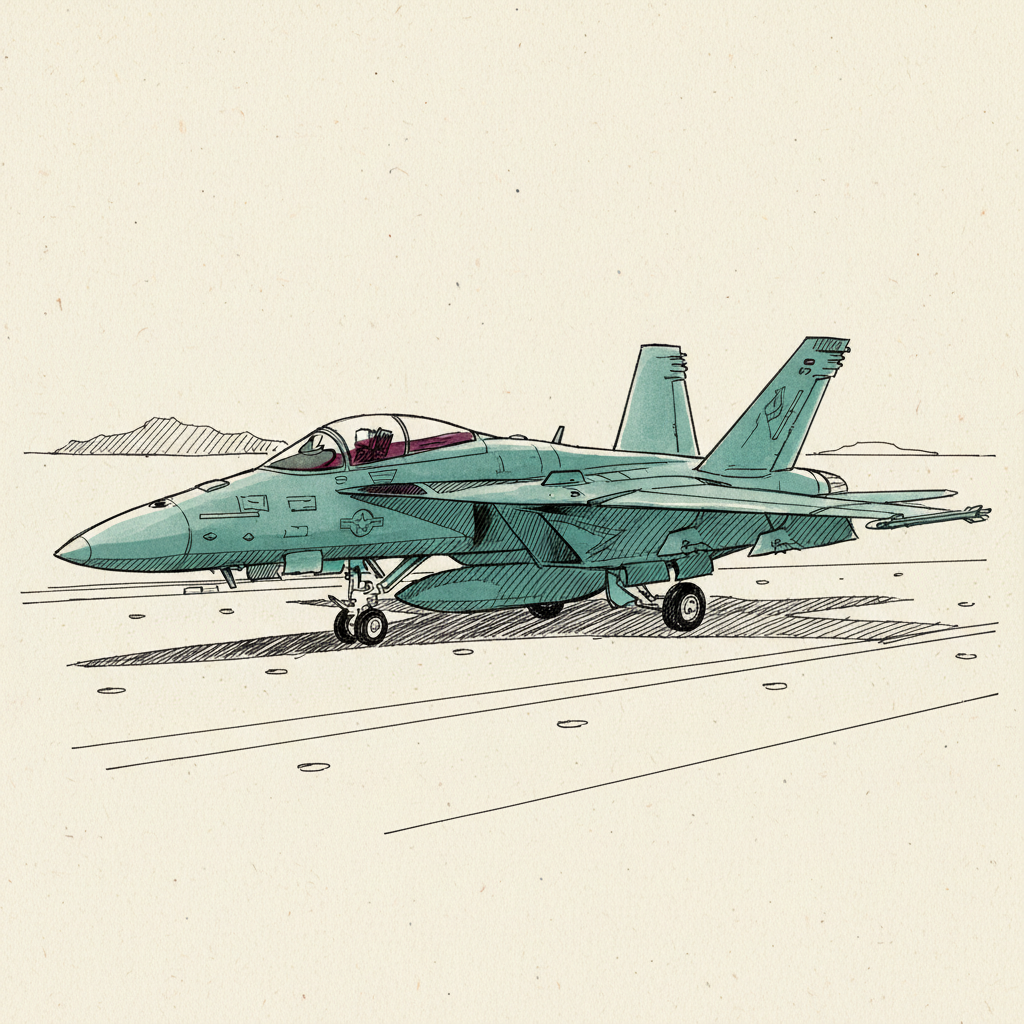
F/A-18 Super Hornet
US Navy carrier-based multirole fighter jet; on 8 May 2026 used to fire precision munitions into the smokestacks of two Iranian-flagged tankers.
Last refreshed: 9 May 2026 · Appears in 1 active topic
How does bombing a smokestack disable a ship without sinking it?
Timeline for F/A-18 Super Hornet
Fired precision munitions into smokestacks of M/T Sea Star III and M/T Sevda on 8 May
Iran Conflict 2026: F/A-18 disables tankers via smokestack on 8 May- How does the US Navy disable a ship by bombing its smokestack?
- A precision strike on the exhaust stack destroys the engine cooling and exhaust system, rendering propulsion inoperable without breaching the hull or sinking the vessel.Source: The War Zone
- What is the F/A-18 Super Hornet used for in the Iran conflict?
- US Navy F/A-18s from USS George H.W. Bush disabled two Iranian-flagged tankers on 8 May 2026 using smokestack strikes, enforcing sanctions without sinking the vessels.Source: Lowdown
- Is smokestack bombing legal under international maritime law?
- Naval law scholars are divided. San Remo Manual Rule 67 and UNCLOS Article 58 debates around proportionality in EEZ enforcement are central to the legal argument.Source: US Naval War College
- What planes are aboard USS George H.W. Bush?
- USS George H.W. Bush (CVN 77) carries F/A-18E/F Super Hornets as its primary strike aircraft, alongside EA-18G Growlers and E-2D Hawkeyes.
- How many F/A-18 Super Hornets does the US Navy have?
- The US Navy operates over 500 F/A-18E/F Super Hornets across its carrier air wings, making it the most numerous carrier-based strike aircraft in US service.
Background
The F/A-18 Super Hornet entered the spotlight on 8 May 2026 when US Navy aircraft from USS George H.W. Bush (CVN 77) disabled two Iranian-flagged tankers in the Persian Gulf using a precision strike on their smokestacks, a technique that disables propulsion without sinking the vessel. The strikes targeted M/T Sea Star III and M/T Sevda, a tactic first reported by The War Zone and designed to enforce US warnings against Iranian oil exports without triggering a full naval confrontation.
The Super Hornet is the US Navy's primary carrier-based multirole aircraft, first entering service in 1999 as the successor to the original F/A-18 Hornet. It carries a crew of one or two, has a combat radius of roughly 720 km, and can be armed with precision-guided munitions, anti-ship missiles, and stand-off weapons. The aircraft is manufactured by Boeing and remains the backbone of US carrier air wings, with over 500 in active service.
The smokestack-bombing technique demonstrated the Super Hornet's versatility as an instrument of graduated coercion: disabling a vessel's engine exhaust disables propulsion without a sinking that would constitute an act of war under international maritime law. The approach mirrors the logic of UNCLOS Article 58 debates around proportionality in the exclusive economic zone, and has drawn significant legal scrutiny from naval-law scholars.


