Skip to content
Welcome, thoughtbot's Giant Robots listeners!Start here
Is Britain Actually Broke?
7OCT

Banks passed, so the buffer was cut

3 min read
12:52UTC

The Bank of England modelled a severe recession through the banks' books, judged the system resilient, and then lowered the capital it requires them to hold by 100 basis points to 13%.

EconomicDeveloping
Key takeaway

The rulebook written after 2008 caught banks, and banks are now the one thing in Britain working.

The Bank of England put the banking system through a severe hypothetical shock in its 2025 stress test, judged it resilient, and cut the assessed capital requirement by 100 basis points (one percentage point) to 13% in December 2025⁠1. The scenario was not a mild one: two simultaneous deep recessions with large falls in asset prices. Barclays came through it at a minimum 8.8% before management actions and 9.3% after, against a 7.2% requirement⁠2. Those percentages are CET1 ratios, common equity tier one, the highest-quality loss-absorbing capital a bank holds measured against the risk on its books.

A regulator lowering its demands after a test is a stronger signal than a bank passing one. Passing can be arranged; requiring less capital is the Bank of England putting its own judgement on the line about how much cushion the system needs. Nothing else in this register has a supervisor moving in that direction.

Two honest caveats belong here rather than in a footnote. A stress test models a hypothetical recession, it does not observe a real one, and official reassurance about bank balance sheets had a poor record in 2007. What the December 2025 result tells us is that the banks survived a modelled recession, and nothing more than that. The second caveat is structural: the post-2008 Reform programme, capital floors, annual stress testing, statutory resolution powers, was built to stop one specific failure mode, a leveraged private lender with funding that can run. None of the distressed ledgers in this register has runnable funding, which is why none of them can produce a 2008-style overnight event. It is also why none of them has an automatic stabiliser when things go wrong.

Deep Analysis

In plain English

A bank's capital is the buffer of its own money, not customer deposits, that absorbs losses before the bank itself becomes insolvent. Common equity tier one (CET1) is the highest-quality form of that buffer. Every year or two, the Bank of England runs a stress test: a hypothetical severe recession is modelled through each bank's books to see whether its capital would survive. In 2025, banks came through comfortably, and the regulator responded by lowering how much capital it requires them to hold, from 14% to 13%, because the test suggested less was needed to stay safe in a genuinely bad scenario.

What could happen next?
  • Meaning

    The capital requirement cut is a genuine counter-indicator to the topic's central question, though a stress test can only ever model a hypothetical scenario, not observe an actual recession.

First Reported In

Update #1 · The distress moved from banks to councils

Bank of England· 27 Jul 2026
Read original →
Causes and effects
This Event
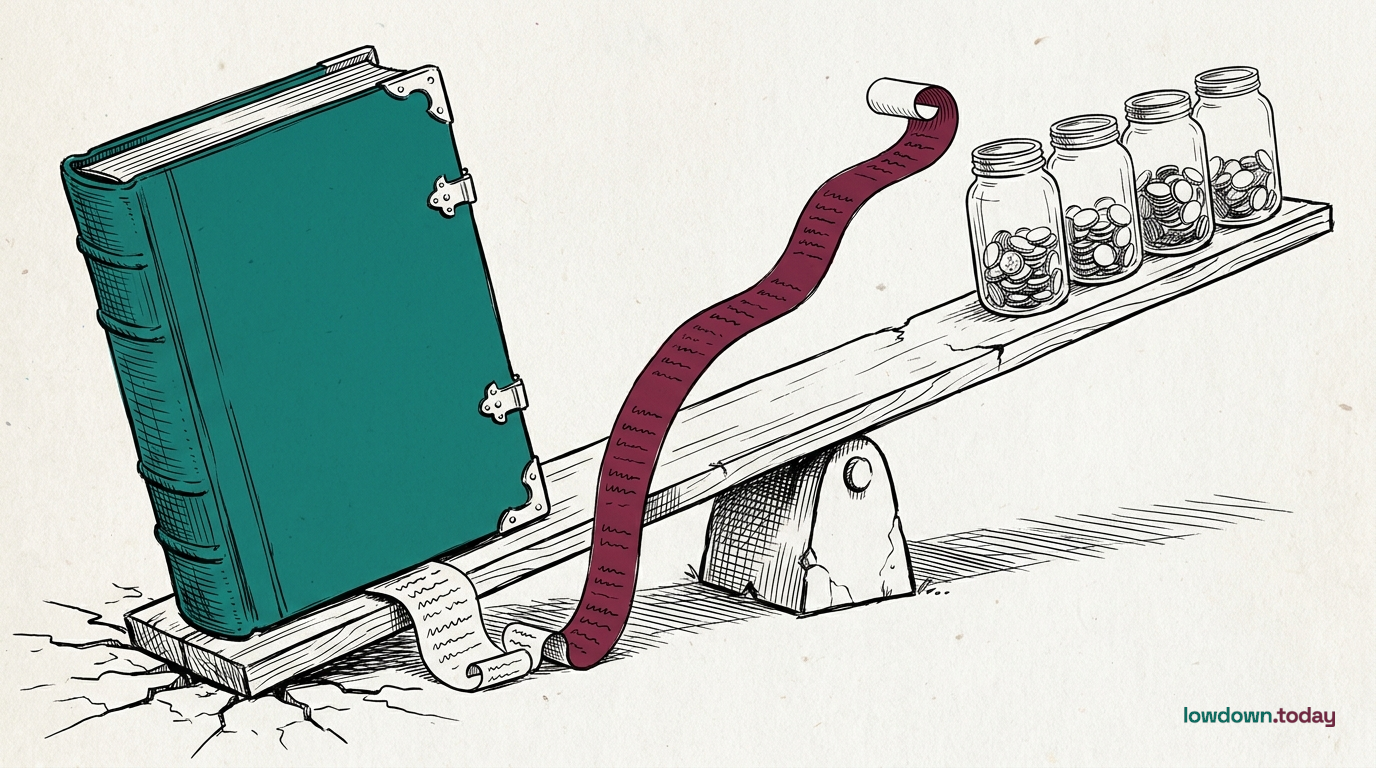
Banks passed, so the buffer was cut
The institutions at the centre of 2008 are the one part of this register where a regulator has actively reduced its demands.
Different Perspectives
Conservative Party
Conservative Party
Leader Kemi Badenoch said Labour will run out of money and proposed lifting defence to 3% of GDP, paid for from welfare. Shadow work and pensions secretary Helen Whately put those savings at £23bn, "just the start".
Reform UK
Reform UK
Treasury spokesman Robert Jenrick pledged £80bn a year of spending cuts by the end of the next parliament and claimed £30bn a year of interest savings. The Spectator judged that the sums still do not fully add up.
Centre for Policy Studies
The right-of-centre think tank argued on 4 October that Britain is not a low-tax country once workplace pensions and student-loan repayments are counted. Its comparison rests on 2019 data.
Institute of Economic Affairs
The free-market think tank argued on 28 September that alcohol, tobacco and landfill duties raised £5.2bn less than the OBR projected. That comparison is separate from the five-month borrowing overshoot.
Resolution Foundation
The centre-left think tank said on 8 September that about £1 in every £12 of public spending now goes on debt interest. In July it put headroom against the fiscal rules at about £10bn.
Audit Scotland
Audit Scotland
It reported on 17 September that three Scottish budgets planned ScotWind drawdowns and drew nothing each time. It warned that using one-off receipts to balance annual budgets can weaken spending control.