Skip to content
Briefings are running a touch slower this week while we rebuild the foundations.See roadmap
AI: Jobs, Power & Money
2MAY

Cboe cuts 20% on record-revenue day

3 min read
15:17UTC

Cboe Global Markets cut 334 of 1,670 staff (20 per cent) on 1 May at record Q1 revenue of $728.9 million; the share price hit a record on the announcement.

EconomicDeveloping
Key takeaway

Cboe cut 20 per cent of staff at record Q1 revenue, and shares hit a record the same day.

Cboe Global Markets cut approximately 334 of 1,670 staff (20 per cent) on 1 May 2026 at record Q1 revenue of $728.9 million 1. CBOE shares hit a record on the day of the announcement. The exchange operator runs the largest US options market and a substantial European derivatives venue; the headcount it cut is concentrated in the technology and operations functions that automation has been compressing for fifteen years.

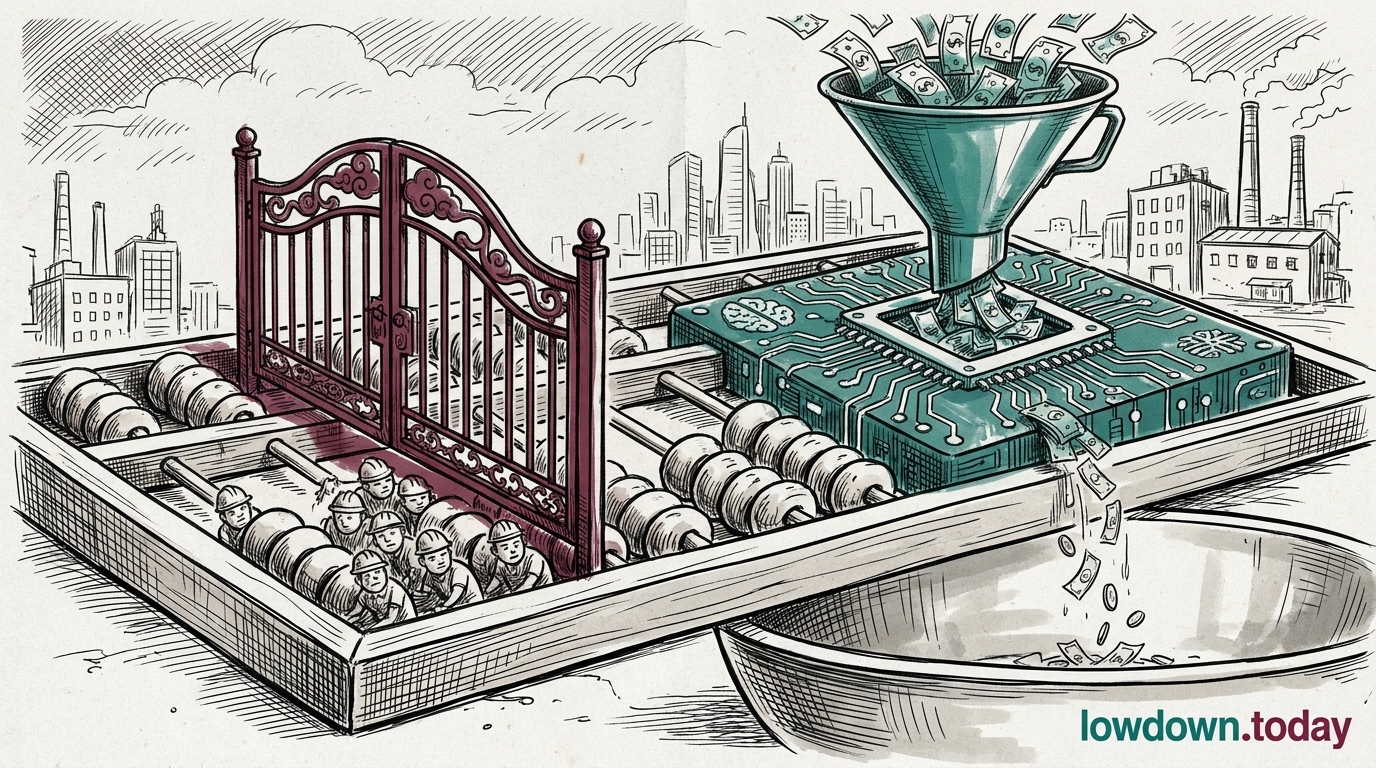
Equity markets have rewarded AI-attributed workforce reductions at strong-revenue firms throughout 2026, with Challenger's cumulative AI-attributed cuts crossing 107,094 by April and AI leading all cut reasons in March . CBOE is the cleanest single-day version of the pattern this week: record revenue, record share price, 20 per cent staff cut, all on one announcement. Workforce reductions defend the share price; the share price funds the AI infrastructure spend; the AI infrastructure spend produces the substitution that justifies the next round of reductions.

For a financial exchange, the 20 per cent cut sits inside a specific supervisory context. AISI confirmed the same day that OpenAI's GPT-5.5 cleared the 32-step autonomous attack benchmark, doubling the count of frontier models the Bank of England's April Financial Policy Committee directive must now cover. An exchange operator cutting a fifth of its workforce while autonomous AI capability proliferates into the financial-supervisory void is the operational version of the hyperscaler capital story: capability displacing labour faster than the regulatory framework can describe what it is doing.

For pension and equity holders, CBOE is the small-cap clean read of the pattern. The hyperscalers obscure it with capex and AI revenue mix; CBOE shows it without disguise. Strong revenue, record share price, headcount down 20 per cent, all in one day.

Deep Analysis

In plain English

Cboe Global Markets runs some of the world's largest financial exchanges, where professional traders buy and sell options and futures contracts. It is not a consumer business, but its pricing signals flow through to every pension fund and investment portfolio. On 1 May 2026, Cboe announced it had cut 334 people, one in five of its entire workforce. That same day it reported its best quarterly revenue ever. When news of the cuts reached investors, Cboe's share price hit a record high. The pattern is clear: investors are now rewarding companies that cut staff while reporting record results, reading the combination as evidence that AI is replacing human labour at a profit. At Cboe, the work being replaced is primarily in trade surveillance, risk analytics, and middle-office operations that AI systems can now handle at lower cost and higher speed than human teams.

Deep Analysis
Root Causes

Cboe's 20% cut has two structural drivers.

First, AI-powered trade surveillance tools (Nasdaq's Surveillance Insight, Eventus Systems' Validus) can process the same event volumes as a team of 20-30 surveillance analysts at 10-15% of the annual cost, per Cboe's own efficiency guidance on the Q1 call. Exchange middle-office headcount that was previously required for regulatory compliance is now a technology cost rather than a labour cost.

Second, Cboe's share price response confirms that markets have internalised the labour-substitution trade. Before 2024, mass layoffs at record revenue were unusual enough to trigger analyst concern about organisational health. The 1 May response, record share price on record revenue plus 20% job cut, reflects a market consensus that AI-enabled staff reduction is a quality-of-earnings indicator rather than a warning sign.

What could happen next?
  • Precedent

    The Cboe record-revenue plus 20%-cut plus share-price-record on the same day establishes a new market narrative: AI-enabled staff cuts at record revenue are now rewarded as a quality-of-earnings signal, which will spread the pattern to other financial infrastructure operators.

  • Risk

    IOSCO's concern about correlated AI surveillance failure across exchanges is unaddressed by Cboe's cuts; a common-mode surveillance failure in a high-volatility environment could produce a flash-crash type event with no human failsafe.

First Reported In

Update #8 · Beijing court bans AI sackings as Big Tech burns cash

Yahoo Finance· 2 May 2026
Read original
Different Perspectives
UK financial regulators (BoE FPC / FCA)
The Bank of England's April FPC directive on agentic AI in payments was scoped around one frontier model; AISI confirmed a second model cleared the same 32-step threshold on 1 May. The supervisory architecture is one model behind the capability it was built to contain.
Indian IT sector workers (TCS, Infosys, Wipro)
TCS posted its first annual revenue decline in the modern era, Infosys shed 8,400 workers in a quarter, and Wipro hit its zero-fresher target. Western Big Tech's AI automation is cannibalising the offshored-services model that employs roughly five million Indian IT workers.
Chinese workers (Hangzhou and Beijing plaintiffs)
Workers Zhou and Liu won cases that established a two-court doctrinal chain: AI adoption is the employer's deliberate strategy, placing the cost of displacement on the employer rather than the worker. Any Chinese employee facing AI-driven dismissal now has a citable legal route that American, British, and European counterparts do not.
Chinese government, courts, and domestic employers
The Hangzhou rulings were released on Workers' Day eve alongside the Ministry of Human Resources' recognition of 42 new AI occupations. Domestic firms now face mandatory retraining obligations; the Orgvue estimate of 8-14 months added to displacement timelines will feature in employer compliance briefings throughout 2026.
EU regulators and European Parliament
The second Digital Omnibus trilogue collapsed without agreement on 28 April; the third is scheduled for 13 May with the binding employer AI-literacy obligation still contested. Brussels is arguing over a non-binding encouragement clause while Beijing's courts have already bound employers.
US legislators (Warner, Rounds, Hawley, Sanders)
Warner and Rounds produced the Economy of the Future Commission Act, the most concrete federal vehicle still moving, endorsed by the companies it would notionally regulate. The Sanders-AOC moratorium was killed by Democratic senators; the Hawley-Warner disclosure bill remains in committee with no floor date.
