Skip to content
You can now search across every topic, entity and event.What's new
AI: Jobs, Power & Money
2MAY

AI now leads all US layoff reasons

3 min read
15:17UTC

For the first time on record, AI topped every stated reason for American job cuts in a single month.

EconomicAssessed
Key takeaway

AI now leads all stated reasons for US layoffs, with cumulative cuts approaching 100,000.

Challenger, Gray & Christmas counted 15,341 AI-cited layoffs in March. That is one quarter of all announced US reductions, and the first month AI has led every stated reason since tracking began in 2023 1. The cumulative total since 2023 now stands at 99,470, roughly the workforce of Goldman Sachs, and within weeks of crossing 100,000.

Tech sector cuts for Q1 reached 52,050, up 40% year on year . Andy Challenger noted that "AI replacing coding functions in technology companies is where the actual role replacement is visible." The attribution share jumped from roughly 10% in February to 25% in March. That is not incremental. It suggests either a genuine acceleration or a normalisation of corporate candour about replacing workers with machines.

If attribution is normalising, the silence of the previous months understated reality. If it reflects acceleration, Q2 figures could approach 40%. Either reading is significant.

Deep Analysis

In plain English

Every month, a US firm called Challenger, Gray & Christmas counts all the job cuts companies announce publicly and asks why they did it. For the first time since they started asking that question in 2023, AI came top of the list in March 2026. One in four of all announced American job cuts that month named AI as the reason. The total since tracking began is approaching 100,000. That is roughly the number of people who work for Goldman Sachs worldwide. The important thing is not just the number. It is that companies are now saying it openly. Previously, most AI-related cuts were labelled as restructuring or cost savings. Something changed in March.

Deep Analysis
Root Causes

Large language models reached a capability threshold in 2024-2025 where coding assistance tools could handle routine development tasks that previously required junior engineer time. This made a workforce reduction economically logical before AI capabilities are fully exploited, compressing the adoption-to-displacement timeline.

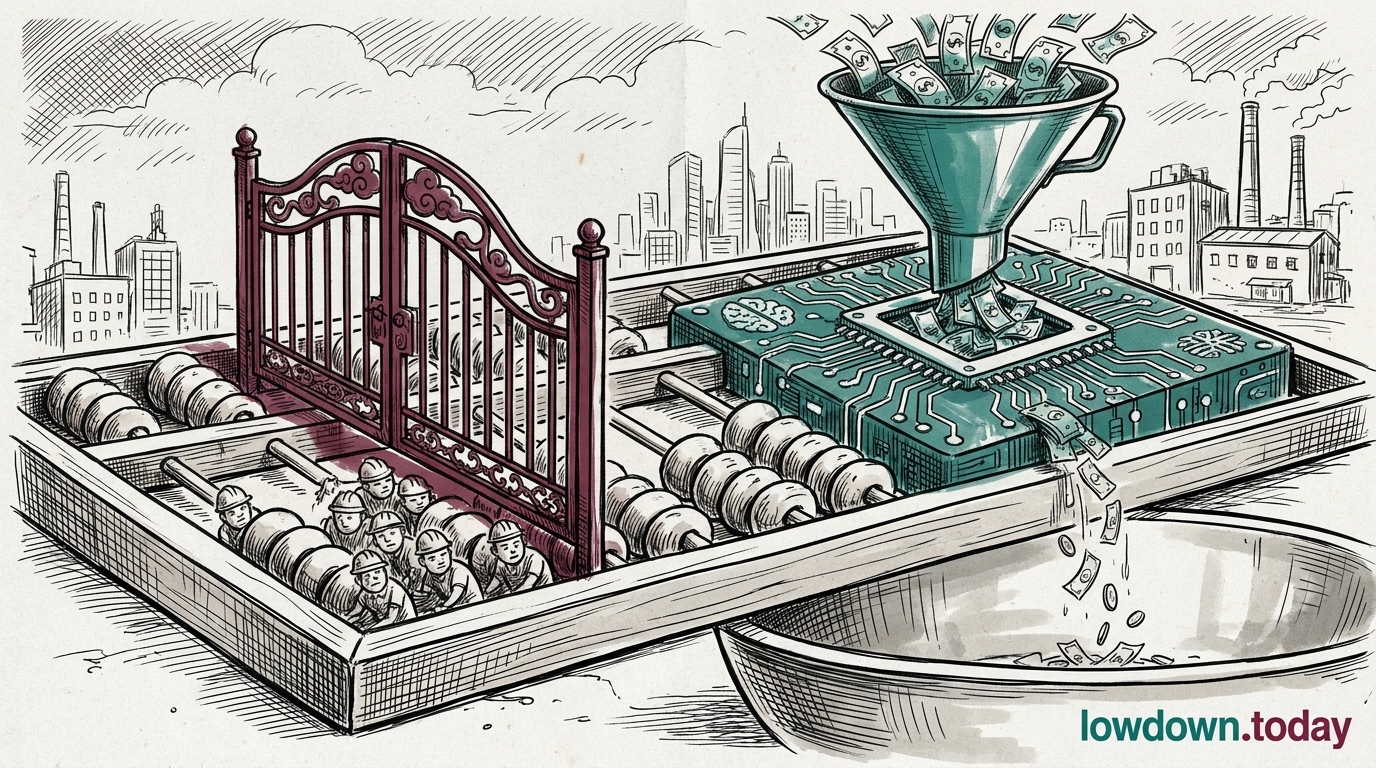
The five largest US tech companies committed $650-690 billion in capital expenditure to AI infrastructure. That capital must be serviced from operating margins. Reducing payroll is the fastest available lever. Salary savings fund hardware. The displacement is therefore partly a financing decision, not purely a capability one.

Corporate attribution behaviour changed in early 2026 as the reputational cost of naming AI as a layoff driver fell. Once Oracle and Salesforce cited AI explicitly at scale, stating the same reason became lower-risk for smaller firms. Attribution normalisation creates a feedback loop: as more companies cite AI, the social licence for AI-attributed cuts widens further.

What could happen next?
  • Q2 2026 AI-attributed cuts could approach 30-40% of all announced US layoffs if the March attribution trend continues, implying 180,000 or more AI-cited positions by mid-year.

    3 months · Possible
  • Cumulative AI-attributed cuts will cross 100,000 in April 2026, the first hard six-figure milestone in displacement tracking history, likely prompting intensified Congressional and media scrutiny.

    1 month · Likely
  • Wage growth compression to 3.5% annually, combined with rising tech unemployment, will reduce consumer spending power among the highest-earning quintile of workers, potentially dampening demand for premium goods and services.

    6 months · Possible
First Reported In

Update #4 · AI leads US layoffs as cuts go uncounted

Challenger, Gray & Christmas· 4 Apr 2026
Read original
Different Perspectives
Barclays
Barclays
Barclays economist Pooja Sriram flagged a 28,000-a-month bleed in finance and information roles the same week Microsoft disputed that AI drove its own 4,800 cuts. The bank treats Challenger's AI-attribution share as a lagging indicator against faster erosion visible in raw labour-market data.
European Commission
European Commission
Brussels deferred the Digital Omnibus's Annex III employment-compliance deadline from 2 August 2026 to December 2027, even as California advanced three binding AI-hiring bills the same week. The 17-month delay leaves EU workers without the algorithmic-hiring safeguards the regulation already promises.
OpenAI
OpenAI
OpenAI proposed a 5% US government equity stake worth $42.6bn, structured as a public wealth fund modelled on the Alaska Permanent Fund, with Sam Altman pitching it directly to Trump, Bessent and Lutnick. The offer pre-empts Sanders' rival one-time 50% AI-stock tax, which has not yet reached committee.
India's IT and outsourcing sector
BAT's transfer of 3,500 roles to Accenture on 29 June fits a delivery model Indian IT firms increasingly run: consultancies win Western contracts, then execute through offshore centres. The sector expects more Fit2Win-style transfers, not straight redundancies, as employers absorb AI without cutting outsourced headcount.
European Trade Union Confederation
ETUC says the Council's shift from 'ensure' to 'support' in the AI-literacy duty, confirmed in the Digital Omnibus's final adoption on 29 June, is a collapse of the legal threshold, not a drafting tidy-up. It expects EU workers to face AI-driven hiring and monitoring decisions with a statutory right to explanation that exists in name only.
British American Tobacco's Fit2Win workforce
BAT is cutting 9,000 roles under Fit2Win, transferring 3,500 to Accenture rather than making them redundant, to reach roughly £500m in AI-driven savings by 2027. For affected staff, that distinction decides whether they keep a job at all, just not at BAT.
