Skip to content
Briefings are running a touch slower this week while we rebuild the foundations.See roadmap
AI: Jobs, Power & Money
23APR

Strong March payrolls mask tech decline

3 min read
14:51UTC

The US economy added 178,000 jobs and tech unemployment hit a post-dot-com high. Two economies are running in parallel.

EconomicAssessed
Key takeaway

Broad payrolls rebounded while tech unemployment hit 5.8%, the worst since the dot-com bust.

The Bureau of Labor Statistics reported +178,000 nonfarm payrolls in March, beating consensus of 59,000 1. Unemployment edged down to 4.3%. Health care added 76,000 positions. Construction added 26,000. Technology was not a growth sector.

Tech sector unemployment rose to 5.8%, the highest since the dot-com bust of 2001-02 2. Annual wage growth fell to 3.5%, the lowest since May 2021. Median tech reemployment time stretched to 4.7 months, up 47% from 3.2 months in 2024. When the same mid-level roles are eliminated across multiple employers, there is no adjacent firm to absorb the displaced.

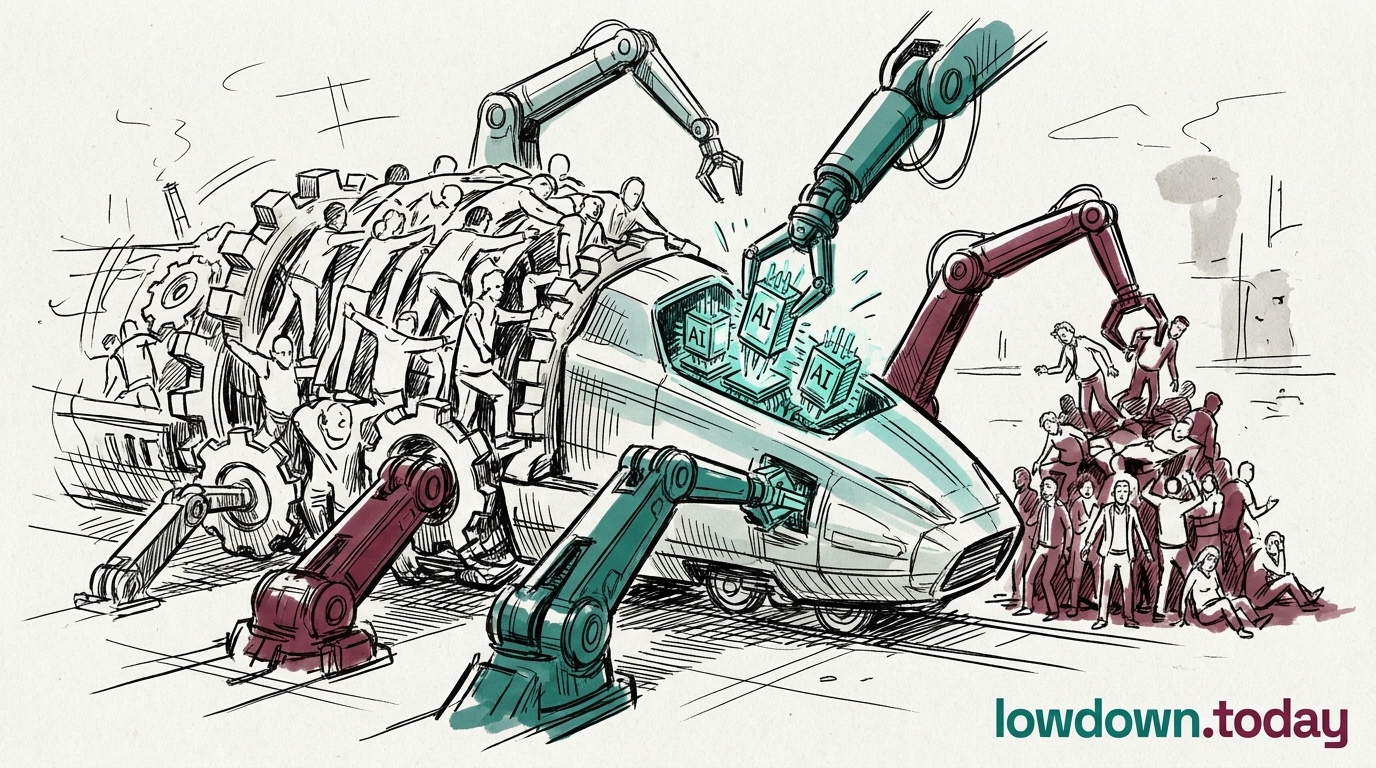
Two economies are running in parallel: the broad labour market is hiring, and the knowledge-worker sector is contracting at its fastest rate in 25 years.

Deep Analysis

In plain English

The US government publishes a monthly jobs report that tallies how many people found work or lost it. March's headline number looked good: 178,000 new jobs, well above what forecasters expected. Hospitals and building sites accounted for most of it. But inside that headline is a much worse story for tech workers. Unemployment in the technology sector hit 5.8%, the highest since the dot-com crash of the early 2000s. And when tech workers lose their jobs, they are now waiting nearly five months on average to find a new one. That is up 47% in just two years. The headline says the economy is fine. The detail says one important part of it is not.

Deep Analysis
Root Causes

The sectoral divergence in this jobs report has two distinct drivers. Health care, construction, and logistics growth reflects demographic demand (ageing population) and policy-driven infrastructure investment. These sectors are structurally hiring regardless of the AI cycle.

Technology sector contraction reflects the specific capability profile of current AI tools. Code generation, customer service automation, and data processing are among the earliest automatable white-collar functions. Tech companies are the earliest to deploy these tools at scale against their own workforces, producing a concentrated sectoral effect invisible in aggregate data.

The 47% increase in median reemployment time reflects the simultaneity of cuts. When Oracle, Dell, Amazon, and Salesforce all reduce mid-level software roles in the same quarter, there is no adjacent employer to absorb the displaced. Market saturation of similar skills extends the jobless period beyond anything historical precedents would predict.

What could happen next?
  • If tech sector unemployment continues rising while headline unemployment holds, Federal Reserve rate decisions calibrated to aggregate data will provide no relief to the distressed sector, extending the recovery timeline for displaced tech workers.

  • Median reemployment time of 4.7 months, if it rises toward 6-7 months, will push more displaced workers into savings depletion and credit stress, increasing default rates in consumer finance portfolios concentrated in high-income tech markets.

First Reported In

Update #4 · AI leads US layoffs as cuts go uncounted

Bureau of Labor Statistics· 4 Apr 2026
Read original
Different Perspectives
UK financial regulators (BoE FPC / FCA)
The Bank of England's April FPC directive on agentic AI in payments was scoped around one frontier model; AISI confirmed a second model cleared the same 32-step threshold on 1 May. The supervisory architecture is one model behind the capability it was built to contain.
Indian IT sector workers (TCS, Infosys, Wipro)
TCS posted its first annual revenue decline in the modern era, Infosys shed 8,400 workers in a quarter, and Wipro hit its zero-fresher target. Western Big Tech's AI automation is cannibalising the offshored-services model that employs roughly five million Indian IT workers.
Chinese workers (Hangzhou and Beijing plaintiffs)
Workers Zhou and Liu won cases that established a two-court doctrinal chain: AI adoption is the employer's deliberate strategy, placing the cost of displacement on the employer rather than the worker. Any Chinese employee facing AI-driven dismissal now has a citable legal route that American, British, and European counterparts do not.
Chinese government, courts, and domestic employers
The Hangzhou rulings were released on Workers' Day eve alongside the Ministry of Human Resources' recognition of 42 new AI occupations. Domestic firms now face mandatory retraining obligations; the Orgvue estimate of 8-14 months added to displacement timelines will feature in employer compliance briefings throughout 2026.
EU regulators and European Parliament
The second Digital Omnibus trilogue collapsed without agreement on 28 April; the third is scheduled for 13 May with the binding employer AI-literacy obligation still contested. Brussels is arguing over a non-binding encouragement clause while Beijing's courts have already bound employers.
US legislators (Warner, Rounds, Hawley, Sanders)
Warner and Rounds produced the Economy of the Future Commission Act, the most concrete federal vehicle still moving, endorsed by the companies it would notionally regulate. The Sanders-AOC moratorium was killed by Democratic senators; the Hawley-Warner disclosure bill remains in committee with no floor date.
