Skip to content
Briefings are running a touch slower this week while we rebuild the foundations.See roadmap
AI: Jobs, Power & Money
23APR

AI hollows out entry-level career paths

2 min read
14:51UTC

A study of 62 million resumes found that AI-adopting firms stopped hiring juniors while leaving senior roles untouched.

EconomicAssessed
Key takeaway

Entry-level postings fell 15% at AI-adopting firms, severing the pipeline to senior roles.

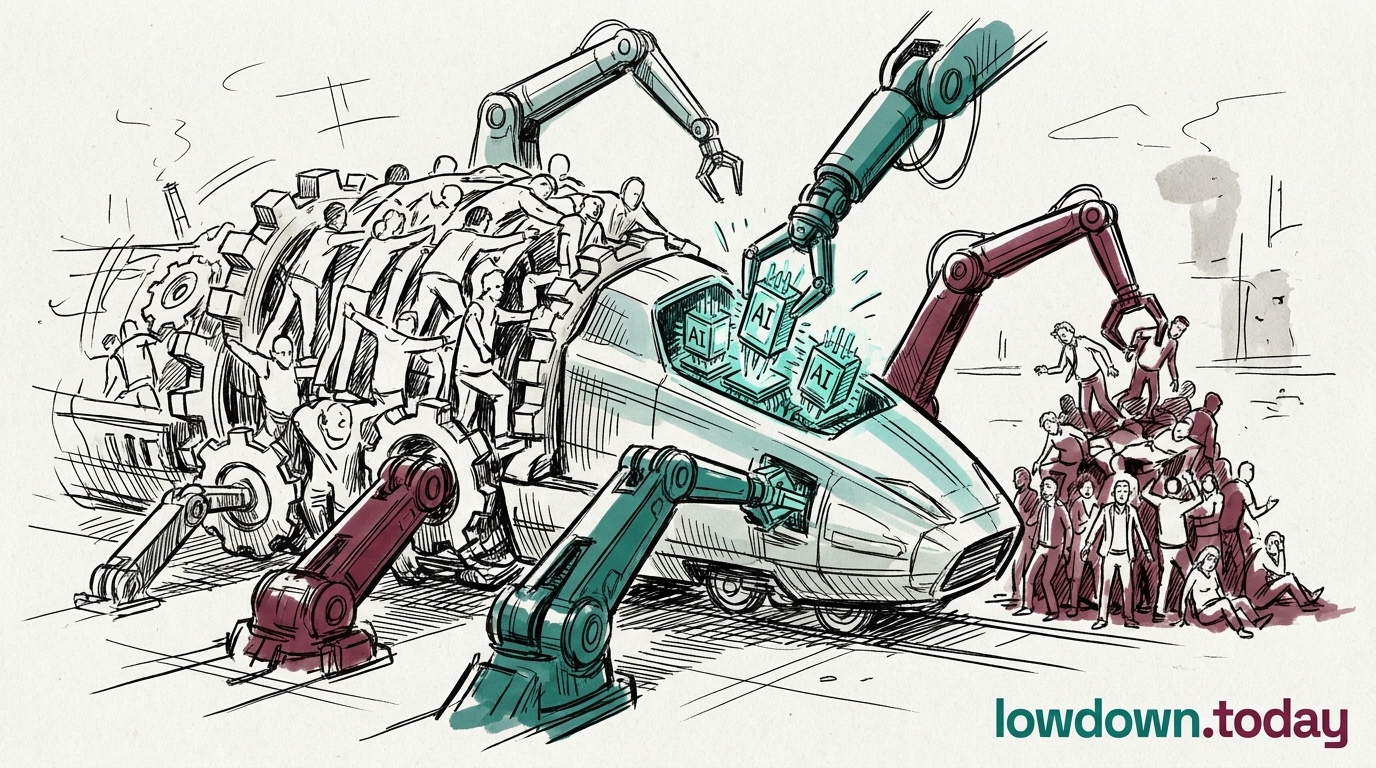
A working paper by Seyed Mahdi Hosseini Maasoum and Guy Lichtinger, drawing on 62 million US worker resumes across 285,000 firms, found that entry-level job postings fell 15% in firms adopting AI tools 1. Senior roles remained flat. The decline is driven by slower hiring, not increased firing. Companies are not sacking juniors. They are simply not replacing them.

This confirms the Federal Reserve Bank of Dallas finding that employment losses concentrate among workers under 25 through collapsed job-finding rates . In three to five years, the juniors never hired will not exist as mid-career professionals. Companies consuming this seed corn face a structural senior talent shortage they are not accounting for.

Deep Analysis

In plain English

A study that looked at the hiring records of 285,000 American companies found something specific: firms that adopted AI tools reduced their entry-level job postings by 15%, while leaving senior positions largely unchanged. The companies are not firing junior workers. They are simply not replacing them when they leave, and not hiring new ones when the workload grows. AI is doing what those jobs used to do. The problem with this is that entry-level jobs are where people learn. In five years, the engineers and analysts who should be reaching mid-career expertise will not exist, because they were never hired as juniors. Companies are borrowing from their own future talent supply.

Deep Analysis
Root Causes

Large language models trained on code, documentation, and analysis outputs can now perform the most common entry-level tasks in software development, data analysis, and content production. These are the same tasks that have historically served as on-the-job training for junior professionals. Companies discover they can sustain output without hiring juniors, not because they have made a long-term workforce planning decision, but because immediate productivity works without them.

The quarterly earnings pressure on public companies creates a structural incentive to reduce headcount costs in the near term without accounting for the loss of future talent pipeline. CFOs optimising for 2026 margins are not being measured on whether they have a senior engineer cohort in 2031. The time horizon mismatch between quarterly reporting and multi-year talent pipeline effects is a core driver.

What could happen next?
  • If entry-level hiring in AI-adopting firms remains suppressed for 3-5 years, the mid-career professional cohort of 2029-2031 will be structurally smaller, driving a senior talent shortage that companies are not currently accounting for in workforce planning.

  • Youth unemployment will rise in professional and technical occupations as entry-level roles contract, compounding the 18-24 unemployment trend already visible in UK data (14.5%) and US Federal Reserve Bank of Dallas research.

First Reported In

Update #4 · AI leads US layoffs as cuts go uncounted

Harvard Business Review· 4 Apr 2026
Read original
Different Perspectives
UK financial regulators (BoE FPC / FCA)
The Bank of England's April FPC directive on agentic AI in payments was scoped around one frontier model; AISI confirmed a second model cleared the same 32-step threshold on 1 May. The supervisory architecture is one model behind the capability it was built to contain.
Indian IT sector workers (TCS, Infosys, Wipro)
TCS posted its first annual revenue decline in the modern era, Infosys shed 8,400 workers in a quarter, and Wipro hit its zero-fresher target. Western Big Tech's AI automation is cannibalising the offshored-services model that employs roughly five million Indian IT workers.
Chinese workers (Hangzhou and Beijing plaintiffs)
Workers Zhou and Liu won cases that established a two-court doctrinal chain: AI adoption is the employer's deliberate strategy, placing the cost of displacement on the employer rather than the worker. Any Chinese employee facing AI-driven dismissal now has a citable legal route that American, British, and European counterparts do not.
Chinese government, courts, and domestic employers
The Hangzhou rulings were released on Workers' Day eve alongside the Ministry of Human Resources' recognition of 42 new AI occupations. Domestic firms now face mandatory retraining obligations; the Orgvue estimate of 8-14 months added to displacement timelines will feature in employer compliance briefings throughout 2026.
EU regulators and European Parliament
The second Digital Omnibus trilogue collapsed without agreement on 28 April; the third is scheduled for 13 May with the binding employer AI-literacy obligation still contested. Brussels is arguing over a non-binding encouragement clause while Beijing's courts have already bound employers.
US legislators (Warner, Rounds, Hawley, Sanders)
Warner and Rounds produced the Economy of the Future Commission Act, the most concrete federal vehicle still moving, endorsed by the companies it would notionally regulate. The Sanders-AOC moratorium was killed by Democratic senators; the Hawley-Warner disclosure bill remains in committee with no floor date.
