Skip to content
You can now search across every topic, entity and event.What's new
AI: Jobs, Power & Money
10APR

Two thirds of CEOs freeze hiring

1 min read
16:54UTC

The executives who control $19 trillion in assets are not planning to hire.

EconomicAssessed
Key takeaway

Two thirds of major CEOs plan to freeze or cut hiring for the rest of 2026.

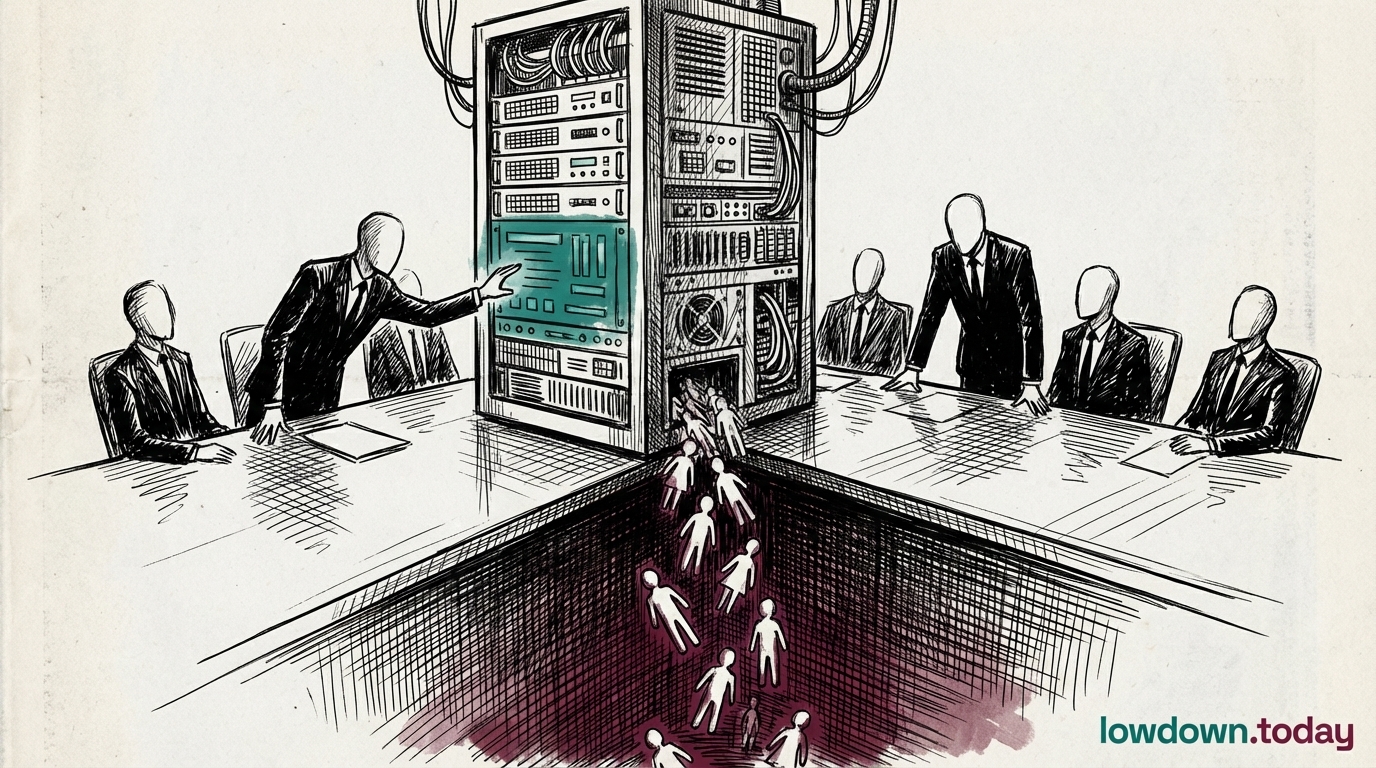
A Fortune survey of more than 350 public-company CEOs managing $19 trillion in combined assets found that 66% plan to freeze or cut hiring through the rest of 2026 1. The figure aligns with the Atlanta Fed projection of 502,000 AI-attributed cuts , translating executive intention into corporate consensus.

Some 53% of investors expect AI returns within six months. Yet 84% of CEOs acknowledge meaningful returns require multiple years. Firms are cutting the HR and middle-management roles needed to define future jobs and redesign workflows, stripping out the supervisory capacity that managed previous technology transitions.

Deep Analysis

In plain English

Fortune magazine surveyed more than 350 of the largest listed company bosses in the US, representing $19 trillion in total company value. Two thirds of them said they planned to freeze or cut hiring for the rest of 2026. The survey also found a contradiction: investors expect AI to pay back its costs within six months, but the chief executives themselves know that meaningful returns take several years. Companies are cutting jobs now based on AI promises that most of them acknowledge will not materialise for years. They are also cutting the HR and management roles that would normally plan what jobs look like after the transition. That capacity is gone, making it harder to redesign work when the AI tools eventually deliver.

What could happen next?
  • The 66% hiring freeze, if sustained through Q4 2026, will reduce the absolute number of job openings in the US by a material amount, extending reemployment timelines and compressing wage growth across white-collar sectors.

First Reported In

Update #4 · AI leads US layoffs as cuts go uncounted

Fox News / Axios / Al Jazeera· 4 Apr 2026
Read original
Different Perspectives
Office for National Statistics
Deferred its Transformed Labour Force Survey beyond November 2027 and disclosed a May 2026 telephone-collection failure. The ONS carries no AI-attribution layer at all, so Britain sits outside this month's cohort of measuring states by its own admission.
Uber India, Swiggy, Zomato and Urban Company
Named as respondents after the Karnataka High Court extended the interim welfare-fee deposit arrangement under the state's gig-worker welfare law to Uber India on 28 July, joining the other platforms already under the same order. The companies are contesting the underlying law while complying with the interim deposit terms.
Kenya State Department for ICT and the Digital Economy
Its draft AI policy, open for consultation to 4 August, proposes a pay floor for data-annotation work, where Kenyan annotators earn $1.46 to $3.74 an hour against $21 to $27 in the US, on figures relayed by the trade outlet WeeTracker. Kenya is legislating on AI labour even though the World Bank rates it among the least exposed economies.
ARAN and Italian public-sector unions
Signed the CCNL Funzioni Centrali 2025-2027 on 6 August, the first Italian national contract with a dedicated AI Title, barring fully automated employment decisions without meaningful human intervention and requiring advance union notice of AI deployment. The unions secured this through bargaining rather than waiting for legislation.
US employers reporting to Challenger, Gray & Christmas
Named artificial intelligence as the leading stated cause of job cuts for a fifth consecutive month in July, at 33% of that month's total, even as the overall cut count fell 27%. Employers kept citing AI as the reason even as scrutiny of the attribution rose.
Bank for International Settlements
Bulletin 130 reports a 0.75 percentage point average unemployment rise across high-AIPI countries between 2023 and 2025, while its own footnote 2 states the index is strongly correlated with employment shares in AI-exposed sectors it is used to predict. The bulletin calls the productivity payoff uncertain and uneven.