Skip to content
You can now search across every topic, entity and event.What's new
AI: Jobs, Power & Money
17JUL

Salesforce down 32% for not firing

3 min read
14:01UTC

Marc Benioff told investors on 27 May that Salesforce headcount has stayed near 83,000 and 'mostly flat for two years', adding 'we are not hiring more engineers' as Agentforce crossed $1.2 billion in recurring revenue.

EconomicDeveloping
Key takeaway

Salesforce trades at a 32% discount for not firing while running the same AI playbook as rewarded rivals.

Marc Benioff told investors on 27 May that Salesforce headcount has stayed near 83,000 and 'mostly flat for two years', adding 'we are not hiring more engineers' 1. Agentforce, Salesforce's AI agent product, crossed $1.2 billion in annual recurring revenue (ARR, the run-rate of subscription income), up from the $800 million reported in late April . Days later Aneel Bhusri, chief executive of Workday, said he would 'keep headcount as close to flat as possible' at roughly 20,800 staff, citing his own AI tools 2.

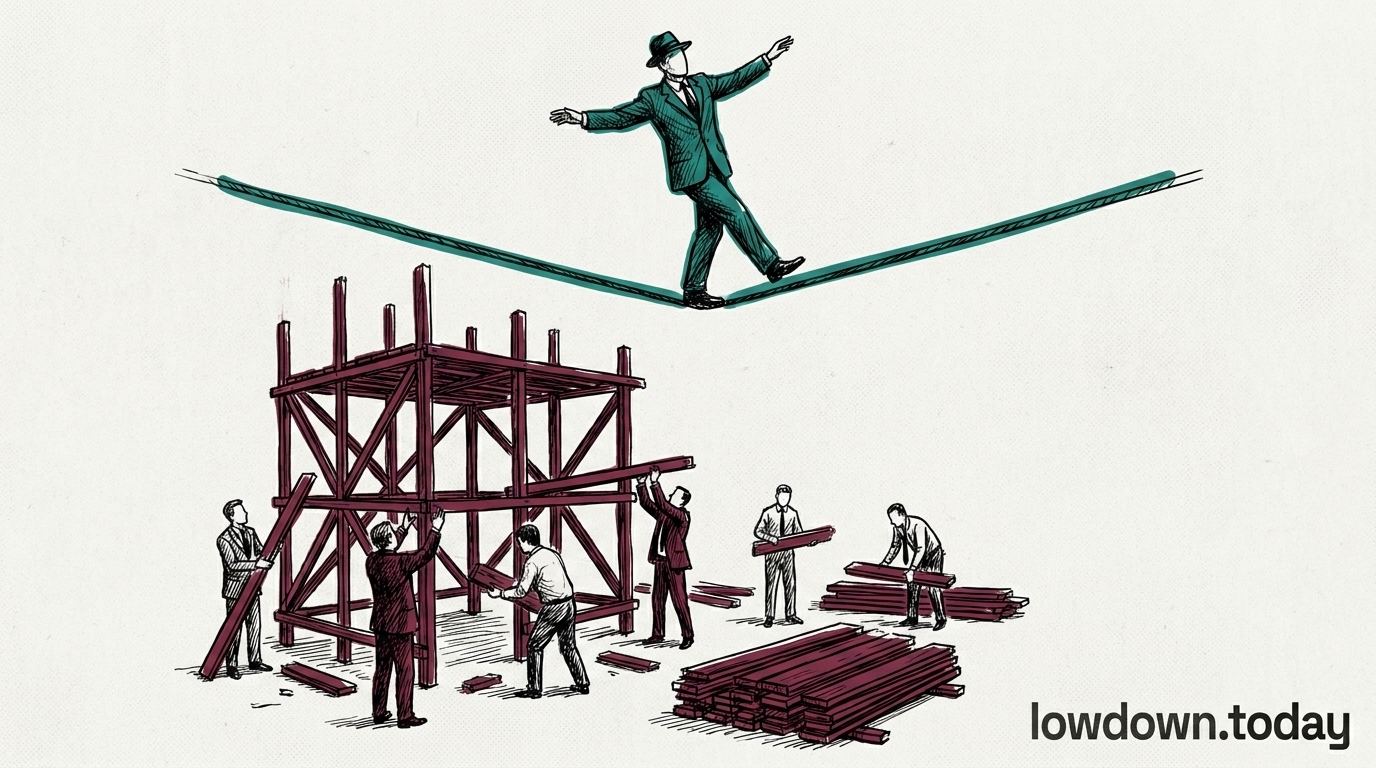
The market reaction split the field along a single line. Cloudflare was rewarded after cutting 1,100 jobs on record revenue , and CBOE hit a record share price the day it cut 20% of staff . Salesforce, running the same AI playbook but declining to fire, sits down 32% for 2026. Investors appear to price declared cuts as a discipline signal and efficiency-without-firing as weakness.

That read deserves a caveat stated plainly. Salesforce's 32% drop may be ordinary software-sector multiple compression from rates and a growth scare, not a specific penalty for refusing to fire. Treat this as an emerging market signal, not a proven law. The direction holds across independent first-party evidence: Benioff's own quote, Bhusri's flat-headcount pledge, and the fact that only one major firm in the late-May cluster is still growing staff.


Deep Analysis

In plain English

Salesforce and Workday are two of the biggest companies that make software used by businesses worldwide. Both said in the same week that they are not planning to hire more staff, even though their businesses are growing. Normally, a growing company hires more people. But both said AI tools can do much of the work new hires would have done. Salesforce's AI product alone is now earning more than $1 billion a year. The stock market punished Salesforce for this choice, dropping its share price by 32% so far in 2026. Investors preferred companies that went further and actually cut staff, which reduces costs more visibly. The tension: holding headcount flat is a bet that AI will eventually deliver productivity that investors can see in profit margins.

Deep Analysis
Root Causes

Agentforce crossing $1.2 billion ARR means AI agent revenue now offsets the marginal cost of roughly 5,000 to 7,000 software engineers at Salesforce's salary band. The economic logic to freeze hiring does not require a board decision: it follows automatically from the unit economics once AI agent output exceeds human marginal cost per task.

A measurement lag drives the market reward asymmetry. Outright cuts show in the next quarter's payroll line, giving investors a concrete figure. Salesforce's flat headcount does not appear in margins for a full fiscal year, so Wall Street prices the certainty of cash it can see over the strategy it cannot yet measure.

Escalation

The flat-headcount stance is stable in the short term but structurally under pressure: if competitors who cut actively outperform on margins, Salesforce and Workday face board-level pressure to follow. The 32% share decline is a leading indicator of that pressure.

What could happen next?
  • Precedent

    Two of the five largest enterprise software companies by market cap have formalised flat-headcount-as-policy; smaller software companies will treat this as permission to do the same without announcing cuts.

    Short term · Assessed
  • Risk

    Graduate hiring in enterprise software collapses without any WARN Act trigger, since no existing role is eliminated.

    Medium term · Reported
  • Consequence

    Market pressure on Salesforce (down 32%) may force active cuts within two to three earnings cycles, converting a flat-headcount posture into an outright reduction.

    Medium term · Reported
First Reported In

Update #11 · Markets now reward the cut, punish the freeze

Motley Fool· 1 Jun 2026
Read original
Different Perspectives
Stanford's 'We Must Act Now' signatories
More than 200 academics, including 16 Nobel laureates, published a 13 July letter warning of AI-driven labour disruption, citing Daron Acemoglu's NBER estimate that AI's total factor productivity gain stays under 0.66% over ten years. The letter's own cited economics sit well below Goldman Sachs Research's 1.5-percentage-point estimate published the same week.
Germany / the Bundesrat
Germany's Bundesrat acted on the EU AI Act's employment provisions on 10 July, more than a year ahead of the Act's 2 December 2027 enforcement deadline. Germany is moving on statutory AI-employment disclosure while the US Congress and Federal Reserve have no equivalent instrument.
Indian IT services sector (TCS, HCLTech, Wipro)
TCS cut 19,271 roles and HCLTech cut 3,292 in the same reporting week that Wipro's headcount rose by 888 under its own zero-fresher-hiring pledge for FY27. The divergence shows attrition, not layoffs, is how India's outsourcers absorb AI-driven project compression while their net headcount numbers stay ambiguous.
Federal Reserve
Federal Reserve
Barr said on 14 July there is little evidence of AI displacement, citing a 43-versus-10 adoption gap by education; Cook said the next day the dire predictions have not come to fruition, her text carrying none of the bond-spread language she used in May. The Fed reads AI's labour effect through national aggregates, where four banks' cuts remain statistically invisible.
Barclays
Barclays
Barclays economist Pooja Sriram flagged a 28,000-a-month bleed in finance and information roles the same week Microsoft disputed that AI drove its own 4,800 cuts. The bank treats Challenger's AI-attribution share as a lagging indicator against faster erosion visible in raw labour-market data.
European Commission
European Commission
Brussels deferred the Digital Omnibus's Annex III employment-compliance deadline from 2 August 2026 to December 2027, even as California advanced three binding AI-hiring bills the same week. The 17-month delay leaves EU workers without the algorithmic-hiring safeguards the regulation already promises.



