Skip to content
Foundations rebuilt, and the first new thing is here: search across every topic, entity, and event.Try search
2026 FIFA World Cup
11JUN

Protesters target Azteca reopening

3 min read
09:02UTC

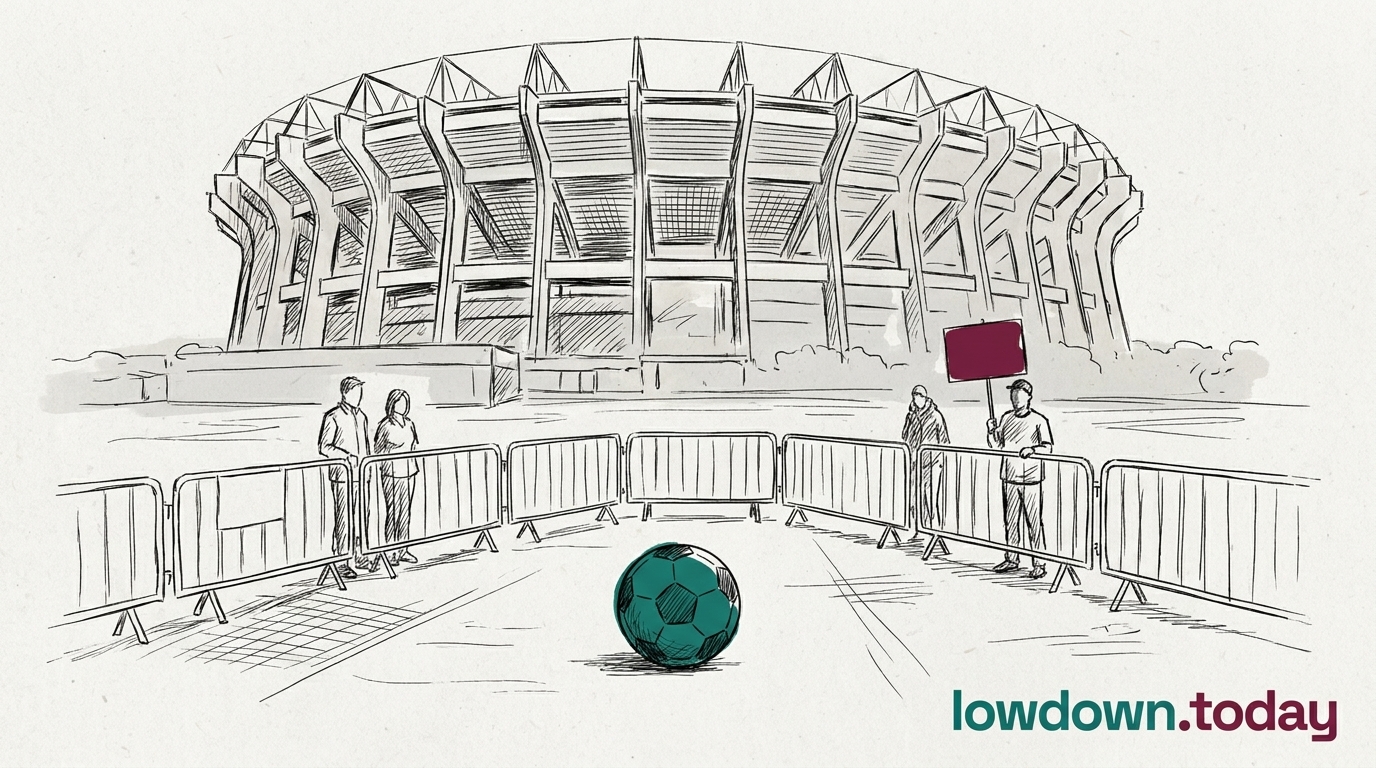
The Neighbourhood Assembly Against Megaprojects announced protests for 28 March at Estadio Azteca, citing water scarcity, police harassment of demonstrators, and privatisation linked to the renovation.

SportDeveloping
Key takeaway

The 28 March demonstration introduces a civilian protest management challenge to Mexico's World Cup security framework, with the authorities' response setting a precedent for every subsequent match at Azteca.

The Neighbourhood Assembly Against Megaprojects has called protests for 28 March at Estadio Azteca, timed to coincide with the MexicoPortugal friendly that marks the stadium's reopening after months of renovation 1. The group cites three grievances: water scarcity around the stadium, police harassment of demonstrators, and privatisation linked to the renovation works. Organisers describe a newly built "Water Garden" near the venue as a tool to suppress protests over water access 2.

The reopening resolves one source of uncertainty — owner Emilio Azcárraga had said he was "not sure" renovation deadlines would be met , and round-the-clock construction continued through March. Azteca passed its final audio and video tests on 23 March, with 2,200 square metres of LED screens and 1,200 connectivity antennas confirmed operational 3. The stadium is the only venue to host three World Cup editions — 1970, 1986 and 2026 — and FIFA takes full possession in early May.

Mexico City's aquifer supplies roughly 70 per cent of the capital's water and has been over-extracted for decades, producing subsidence that reduces supply and damages infrastructure. Neighbourhoods around Azteca in the southern borough of Coyoacán have experienced intermittent water access for years. For residents, the stadium renovation consumed public resources and political attention while their access remained unreliable.

President Sheinbaum's Plan Kukulkan deployed up to 100,000 security forces across Mexico City, Guadalajara and Monterrey, with anti-drone systems and explosives-detection dogs. The apparatus was designed around the cartel threat exposed by the violence that followed El Mencho's killing on 22 February . Whether authorities apply the same posture to water-rights demonstrators on 28 March will establish how civilian protest is managed at Mexican tournament venues through July.


Deep Analysis

In plain English

Residents near Estadio Azteca say the stadium renovation has worsened their access to water — already a serious problem in a city that struggles to supply its population reliably. They plan to demonstrate at the stadium's 28 March reopening. Organisers claim that a decorative 'Water Garden' built near the venue was constructed specifically to make it appear that their water concerns had been addressed, rather than to actually solve them. The protest covers three distinct grievances: water access, alleged police harassment of previous demonstrators, and the privatisation of public resources through the renovation process.

Deep Analysis
Synthesis

The Water Garden tactic exemplifies a recurring mega-event governance pattern: micro-scale amenity projects deployed as social-licence instruments rather than genuine redress mechanisms. Combined with FIFA's documented retreat from anti-discrimination and human rights commitments — visible across this tournament's planning cycle — the episode suggests a governing body that has systematically narrowed its community-accountability obligations in proportion to its growing commercial leverage over host cities.

Root Causes

Mexico City draws approximately 70% of its water from an over-exploited aquifer, causing subsidence of up to 50 centimetres per year in some districts. Stadium renovation increases impermeable surface area, reducing local groundwater recharge in an already stressed system. The structural water deficit predates the Azteca renovation by decades; the protest channels accumulated systemic grievance onto a highly visible, internationally covered target.

Escalation

Escalation risk is moderate but bounded. The Neighbourhood Assembly's Water Garden framing indicates prior engagement with authorities — this is an organised coalition, not a spontaneous mobilisation. However, Mexico City has a documented history of heavy-handed responses to infrastructure protests, notably the 2021 Metro Line 12 safety demonstrations. Any use of force on 28 March would immediately amplify existing international criticism of the tournament's human rights posture.

What could happen next?
  • Meaning

    Short term · Assessed
  • Meaning

    Short term · Assessed
  • Meaning

    Short term · Assessed
First Reported In

Update #2 · Fans file EU antitrust case against FIFA

The Times· 24 Mar 2026
Read original
Causes and effects
This Event
Protesters target Azteca reopening
Organised opposition to the Azteca renovation connects FIFA's infrastructure demands to Mexico City's water crisis, and the 28 March protest tests how authorities distinguish between security threats and civilian dissent under Plan Kukulkan.
Different Perspectives
FIFA
FIFA
FIFA's 48-team format, projecting $13.1 billion in 2026-cycle revenue against $7.5 billion for 2019-2022, opened on 11 June despite simultaneous legal, labour and security crises. Expanding to 48 sides structurally reduced the stakes of individual group results, which is both its commercial logic and the mechanism that let the build-up machinery run without cancellation.
Brazil
Brazil
Brazil open Group C against Morocco on 13 June missing Neymar, Rodrygo, Estevao and Militao; Ancelotti expressed no regrets carrying an injured Neymar and targets the Haiti fixture on 20 June for his return. Morocco's full-strength XI is rated higher by performance index than Brazil's depleted opener lineup, making this the most awkward first fixture any pre-tournament favourite has drawn.
United States
United States
The co-host avoided its most damaging opening image when UNITE HERE Local 11 reached a tentative deal with Legends on 9 June, pulling a threatened strike off the table days before Pochettino's 4-3-3 faces Paraguay. The agreement requires a ratification vote this week; rejection returns the threat before the first US match.
South Africa
South Africa
Bafana Bafana returned to the World Cup after a 16-year absence in Hugo Broos's final tournament before retirement, arriving at the Azteca opener with a counter-attacking shape to exploit possession-heavy hosts at altitude. Broos told his players to silence the Mexican crowd; his pace through Appollis and Mofokeng sets the tone for Group A.
Mexico
Mexico
Mexico opened the tournament at home on 11 June carrying a 0W-5L-2D opener record and a sold-out Azteca, while the official Zocalo fan zone was occupied by teachers and families of the disappeared on the same morning. Sheinbaum's offer of 18 alternative venues rather than a clearance order reflects her calculation that force produces worse headlines than co-existence.
Norwegian Football Federation
NFF president Lise Klaveness sent a letter of support backing FairSquare's Article 15 ethics complaint against Infantino, explicitly noting Norway was acting alone as a deliberate signal. The filing converted an external NGO campaign into the first internal federation action against the FIFA president, arriving in the same fortnight as Platini's Paris criminal complaint.


