Skip to content
You can now search across every topic, entity and event.What's new
2026 FIFA World Cup
3JUN

Azteca owner unsure stadium is ready

3 min read
08:50UTC

Workers are fitting seats and roof panels around the clock, but the stadium's owner cannot guarantee the 28 March deadline. The World Cup's opening match hangs on the outcome.

SportDeveloping
Key takeaway

Private ownership of the Azteca removes the government accountability that forced Brazil's 2014 venues to finish.

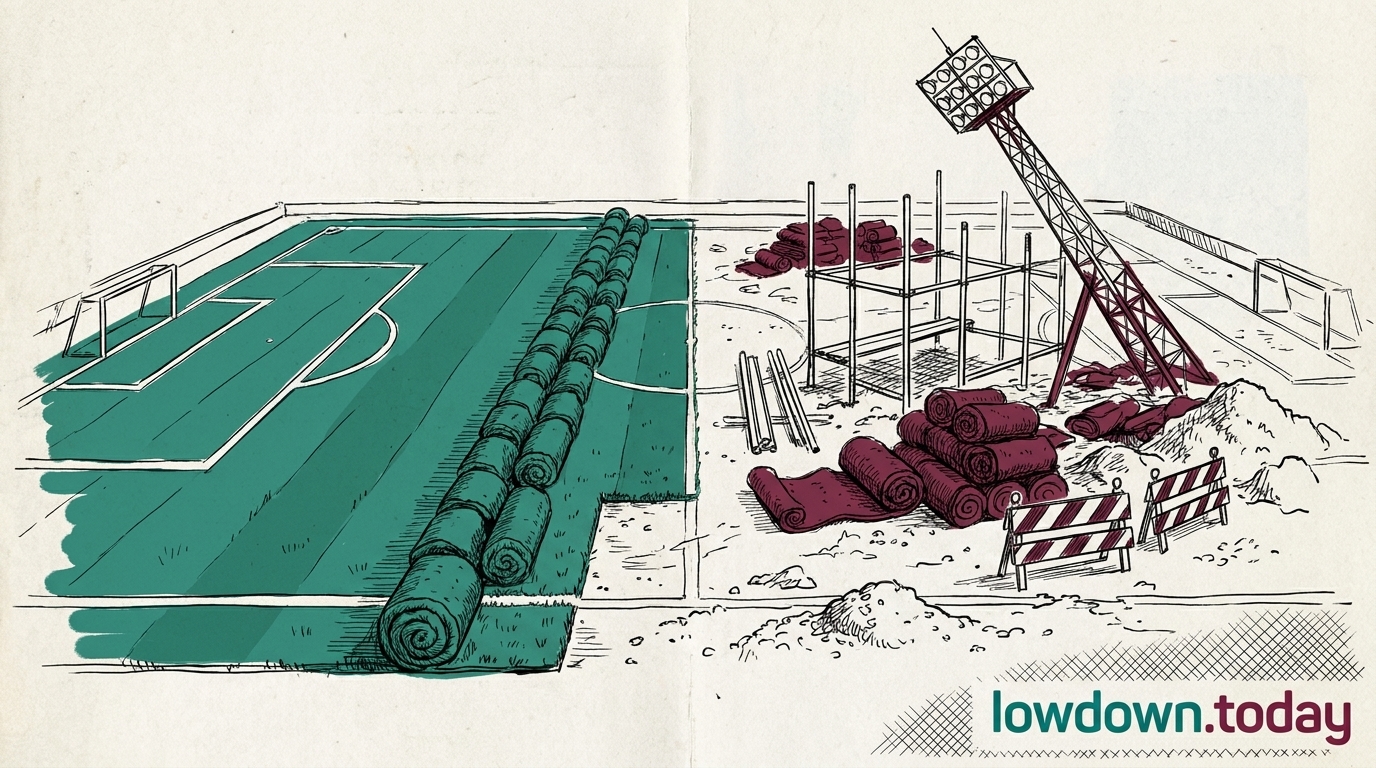
Estadio Azteca is scheduled to reopen on 28 March with a MexicoPortugal friendly, but the stadium's owner, Emilio Azcárraga, has said publicly he is "not sure" the renovation deadline will be met 1. Workers are fitting seats and installing the new red membrane roof around the clock. As of early March, cranes and rubble were still visible at the site 2.

Azteca is one of two stadiums in the world to have hosted two World Cup finals — Pelé's Brazil lifted the Jules Rimet trophy there in 1970, and Maradona's Argentina won in 1986. The renovation has been among the most ambitious in the tournament's construction programme: the concrete bowl, built in 1966, required structural reinforcement alongside the cosmetic overhaul. FIFA takes full possession of all tournament stadiums in early May, leaving roughly five weeks between the planned reopening and the handover.

The consequence of failure is specific. The 11 June opening match — Mexico vs South Africa — could be relocated. StadiumDB assessed the opening match as "at risk" as early as February 3. Moving that fixture from Azteca would strip Mexico of its centrepiece hosting moment in a tournament it fought to co-host, and it would force FIFA to find an alternative venue with barely a month's notice.

Azteca's problem is distinct from the surface-conversion challenges facing eight US venues, where artificial pitches must be replaced with Hybrid grass after Copa América 2024 failures that left players describing conditions as "like a trampoline." But both feed the same operational question facing a tournament spread across 16 venues in three countries: whether the physical infrastructure will be ready by 11 June. Mexico's stadium is a construction timeline problem; America's are agronomic ones. Neither has margin for further delay.


Deep Analysis

In plain English

The Azteca is the world's most storied football stadium — it hosted World Cup finals in both 1970 and 1986. After a major renovation, it was supposed to reopen on 28 March for a test match against Portugal. But even the stadium's owner admits he is not certain the work will be done in time. FIFA takes formal possession of all stadiums in early May. If the Azteca is still incomplete at that point, the 11 June opening match — Mexico vs South Africa — may have to move to another city, which would be unprecedented in World Cup history.

Deep Analysis
Synthesis

The Azteca situation and the cartel security crisis in Guadalajara represent Mexico's two simultaneous hosting vulnerabilities — one physical infrastructure, one public order — both converging in June 2026. A venue relocation would exceed the security crisis in reputational damage, though the security risk is more consequential in human terms.

Root Causes

The Azteca is owned by TelevisaUnivision, Mexico's dominant media conglomerate, rather than by a public authority. Private ownership means FIFA has limited contractual leverage to compel completion on its timeline.

Government intervention to override a private contractor raises legal and political complications that are absent in publicly owned venues — the model used by every other World Cup host city in 2026.

Escalation

The 28 March friendly functions as a public stress-test with only six weeks until FIFA's possession deadline. A failed or partial reopening would trigger immediate FIFA contingency planning.

Mexican authorities would then face pressure to intervene with the private owner — a politically awkward dynamic given Sheinbaum's concurrent cartel security obligations in Guadalajara.

What could happen next?
  • Risk

    A failed 28 March reopening gives FIFA grounds to invoke contingency relocation before its May possession date, stripping Mexico City of its opening match.

    Immediate · Assessed
  • Precedent

    Relocating a World Cup opening match would be unprecedented, permanently marking the 2026 tournament as logistically troubled from day one.

    Short term · Assessed
  • Consequence

    Mexico City's hospitality sector faces stranded revenue if the opening match relocates on short notice, with limited recourse against a private venue owner.

    Short term · Suggested
  • Risk

    TelevisaUnivision's simultaneous role as venue owner and World Cup broadcaster creates a potential conflict of interest if the company downplays readiness concerns in its own media coverage.

    Immediate · Suggested
First Reported In

Update #1 · Iran splits on World Cup boycott

Washington Times· 22 Mar 2026
Read original
Different Perspectives
FairSquare
FairSquare
FairSquare has referred Gianni Infantino to the International Olympic Committee's Ethics Commission over FIFA's political-neutrality rules, using the IOC's authority as a lever FIFA's own president-appointed Ethics Committee cannot provide against itself. Trump's on-podium presence at the final, with Infantino visibly moving him aside, becomes an exhibit for that complaint rather than an argument for it.
Fiscalía General de Justicia de la Ciudad de México
Mexico City's prosecutor has opened four homicide investigations into the crush that killed Emilín Yumith Téllez, Joshami Iraís Robles, Leonardo Ruiz and an unidentified fourth victim at the Ángel de la Independencia, three of them classified as negligent homicide. Three weeks after the final whistle, no determination has been reached.
FIFA / Gianni Infantino
Infantino called the 48-team format "100 percent" right and confirmed FIFA's committees will examine expanding to 64 teams for 2030, on the strength of a goal count FIFA has never published as one audited total for all 104 matches. FIFA has issued no statement on the Malvinas banner review or the Bellingham file since deferring both past the final.
Claudio Tapia / AFA
Claudio Tapia / AFA
AFA president Claudio Tapia told the squad to stand tall after the final, and Argentina's own press did not contest the result, framing the defeat around the possible end of the Messi era rather than any complaint about the match itself. Messi ruled out only the 2030 tournament, leaving his Copa America future unaddressed.
Luis de la Fuente / Spain
Luis de la Fuente nominated Rodri for the Ballon d'Or after the final, framing a title built on one goal conceded as proof a team can win through control rather than scoring. His squad carried eight Barcelona players and none from Real Madrid, the first time that has happened in the federation's history.
Football data analysts
A 6-4 between exhausted, eliminated sides making four half-time changes each reads as collapsed defensive intensity, not proof of a better format. The number that actually tests the 48-team expansion is the per-match rate, roughly 2.9 against 2022's 2.69, not the raw 300-goal aggregate padded by forty extra fixtures.


