X10D
Skydio's autonomous small UAS selected by the US Army for a $52 million contract covering 2,500 units at $20,800 each, the largest single-vendor sUAS order in Army history.
Last refreshed: 25 June 2026 · Appears in 1 active topic
Is the X10D's $20,800 price a market-maker or a loss-leader that cannot scale?
Timeline for X10D
Mentioned in: Minneapolis kills a free Skydio trial
Drones: Industry & DefenceSelected as US Army small-UAS platform at $20,800 per unit
Drones: Industry & Defence: Skydio sells the Army drones at $20,800Background
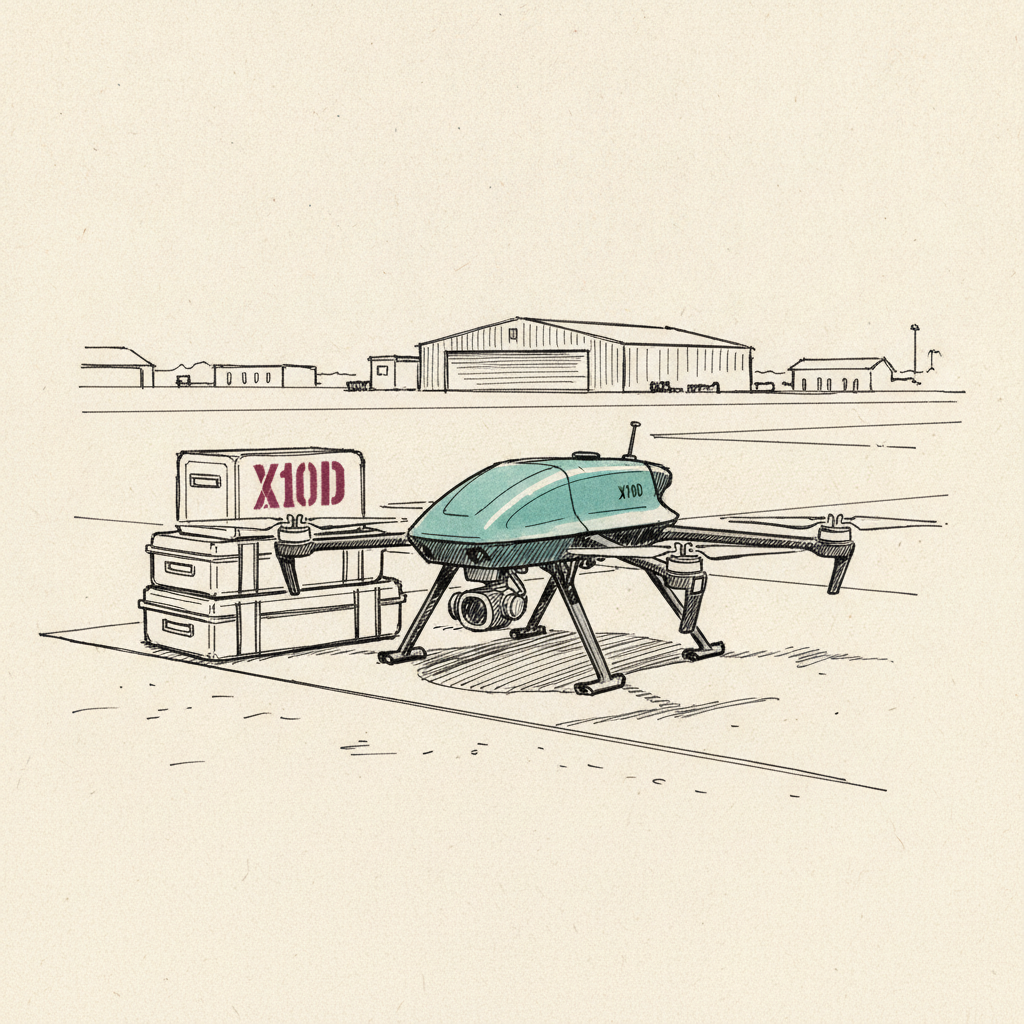
The X10D is Skydio's Group 2-class tactical reconnaissance drone designed for platoon-level ISR in GPS-denied and electronically contested environments. In March 2026 the US Army placed an order worth $52 million for 2,500 units at approximately $20,800 each, the largest single-vendor tactical small-UAS order in Army history, moving from bid to award in under 72 hours . The X10D uses onboard navigation cameras to map terrain in real time, enabling autonomous flight without GPS. It carries high-resolution visual and thermal sensors for day/night operations, a multiband radio for connectivity under electronic warfare, and undergoes 550 acceptance checkpoints before delivery. Each unit is assembled and tested at Skydio's factory in Hayward, California, with a reported build time of approximately nine minutes.
Skydio was founded in 2014 and is the dominant US-made small-drone manufacturer following the FCC's ban on Chinese drones from US government networks. The X10D is the successor to the earlier X2 series and represents Skydio's shift into military Group 2 territory after establishing itself in public-safety and commercial markets. The $3.5 billion SkyForge co-location programme committed Skydio to expanding domestic production capacity precisely to support orders at this scale .
The X10D's unit price is significant across the industry because it sets a real Army-contract benchmark for what attritable-mass reconnaissance costs. At roughly one-tenth the price of previous comparable systems, the order validates the economic model that Skydio built its SkyForge manufacturing investment around: fixed-price, high-volume, domestically produced. The contract is expected to influence allied procurement by demonstrating what US-integrated interoperability costs in practice.
What is the Skydio X10D drone used for?
How much did the US Army pay for Skydio X10D drones?
Can the Skydio X10D fly without GPS?
Where are Skydio X10D drones manufactured?

