Roland-Garros
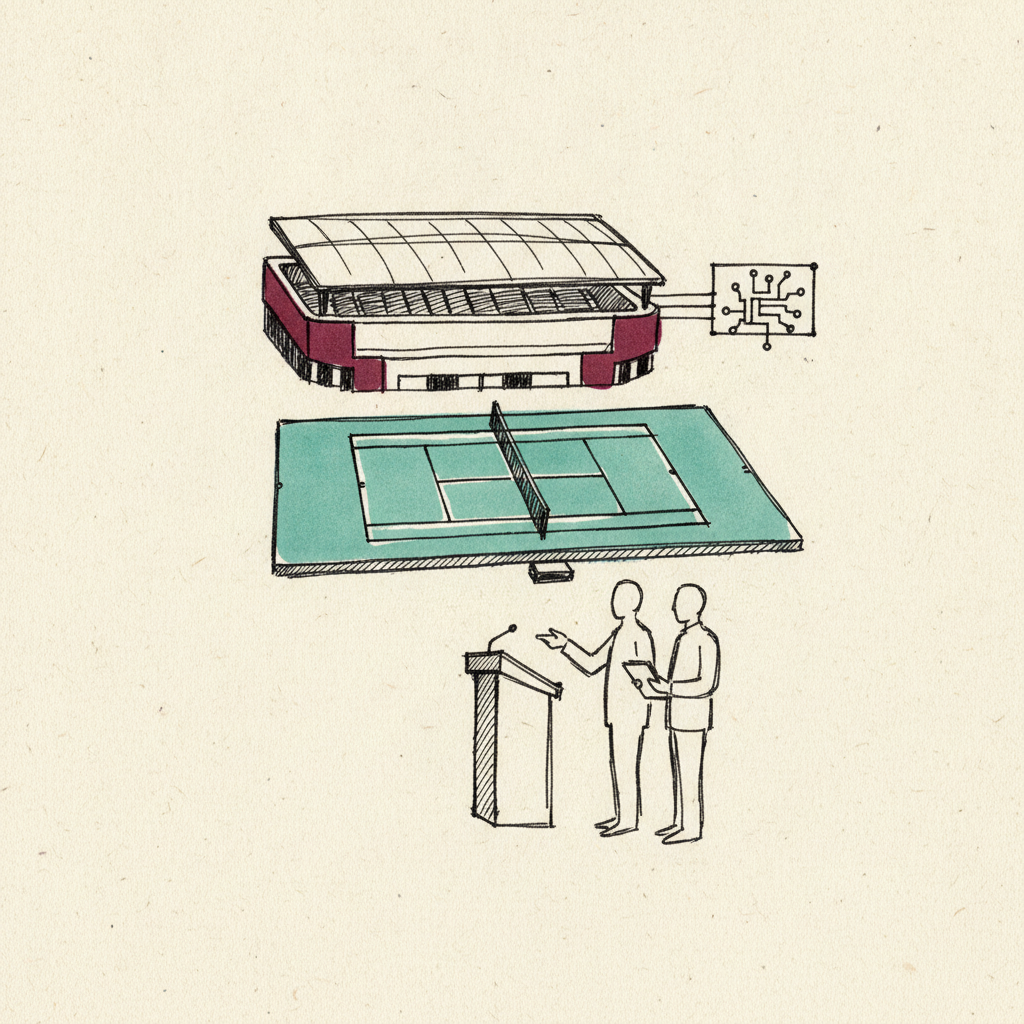
Roland-Garros is the annual French Open tennis Grand Slam tournament held in Paris; France Televisions uses it as a live AI production sandbox through its RG Lab unit.
Last refreshed: 15 July 2026 · Appears in 1 active topic
Timeline for Roland-Garros
Mentioned in: European Athletics ships labelled AI commentary
Media's AI PivotMentioned in: TwelveLabs banks $100m for video AI
Media's AI PivotHosted France Televisions' 2026 RG Lab AI production deployment
Media's AI Pivot: France TV names its AI vendorsBackground
Roland-Garros is the annual French Open tennis Grand Slam, held each May and June at the Stade Roland-Garros complex in the 16th arrondissement of Paris. One of the four major championships recognised by the International Tennis Federation, it is the sport's only Grand Slam played on clay, giving it a distinctive character that differentiates it from the grass courts of Wimbledon and the hard courts of the US and Australian Opens. The tournament draws approximately 500,000 spectators across its two-week run and is broadcast to audiences in more than 150 countries.
Beyond its sporting significance, Roland-Garros has become a documented site of AI production experimentation by French public broadcaster France Televisions, which runs an initiative called RG Lab at the tournament. In 2026 France Televisions disclosed the full AI stack it deployed during the Roland-Garros fortnight: Decart's Lucy 2.0 model for near-real-time video transformation; AI anonymisation of on-camera interviewees; 4D Gaussian Splatting volumetric video via Gracia AI; Topaz Labs remastering; agentic AI for an Android XR companion app; and live audience-chat analysis. The disclosure made France Televisions one of the few European public broadcasters to name its generative-AI vendors in a live production context.
The RG Lab case is significant because it represents the transparent, public-sector end of the spectrum: a state broadcaster openly trialling and crediting AI tools at a prestigious sports event. That contrasts with how studios such as Netflix and Lionsgate have approached the same technology in entertainment production, often without disclosure until prompted by external reporting or leaks.
What is Roland-Garros and where is it held?
What AI technology did France Televisions use at Roland-Garros 2026?
What is RG Lab at Roland-Garros?
Why is Roland-Garros important for AI in sports broadcasting?