Ajax
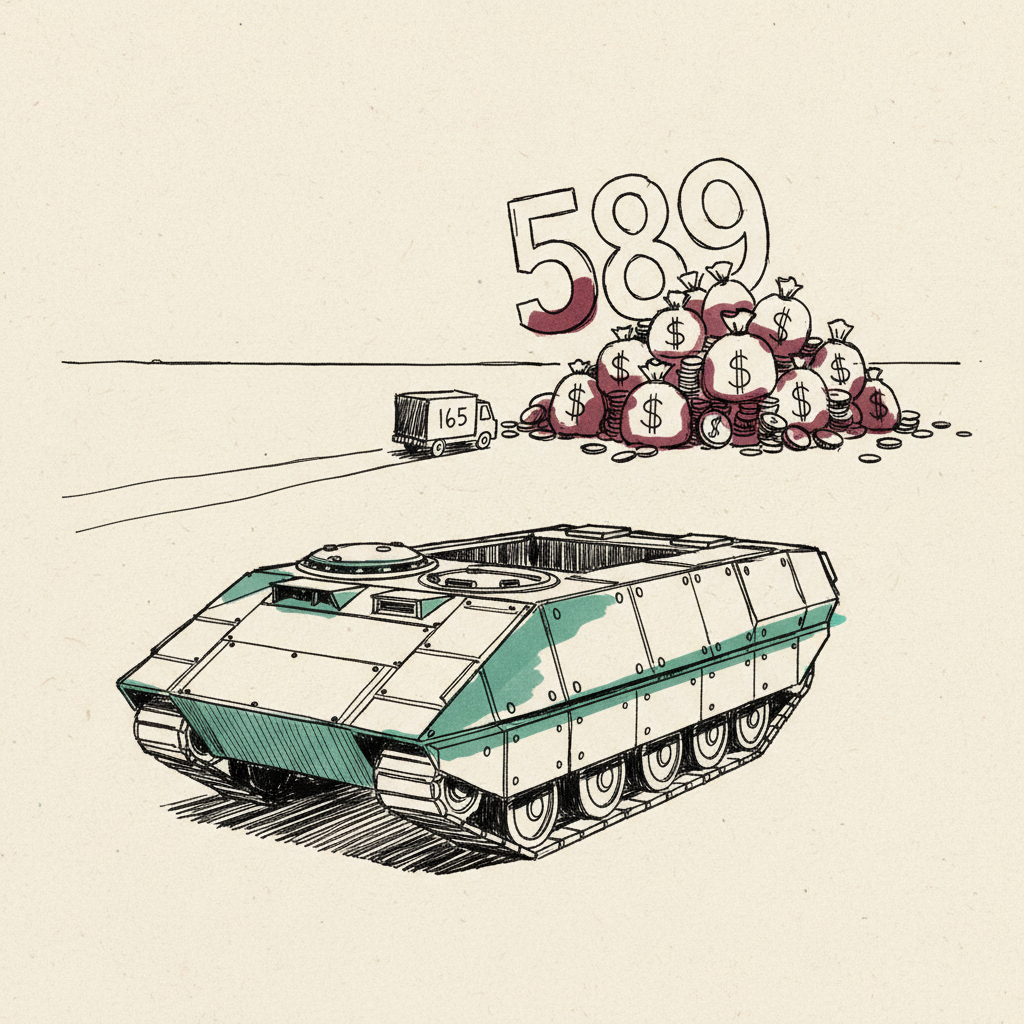
UK Army armoured fighting vehicle; £6.3bn spent, only 165 of 589 delivered after years of failures.
On 16 September 2026 General Dynamics Land Systems UK agreed with ARX Robotics UK to pair HECTOR autonomous wingmen with Ajax, a programme that had delivered 165 of its 589 vehicles for £6.3bn by April.
Last refreshed: 7 October 2026 · Appears in 3 active topics
After spending £6.3bn on Ajax, why has only a quarter of the British Army's order been delivered?
Timeline for Ajax
ARX delivers first GEREONs to Ukraine
Autonomous Systems: Land & SeaMentioned in: UK reopens War Book, hosts 30-nation Hormuz meet
Russia-Ukraine War 2026Mentioned in: ARX builds British Army robot line
Autonomous Systems: Land & SeaBackground
Ajax is a family of tracked armoured fighting vehicles built by General Dynamics UK to replace the British Army's ageing CVR(T) reconnaissance fleet, including Scimitar. The Ministry of Defence contracted 589 vehicles across six variants in 2014 for roughly £5.5bn.
Trials from around 2019 found abnormal noise and vibration that injured crews, alongside faulty sights and unstable software that kept vehicles off the road. General Dynamics and the ministry spent years disputing responsibility. Deliveries first due by 2017 were still incomplete in 2026: a CNBC report on 22 April cited £6.3bn spent against 165 of 589 vehicles delivered, while former commanders described a £28bn decade-long funding gap.
Ajax is the standard example in parliamentary debate of the gap between Britain's defence ambitions and its procurement capacity, and reviews of procurement culture, including Lord Robertson's Strategic Defence Review, cite it. The 165 vehicles delivered by April 2026 are reported operational. The programme is now also the host vehicle for the Army's first robotic-wingman pairing.
Ajax gains an uncrewed escort
On 16 September 2026 General Dynamics Land Systems UK, the vehicle's maker, agreed with ARX Robotics UK to TEAM HECTOR autonomous wingmen with Ajax. Final assembly and machining are to take place in South Wales. No quantity, price or in-service date has been published.
The pairing attaches a fast-moving robot programme to a vehicle that took more than a decade to reach the field. ARX announced a £45m British production line for its GEREON robot in April 2026, under a fast-track Army route, and delivered the first GEREONs to Ukraine on 29 September. Ajax deliveries, first due by 2017, were still incomplete. The wingman deal is the first sign of the vehicle serving as a host for uncrewed systems as well as a reconnaissance platform.
What is the British Army's Ajax vehicle?
How much has the Ajax programme cost and how many vehicles have been delivered?
Will Ajax operate with autonomous robot wingmen?
Why was the Ajax programme delayed?
