Skip to content
You can now search across every topic, entity and event.What's new
US Midterms 2026
14JUN

Generic ballot hits D+5.8, first this cycle

3 min read
11:52UTC

Silver Bulletin's generic-ballot average reached D+5.8 on Tuesday 28 April, the first reading at that level this cycle and a 9.1-point cumulative swing from R+3.3 in January 2025.

PoliticsDeveloping
Key takeaway

A 9.1-point shift across 16 months is the structural signal; what matters is whether it holds through Labor Day.

Silver Bulletin's generic-ballot average reached D+5.8 on Tuesday 28 April, the first reading at that level this cycle 1. The figure is an aggregate of national polls asking voters whether they plan to support a Democrat or Republican for Congress; D+5.8 means Democrats lead by 5.8 percentage points. Cumulatively, the average has swung 9.1 points from R+3.3 in January 2025, a movement that has been consistent rather than spiked.

Three completed special elections sit alongside the polling shift. The GA-14 runoff on Wednesday 8 April produced a 25-point swing toward Democrats in a Republican stronghold ; the Wisconsin Supreme Court race the same day delivered a 20-point liberal margin ; the NJ-11 result on 16 April held the safe Democratic baseline. Two of those three ran 15 to 25 points ahead of the generic ballot. That ratio is what distinguishes a noise pattern from a structural one: overperformance concentrated in competitive or Republican-leaning seats, baseline performance in safe seats.

The cumulative 9.1-point shift from January 2025 is the structural variable. A swing of that size across 16 months of polling tracks closely with the 2017-2018 cycle that preceded the Democratic 41-seat House gain. The historical analogy is imperfect because the current House map is different and the Senate map is much harder for Democrats. Counter-view from polling sceptics: generic-ballot swings of this magnitude often compress in the final two months of a campaign as the out-party's structural advantage gets priced in by national polling and as paid advertising lands. The figure that matters is not D+5.8 in April; it is whatever the average reads at Labor Day.

Deep Analysis

In plain English

A generic ballot poll asks voters: if an election were held today, would you vote for a Democrat or Republican for Congress? Nate Silver's polling aggregator, Silver Bulletin, now shows Democrats leading by 5.8 percentage points on 28 April, the highest reading this election cycle. This is a swing of 9.1 points from January 2025, when Republicans led by 3.3 points. Historically, a swing this large has produced significant House seat changes, though the precise number depends on how efficiently votes translate to seats in the districts being contested.

Deep Analysis
Root Causes

The 9.1-point swing from R+3.3 to D+5.8 is driven by two converging factors that Silver Bulletin's aggregate separates: declining Republican approval in suburban districts that were competitive in 2022-2024, and a collapse in low-income voter Republican support traceable to tariff-driven cost-of-living increases.

These factors are structurally different. Suburban decline is a longer-running trend that began in 2016 and has continued through each subsequent election. Low-income defection is a new factor tied to specific economic policy, specifically the 2025-2026 tariff regime, and is potentially reversible if tariff policy changes before November.

What could happen next?
  • Consequence

    Brookings Institution regression maps D+5.8 to 12-20 Republican seat losses in November, which would give Democrats a House majority if the top end of that range materialises on a map where Republicans currently hold 217 seats.

  • Risk

    Generic ballot compression in the final two months before an election is a documented pattern in midterm cycles. If D+5.8 compresses to D+3 or below by Labor Day, the structural advantage narrows below the seat-change threshold.

First Reported In

Update #4 · Calendar versus court

Silver Bulletin· 28 Apr 2026
Read original
Different Perspectives
EU Commission trade directorate
EU trade officials note Iowa Senate moving on Iran-war fertiliser prices confirms the cross-topic energy transmission they flagged after Gulf shocks in May. A Democratic Senate from January 2027 would restore Ways and Means leverage on tariff schedules, reducing the probability of a locked Republican trade posture through 2028.
Chatham House democracy analysts
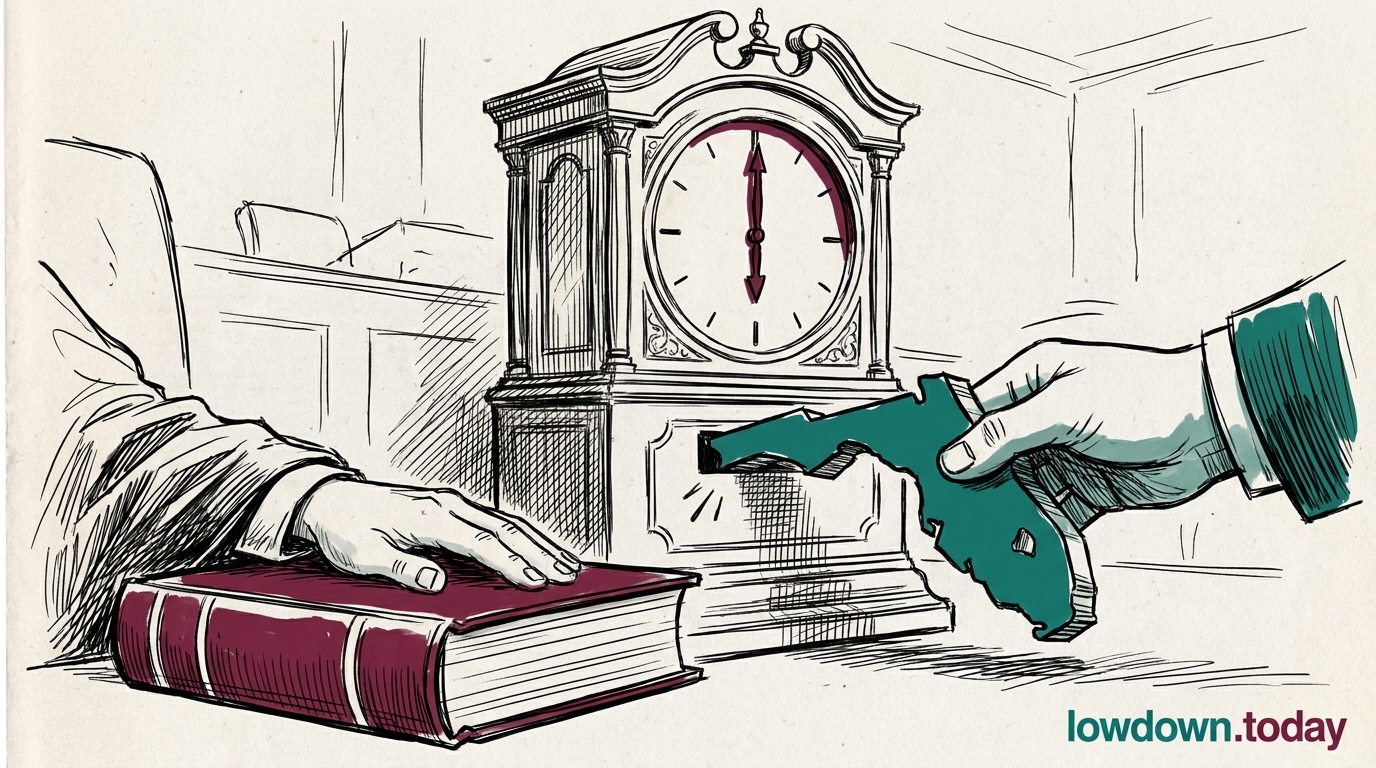
Chatham House analysts assess the Florida qualifying deadline as the point at which redistricting litigation migrated from a live 2026 variable to a post-cycle accountability mechanism; the shadow docket's 7-day Alabama reversal on 2 June and the 13 June Florida lock together confirm that judicial review now operates retrospectively rather than preventively in redistricting disputes.
V-Dem Institute
V-Dem Institute
V-Dem's electoral integrity index identifies the Callais-to-Alabama-stay-to-Florida-qualifying sequence as completing a 13-year Roberts Court rollback: Shelby County (2013) removed preclearance, Brnovich (2021) narrowed vote-denial claims, Callais removed the majority-minority mandate, and the shadow-docket reversal window now forecloses injunctive remedies within any single electoral cycle, meaning judicial review operates retrospectively rather than preventively in redistricting disputes.
Brennan Center for Justice
The Brennan Center characterises Florida's 6-1 ruling as jurisdictional avoidance achieving the same result as a merits ruling, split precisely on appointment lines: all six DeSantis appointees declined to examine his own map. The Equal Ground challenge continues at the First District Court of Appeal with no 2026 remedy available.
National Republican Senatorial Committee
The NRSC brought NRSC v. FEC because the Senate Leadership Fund's parallel-operation model cannot replicate direct candidate coordination, and the December 2025 argument signalled the conservative majority would strike caps ranging from $61,800 to $3.7M per race. A favourable ruling would let the NRSC channel unlimited funds directly through Iowa and four other live Senate campaigns.
EU Commission trade policy directorate
EU trade analysts note the D+6.9 generic ballot is the first reading this cycle making a Democratic House flip structurally plausible; a Ways and Means Committee under Democratic chairmanship after January 2027 would restore congressional leverage on tariff schedules, reducing the probability of locked Republican tariff posture through 2028.