Skip to content
You can now search across every topic, entity and event.What's new
Iran Conflict 2026
23AUG

Hawley signals AUMF at 60-day mark

3 min read
19:02UTC

Senator Josh Hawley told reporters on 15 April that Congress should vote on a military authorisation at the end of 60 days of Iran hostilities.

ConflictDeveloping
Key takeaway

The route to a signed Iran instrument in April 2026 now runs through the Senate, not the White House.

The Senate blocked a fourth War Powers Resolution (WPR) 47-52 on 15 April . Senator Josh Hawley (Republican of Missouri) told reporters afterwards: "at the end of 60 days, I think we need to vote on a military authorization" 1. Hawley added that Donald Trump "does have to come back to Congress" at the 60-day mark and either file a report or seek authorisation.

The WPR 60-day clock, triggered by the 28 February start of hostilities, runs out on Wednesday 29 April, eleven days from this briefing. The House came within one vote of ordering withdrawal on 16 April, failing 213-214 . Thomas Massie (R-KY) crossed to support withdrawal and three Democrats who had opposed the 12 April House version, Juan Vargas, Greg Landsman and Henry Cuellar, flipped to support this one. Members of both caucuses have moved in opposite directions on consecutive votes, which means the headline partisan alignment is churning, not hardening.

A Republican senator moving from blocking WPR withdrawals to signalling an authorisation vote opens a third path a Trump-aligned chamber can walk without defecting on headline partisanship. An authorization for use of military force (AUMF) vote on the floor would produce the first signed Iran instrument of the war, under maximally adversarial legislative conditions, and would collapse the verbal-track architecture every prior section of this briefing documents. Roll Call and NOTUS have placed Majority Leader John Thune on the record as working options. The historical comparison is February 2020, when an Iran WPR passed the Senate 55-45 with eight Republican crossovers; Trump vetoed and the override failed. The arithmetic on withdrawal runs closer in 2026, but the two-thirds veto geometry has not moved.

Deep Analysis

In plain English

The US Senate blocked a vote on ending the Iran war for the fourth time, 47 votes to 52. Senator Josh Hawley then said Congress should vote on formally authorising the war by 29 April, the 60-day legal deadline set by the War Powers Resolution (a law that says the President cannot keep troops in combat without Congress's approval for more than 60 days). Such a vote would produce the first written legal basis for the war that anyone has published.

What could happen next?
  • Meaning

    An AUMF floor vote before 29 April would be the first signed Iran instrument of the war, produced under maximum legislative pressure rather than executive initiative, giving it a different political character than any instrument the White House might draft.

    Short term · Assessed
  • Meaning

    Senate Republicans moving from 'block withdrawal' to 'debate authorisation' removes the WPR from the field as a threat mechanism without requiring any senator to defect on the headline partisan vote.

    Short term · Assessed
  • Meaning

    The procedural question of whether AUMF needs 60 votes (cloture) or 51 (simple majority under Rule XIV) is the technical hinge that Thune's 'working options' are likely targeting.

    Short term · Assessed
  • Meaning

    House proximity to withdrawal (213-214 on 16 April) means an AUMF that passes the Senate would face a House floor that is within one vote of the opposite position.

    Short term · Assessed
First Reported In

Update #72 · Hormuz opens and closes in 24 hours

Roll Call· 18 Apr 2026
Read original
Different Perspectives
Hizballah
Hizballah
Has not commented on the US Treasury's 20 August designation of ten people, including named couriers, over a cash network Treasury says moved money to it from the IRGC-Qods Force. ACLED recorded a sharp rise in attacks around it the same day.
Kuwait
Kuwait
Kuwait's Chief of the General Staff, Lieutenant General Khaled al-Shriaan, co-chaired the 16th US-Kuwait Joint Military Commission at the Pentagon on 21 August. Kuwait has not published what was agreed; only a summary of the meeting's existence and attendees is sourced.
Qatar
Qatar
Has not commented publicly on the $4.5bn KC-46A tanker Foreign Military Sale notification the State Department approved on 20 August. The notification opens a sale process; Doha has not confirmed whether it will proceed to a signed transfer.
Mohammad Bagher Ghalibaf
Told a Baghdad business meeting on 20 August that Iran will not endure a hungry population regardless of its military strength, against 87.9% point-to-point inflation and 128.1% food inflation for Tir. His fellow Majlis Economic Committee member Samsami separately warned a petrol price rise would ignite unrest.
US Navy
US Navy
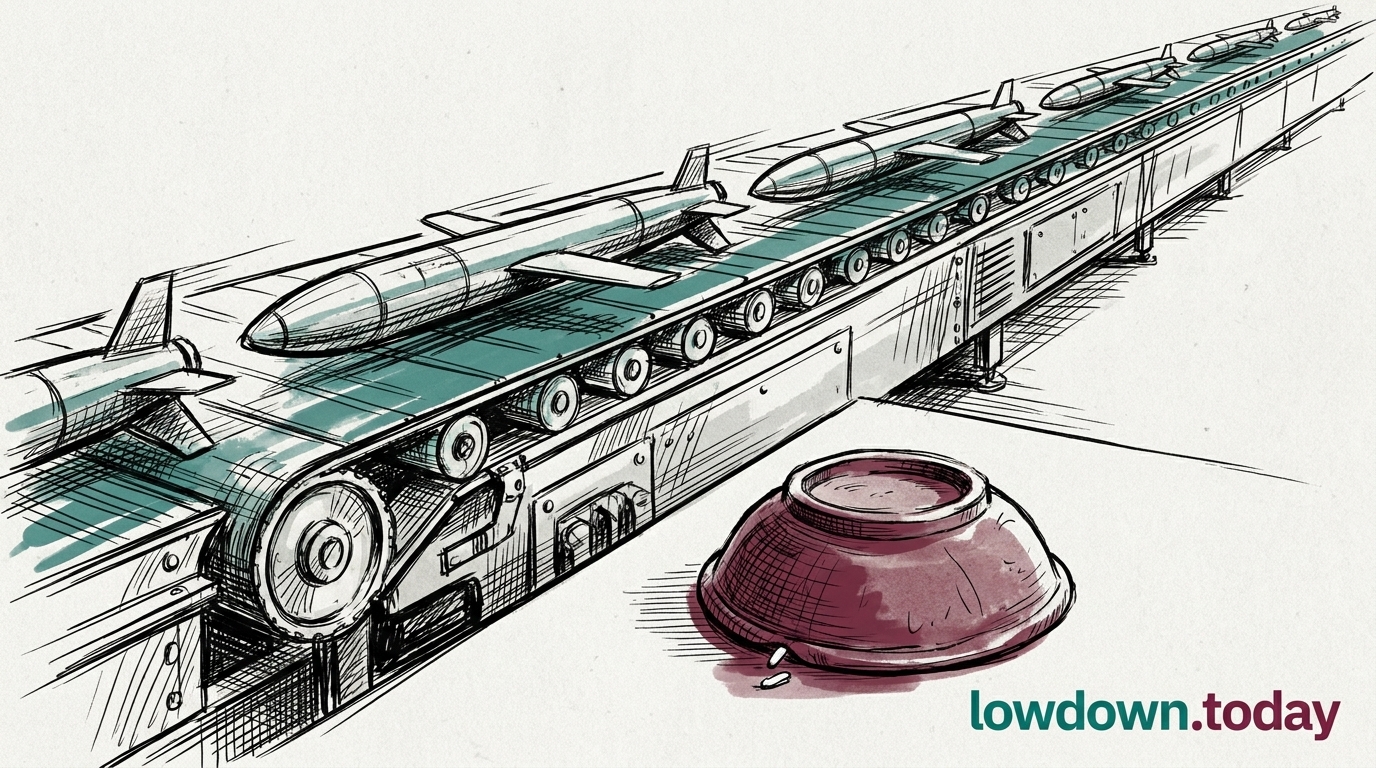
Signed a $22.9bn, seven-year contract with Raytheon on 17 August to raise Tomahawk output from about 60 a year to more than 1,000. The Acting Navy Secretary, quoted via an X post, framed it as the "Arsenal of Freedom" initiative; it replaces the 850 missiles fired by 1 April in about ten months at the new rate.
UK Maritime Trade Operations
UKMTO logged six armed men boarding a tanker 136 nautical miles east of Al Mukalla on 20 August and redirecting it toward Somalia. A vessel steered toward the Somali coast reads as an attempted seizure, a distinct hazard from the stand-off strikes the same lane has seen before.