Skip to content
You can now search across every topic, entity and event.What's new
Iran Conflict 2026
23AUG

FR-DE spread flips three times, no restart

2 min read
19:02UTC

The France-Germany day-ahead power spread reversed direction three sessions running over 14-16 July with every reactor still offline, pricing which grid's cooling load peaked first rather than nuclear supply.

ConflictDeveloping
Key takeaway

The France-Germany spread now prices cooling demand on both grids, not French nuclear availability.

The France-Germany day-ahead power spread flipped direction three sessions running: on 14 July Germany was dearer by EUR 6, a day later France took the dearer leg by the same EUR 6, and by 16 July Germany led again by EUR 3 1. This is the price gap between the two grids' next-day electricity, and it did all of that with the same block of French nuclear frozen offline throughout , so no restart can explain the swings.

The spread normally reads as a proxy for French nuclear: when EDF's fleet runs cheap, France clears below Germany and exports across the interconnector. The curtailment risk EDF flagged on 9 July has now overwhelmed that mechanism entirely. With a single heat dome sitting over both countries at once, the spread stops pricing supply and starts pricing which nation's air-conditioning load tops out first: French cooling demand outran a short fleet on 15 July, German heat pulled its own price up faster on 16 July.

Cross-border traders positioned for France-cheaper on the expected restart got whipsawed session to session, and interconnector flow direction now turns on which grid's demand peaks first rather than on generation. The spread reverts to its old logic only when the reactors come back and one grid regains a structural supply edge over the other.

Deep Analysis

In plain English

France and Germany's electricity prices are usually compared because France normally has cheap nuclear power to sell, making it the cheaper country most days. This week that pattern broke down: the cheaper country flipped three times in three days, even though nothing changed on the nuclear side. Both countries have been running air conditioning hard through the same heat dome, and whichever one's demand is slightly higher on a given day ends up paying slightly more, regardless of which country has more nuclear power switched on.

Deep Analysis
Root Causes

Both grids' peak cooling-demand windows have overlapped during this heat dome, so the marginal price-setting technology alternates day to day. French day-ahead clears on whichever unit meets the last increment of air-conditioning load; German day-ahead clears on its thermal stack.

When both grids' demand peaks land within a day of each other, whichever country's load is fractionally higher on a given session flips the sign, independent of the frozen 3.65 GW nuclear deficit sitting underneath both prices.

Interconnector capacity between France and Germany is finite, so the two markets cannot fully arbitrage the demand difference away within a single day, which is why the spread can swing by EUR 6-9 session to session rather than converging toward zero.

What could happen next?
  • Risk

    Cross-border traders positioned for France-cheaper on an eventual nuclear restart are being whipsawed session to session by a demand signal the restart will not fix.

  • Meaning

    The spread has stopped functioning as a clean proxy for French nuclear availability while the heat dome holds.

First Reported In

Update #27 · TTF hits EUR 55; the arb won't confirm it

energyprices.eu (ENTSO-E sourced)· 16 Jul 2026
Read original
Different Perspectives
Hizballah
Hizballah
Has not commented on the US Treasury's 20 August designation of ten people, including named couriers, over a cash network Treasury says moved money to it from the IRGC-Qods Force. ACLED recorded a sharp rise in attacks around it the same day.
Kuwait
Kuwait
Kuwait's Chief of the General Staff, Lieutenant General Khaled al-Shriaan, co-chaired the 16th US-Kuwait Joint Military Commission at the Pentagon on 21 August. Kuwait has not published what was agreed; only a summary of the meeting's existence and attendees is sourced.
Qatar
Qatar
Has not commented publicly on the $4.5bn KC-46A tanker Foreign Military Sale notification the State Department approved on 20 August. The notification opens a sale process; Doha has not confirmed whether it will proceed to a signed transfer.
Mohammad Bagher Ghalibaf
Told a Baghdad business meeting on 20 August that Iran will not endure a hungry population regardless of its military strength, against 87.9% point-to-point inflation and 128.1% food inflation for Tir. His fellow Majlis Economic Committee member Samsami separately warned a petrol price rise would ignite unrest.
US Navy
US Navy
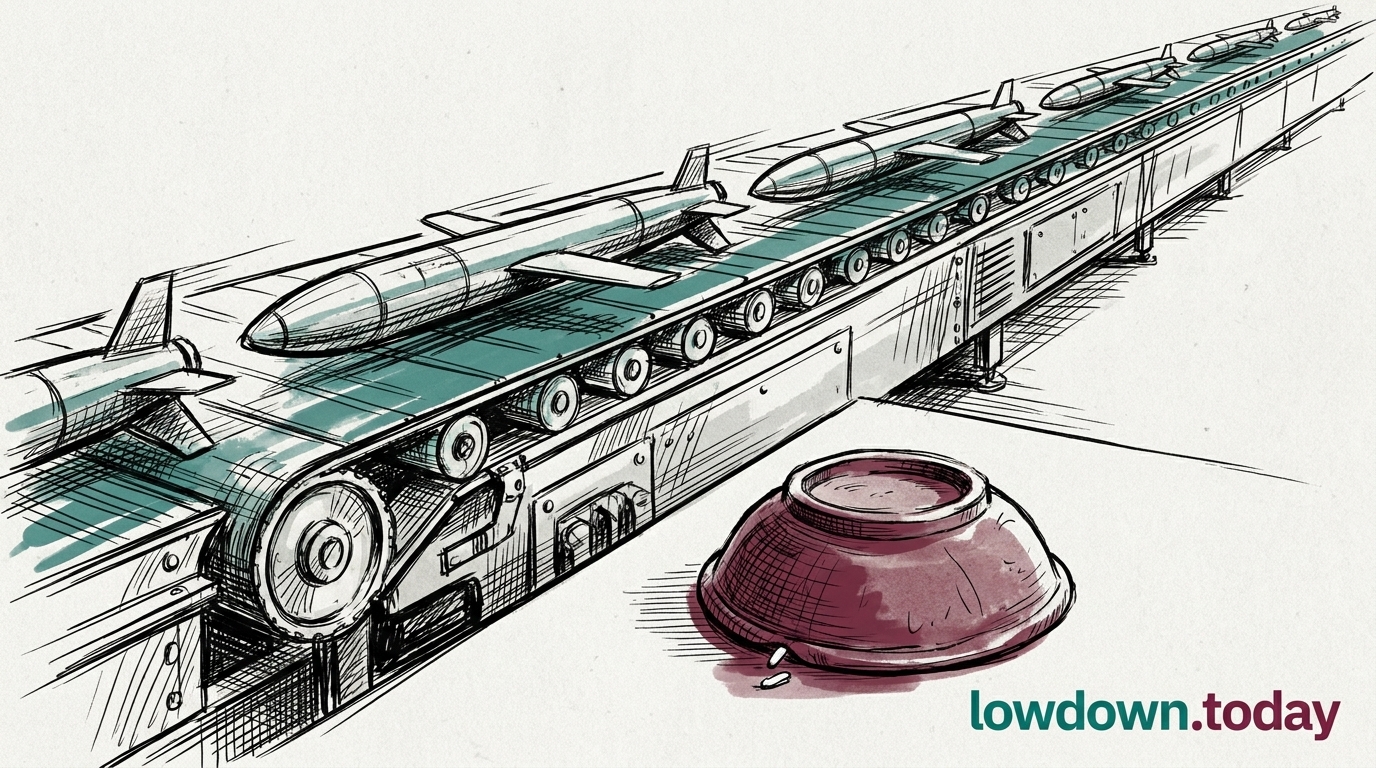
Signed a $22.9bn, seven-year contract with Raytheon on 17 August to raise Tomahawk output from about 60 a year to more than 1,000. The Acting Navy Secretary, quoted via an X post, framed it as the "Arsenal of Freedom" initiative; it replaces the 850 missiles fired by 1 April in about ten months at the new rate.
UK Maritime Trade Operations
UKMTO logged six armed men boarding a tanker 136 nautical miles east of Al Mukalla on 20 August and redirecting it toward Somalia. A vessel steered toward the Somali coast reads as an attempted seizure, a distinct hazard from the stand-off strikes the same lane has seen before.