Skip to content
You can now search across every topic, entity and event.What's new
Iran Conflict 2026
23AUG

EC confirms 22 April energy crisis package

2 min read
19:02UTC

The European Commission confirmed its energy crisis package for 22 April ahead of an informal European Council on 23-24 April, while separately acknowledging it was assessing a five-finance-minister windfall levy letter without committing to an instrument.

ConflictDeveloping
Key takeaway

The 22 April crisis package must cover both ceasefire outcomes and clarify whether storage incentives are in scope.

The European Commission confirmed on 17 April 2026 that its energy crisis measures package will be unveiled on 22 April, ahead of an informal European Council on 23-24 April 1. the Commission separately confirmed it is assessing the five-finance-minister windfall levy letter without committing to a windfall instrument.

The European Commission is the EU executive responsible for proposing legislation and managing energy policy. Scheduling the crisis package for 22 April puts the policy posture on the same calendar day as the US-Iran ceasefire expiry window. That coincidence is not neutral. A package released on a day when the ceasefire holds reads very differently from the same package released on a breakdown morning; the communications posture and the content itself must cover both cases or the Commission loses leverage on whichever way the diplomatic question resolves.

The windfall levy question is the sharpest domestic political fork. The EU Council Russian LNG short-term contract ban enters force on 25 April , three days after the crisis package, compressing the room for industry negotiation on any parallel windfall instrument. If the package frames a windfall as a live option rather than a rejected one, it creates an uncertainty tax on forward European energy positions at exactly the moment implied volatility on late-April TTF options is already misaligned with the physical calendar .

The informal European Council on 23-24 April is the venue where the storage-injection incentive debate, the windfall question, and the Russian LNG ban consequences will surface together. Market participants are watching for any signal that storage-injection incentives are in scope of the Commission's package, rather than the consumer-relief template Bruegel has already rejected. Against Germany's storage crisis at Reden and the bloc's 29.55% reading on 13 April , a crisis package that targets only consumer prices would leave the structural injection problem unaddressed inside a compressing calendar.

Deep Analysis

In plain English

The European Commission the EU's executive body, based in Brussels is preparing an emergency energy package to be announced on 22 April. This package is expected to address rising energy costs and supply shortages caused by the conflict blocking gas shipments through the Strait of Hormuz. The announcement is timed to land just before an informal European Council meeting on 23-24 April, where EU leaders will discuss the crisis. A key question is whether the package will include any measures to help with filling gas storage the underground reserves Europe relies on through winter or whether it will focus only on reducing energy bills for households in the short term.

Deep Analysis
Root Causes

The Commission's calendar constraint is structural: European Council and Commission legislative cycles were designed around a predictable 18-24 month policy development arc. Energy crisis conditions compress that arc to weeks, but the institutional architecture requiring impact assessments, stakeholder consultations, and member state consensus does not compress in the same way.

The windfall levy question is politically freighted for specific member states. France, Italy, and Spain, whose energy companies would bear the primary windfall burden, have distinct electoral and industrial considerations that prevent rapid EU-level consensus. Germany's position, complicated by the SPD-CDU/CSU coalition disagreement on long-term gas infrastructure (event-11), further narrows the political space for an ambitious package.

The five-finance-minister windfall letter from Germany, France, Spain, Italy, and Poland represents a politically significant coalition that cannot be publicly dismissed. The Commission's acknowledgment-without-commitment posture is legally accurate (the Commission is not bound by letters from finance ministers) but politically costly if the package that emerges on 22 April is seen as unresponsive to the dominant member state bloc.

What could happen next?
  • Risk

    A 22 April package framed primarily as a consumer-relief instrument will leave the German storage-injection failure structurally unaddressed, with no policy intervention before the 25 April Russian LNG ban compounds the supply constraint.

  • Opportunity

    If the package explicitly frames storage-injection incentives as in scope, it opens a legislative fast track that could produce a replacement for the abolished German storage levy within weeks rather than months.

First Reported In

Update #3 · TTF holds six-week low as supply stack hardens

Reuters via Yahoo Finance· 17 Apr 2026
Read original
Different Perspectives
Hizballah
Hizballah
Has not commented on the US Treasury's 20 August designation of ten people, including named couriers, over a cash network Treasury says moved money to it from the IRGC-Qods Force. ACLED recorded a sharp rise in attacks around it the same day.
Kuwait
Kuwait
Kuwait's Chief of the General Staff, Lieutenant General Khaled al-Shriaan, co-chaired the 16th US-Kuwait Joint Military Commission at the Pentagon on 21 August. Kuwait has not published what was agreed; only a summary of the meeting's existence and attendees is sourced.
Qatar
Qatar
Has not commented publicly on the $4.5bn KC-46A tanker Foreign Military Sale notification the State Department approved on 20 August. The notification opens a sale process; Doha has not confirmed whether it will proceed to a signed transfer.
Mohammad Bagher Ghalibaf
Told a Baghdad business meeting on 20 August that Iran will not endure a hungry population regardless of its military strength, against 87.9% point-to-point inflation and 128.1% food inflation for Tir. His fellow Majlis Economic Committee member Samsami separately warned a petrol price rise would ignite unrest.
US Navy
US Navy
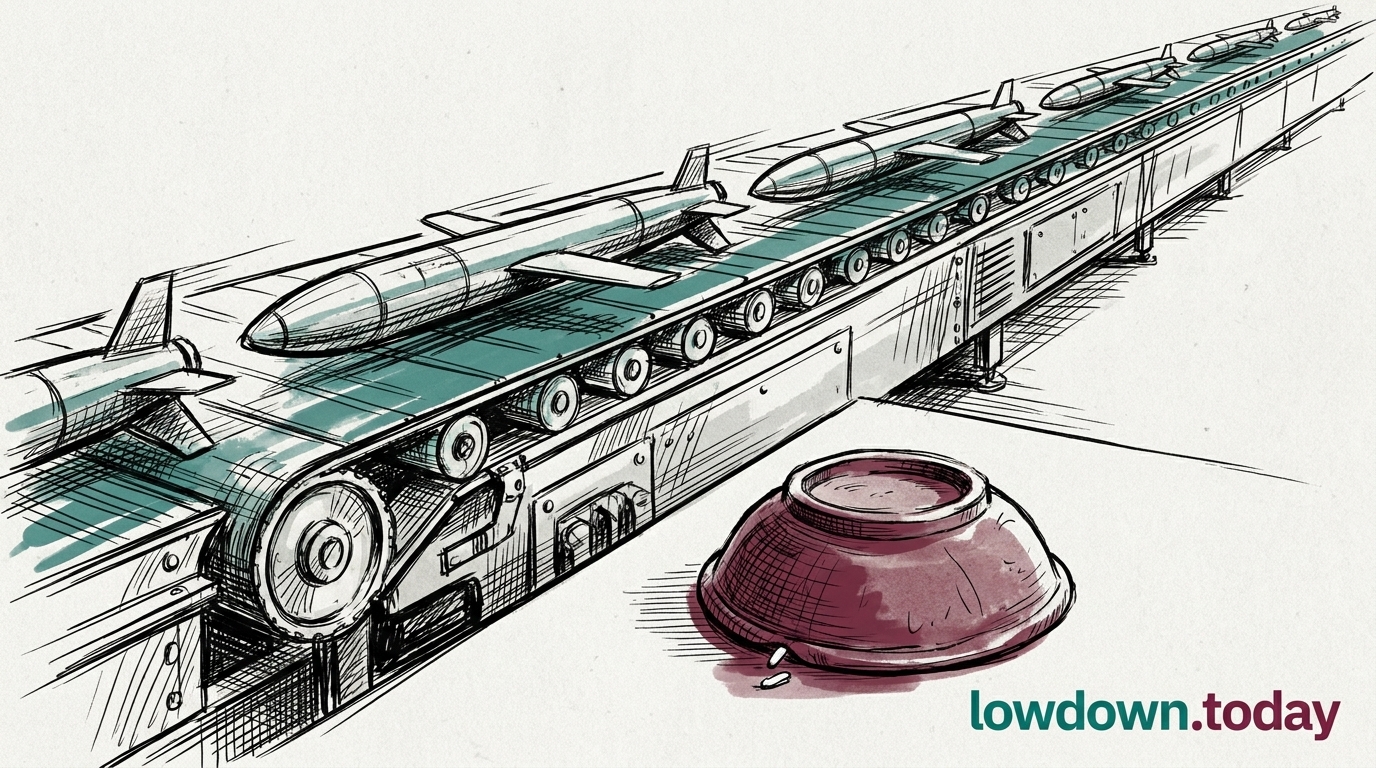
Signed a $22.9bn, seven-year contract with Raytheon on 17 August to raise Tomahawk output from about 60 a year to more than 1,000. The Acting Navy Secretary, quoted via an X post, framed it as the "Arsenal of Freedom" initiative; it replaces the 850 missiles fired by 1 April in about ten months at the new rate.
UK Maritime Trade Operations
UKMTO logged six armed men boarding a tanker 136 nautical miles east of Al Mukalla on 20 August and redirecting it toward Somalia. A vessel steered toward the Somali coast reads as an attempted seizure, a distinct hazard from the stand-off strikes the same lane has seen before.