Skip to content
You can now search across every topic, entity and event.What's new
Iran Conflict 2026
23AUG

Berlin confirms 12 GW gas tender

3 min read
19:02UTC

German Economy Minister Katherina Reiche confirmed the 12 GW hydrogen-ready gas-plant tender programme is formally agreed with the European Commission, with first units operational by 2031 and a 20 GW coalition target by 2030.

ConflictDeveloping
Key takeaway

Reiche's confirmation puts a floor under German gas demand through the early 2030s, closing a three-year coalition fight.

New German Economy Minister Katherina Reiche confirmed that the 12 GW hydrogen-ready gas-plant tender programme is formally agreed with the European Commission. First tenders open in 2026, with additional rounds in 2027 and 2029/2030; all units must be operational by 2031, hydrogen-ready and decarbonised by 2045. A capacity market for supply security from 2032 is targeted for delivery in 2027. The coalition target is up to 20 GW of gas-fired capacity by 2030.

The political resolution matters more than the megawatt count. The September 2026 first-auction date set under the prior coalition had been blocked at substance level by SPD environment-ministry objections that delayed the draft law for three years. Reiche's confirmation closes that fight: Berlin is committed to forward gas-plant build regardless of how the SPD environment portfolio frames its renewables conditions. The 2027 capacity-market delivery target creates an investment-decision hurdle ahead of the build-out, with the binding constraint being whether auction-clearing prices exceed merchant CCGT spreads at 2031 vintage. The forward gas-demand curve through the early 2030s now has a German floor under it, structurally linked to the LNG supply architecture the Kunpeng case is testing in public.

Deep Analysis

In plain English

Germany has agreed with Brussels to build 12 gigawatts of new gas-fired power plants that can later be converted to run on hydrogen, a cleaner fuel. The first contracts go out to tender this year and all the plants must be running by 2031. Germany needs these plants to keep the lights on after closing its nuclear stations and while its wind and solar capacity cannot yet cover all demand on calm or cloudy days.

Deep Analysis
Root Causes

Germany's 2022-23 simultaneous nuclear exit and accelerated coal retirement removed approximately 25 GW of firm dispatchable capacity without a replacement mechanism, creating a structural gap that the renewables build-out cannot close on its own because of intermittency.

The SPD environment ministry's three-year objection to the gas-plant draft law was rooted in the ministry's interpretation that new gas plant build extended fossil fuel lock-in beyond the 2045 climate target, a dispute only resolved by the hydrogen-ready specification that gives plants a defined decarbonisation pathway.

EU state aid rules required Commission notification and approval for the capacity market, adding an external regulatory timeline that the German government could not accelerate unilaterally, which is why the September 2026 auction target in the original draft slipped.

What could happen next?
  • Meaning

    Siemens Energy and GE Vernova are the two primary turbine suppliers with H2-ready CCGT units in commercial delivery; the 12-20 GW programme represents a multi-billion euro order book concentrated in two manufacturers.

    Short term · Assessed
  • Meaning

    The forward gas demand floor through 2031 provides a structural backstop for EU LNG import capacity investment, as European terminal operators can underwrite new regasification capacity against visible German gas demand.

    Short term · Assessed
  • Meaning

    SPD's acceptance of the gas-plant programme at coalition level represents a structural defeat for the German environment ministry's position that new firm capacity should come exclusively from storage and demand response, with implications for the ministry's credibility in future coalition negotiations.

    Short term · Assessed
First Reported In

Update #10 · TTF breaks EUR 50; US LNG hits 58% of imports

Clean Energy Wire· 18 May 2026
Read original
Different Perspectives
Hizballah
Hizballah
Has not commented on the US Treasury's 20 August designation of ten people, including named couriers, over a cash network Treasury says moved money to it from the IRGC-Qods Force. ACLED recorded a sharp rise in attacks around it the same day.
Kuwait
Kuwait
Kuwait's Chief of the General Staff, Lieutenant General Khaled al-Shriaan, co-chaired the 16th US-Kuwait Joint Military Commission at the Pentagon on 21 August. Kuwait has not published what was agreed; only a summary of the meeting's existence and attendees is sourced.
Qatar
Qatar
Has not commented publicly on the $4.5bn KC-46A tanker Foreign Military Sale notification the State Department approved on 20 August. The notification opens a sale process; Doha has not confirmed whether it will proceed to a signed transfer.
Mohammad Bagher Ghalibaf
Told a Baghdad business meeting on 20 August that Iran will not endure a hungry population regardless of its military strength, against 87.9% point-to-point inflation and 128.1% food inflation for Tir. His fellow Majlis Economic Committee member Samsami separately warned a petrol price rise would ignite unrest.
US Navy
US Navy
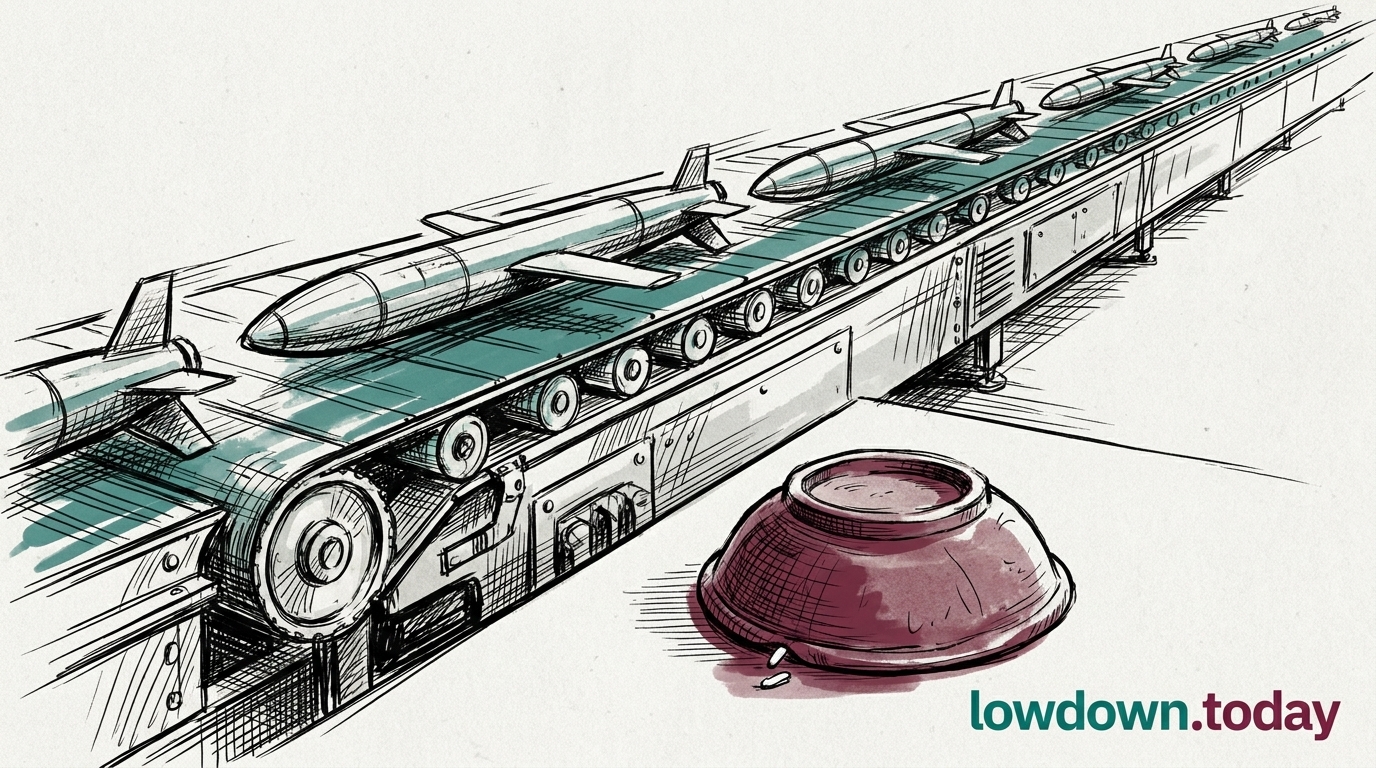
Signed a $22.9bn, seven-year contract with Raytheon on 17 August to raise Tomahawk output from about 60 a year to more than 1,000. The Acting Navy Secretary, quoted via an X post, framed it as the "Arsenal of Freedom" initiative; it replaces the 850 missiles fired by 1 April in about ten months at the new rate.
UK Maritime Trade Operations
UKMTO logged six armed men boarding a tanker 136 nautical miles east of Al Mukalla on 20 August and redirecting it toward Somalia. A vessel steered toward the Somali coast reads as an attempted seizure, a distinct hazard from the stand-off strikes the same lane has seen before.