Skip to content
You can now search across every topic, entity and event.What's new
Iran Conflict 2026
17JUN

Trump flies east, desk still empty

3 min read
09:37UTC

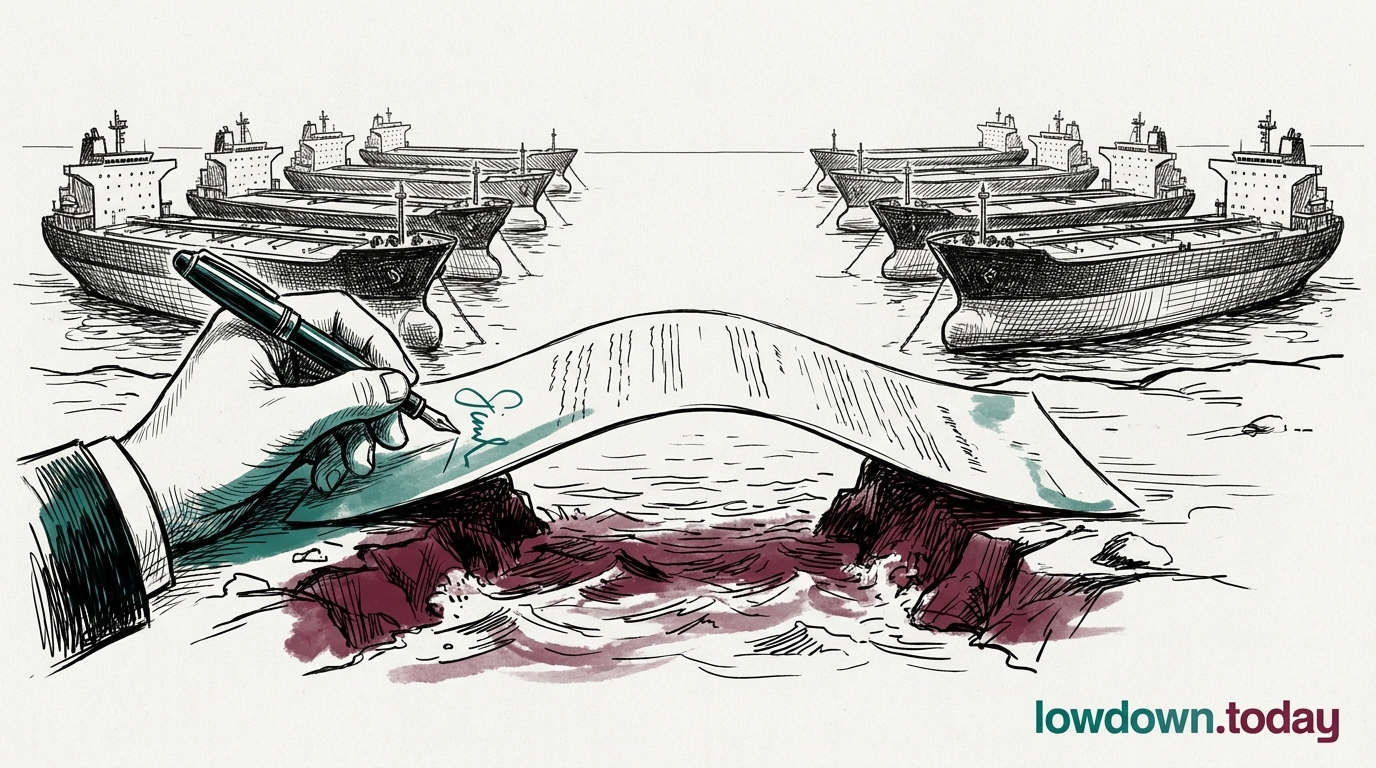
Donald Trump boarded Air Force One for Beijing on 13 May with no Iran instrument signed. The White House presidential-actions index logged zero Iran entries across 12 and 13 May, extending the unsigned streak to Day 75.

ConflictDeveloping
Key takeaway

Trump flew to Beijing on 13 May with zero Iran instruments signed across 75 days of war.

Donald Trump boarded Air Force One for Beijing on the morning of 13 May 2026 without a signed Iran instrument on his way out. The White House presidential-actions index recorded zero Iran-related entries on 12 or 13 May; the only 12 May entry was a routine "Nominations Sent to the Senate" line 1. That extends the streak of zero signed Iran instruments to Day 75, past every modern wartime precedent for an active US blockade.

The departure timing matters. Pete Hegseth's 12 May Article 2 testimony before Senate Appropriations was the legal floor; Trump's physical exit with nothing in his red folder was the operational ceiling. The final pre-departure US action on Iran was Treasury, not the Oval Office: OFAC had designated 12 entities and individuals on 11 May, six of them Hong Kong-registered, plus Universal Fortune Trading LLC as a NIOC (National Iranian Oil Company) front 2. That package was Treasury-initiated, not a presidential executive instrument. The Hong Kong target list was deliberately calibrated to fit inside the summit window : it pressures Iran's oil-logistics network without forcing Xi Jinping to publicly invoke MOFCOM's Blocking Rules during the week he hosts the American president.

Trump's 11 May Oval Office remarks listed three military options (resuming bombing of the remaining identified targets, a Special Forces seizure of Iran's enriched uranium, and a ground takeover of part of the strait), all sitting alongside zero accompanying executive orders, deployment directives, or CENTCOM operational orders. Two days later he flew east with the same blank desk. Axios sources told the outlet they did not expect any Iran kinetic decision before he returns to Washington on 15 May. The Day 75 streak is now framed at one end by a cabinet officer's sworn defence and at the other by a presidential flight to the mediator country.


Deep Analysis

In plain English

When the US president takes major military decisions, like launching a blockade or deploying tens of thousands of troops, there is normally a paper trail. The president signs executive orders, deployment directives, and formal findings that create a legal record of what was decided and why. Since the war with Iran began 75 days ago, President Trump has signed none of these documents on Iran. On 13 May he boarded Air Force One for a summit with China's president Xi Jinping in Beijing, and left with his desk still empty. The last US action on Iran before he flew was a Treasury Department sanctions package. That was a bureaucratic measure, not a presidential order. No one in the White House has explained why no paperwork exists, but a senior official told Congress the day before that the president does not need any.

Deep Analysis
Root Causes

The zero-instrument streak runs from a structural feature of how the Trump 2.0 administration has chosen to conduct the Iran campaign: verbal-track authority substituting for signed presidential instruments at every stage. Operation EPIC FURY was announced via Truth Social. Trump declared the naval blockade in a press briefing on 1 March with no accompanying executive order.

CENTCOM's escort-force order deploying 15,000 personnel to the strait was issued verbally, with no accompanying deployment directive or finding. Each decision that would normally produce an executive order, deployment directive, or finding has instead produced a press briefing or social media post.

The proximate cause of the Day 75 gap is that signing an instrument would require the administration to name specific authorities, define the scope of hostilities, and create a paper record that opposing counsel or a future administration could cite. The verbal track eliminates that record. Trump's departure for Beijing without a signed instrument is consistent with this design; the absence of paper is a structural feature, not a clerical oversight.

What could happen next?
  • Risk

    Trump's return from Beijing on 15 May without a diplomatic breakthrough resets the escalation clock with no legal brake available; Hegseth's Article 2 testimony removed the congressional constraint the same day Trump departed.

  • Opportunity

    If the Xi summit produces a framework for the Pakistan channel, Trump could sign a first Iran instrument as a ceasefire signal rather than an escalation order, converting the unsigned streak into a diplomatic asset.

First Reported In

Update #96 · Hegseth: no AUMF needed. Trump flies east

The White House· 13 May 2026
Read original
Different Perspectives
Lloyd's Market Association
War-risk underwriters price the Houthis' Red Sea attacks because the group announces its targets in advance, but the unclaimed Damietta drone gives insurers a hit with no author to price against. An attack nobody claims costs shipping more than one that is claimed, since premiums are set against a known pattern, not raw damage.
US Central Command
US Central Command
CENTCOM has announced no strike on Iran since resuming bombing on 30 July within hours of an IRGC salvo on Jordan, and centcom.mil did not respond to requests to confirm any pause. The command has gone quiet before while a larger operation was being weighed, so silence alone proves nothing about what it has or has not done.
Hengaw
Hengaw
Hengaw recorded at least 67 executions in Iran during July, of which the state acknowledged only eight, and reported the 1 August execution of protest detainee Arvin Kheirkhahan at Shahrud with no advance notice to his family. A family's first notice of a death sentence is now usually the instruction to collect a body.
Egypt
Egypt
Egypt's government asked media on 2 August to report the Damietta attack accurately, named no author, and said no findings will be published before its own investigation concludes. Cairo holds the debris and jurisdiction over an attack on its own soil, and naming a culprit now would pull it into a dispute it has avoided for five months.
Iran's Foreign Ministry
Araghchi called the Hormuz talks with Oman final-stage on 2 August, four days after his own deputy rejected Oman's lane proposal, and denied the Damietta drone strike as an Israeli false flag while two Iranian officials privately claimed it for Tehran. Iran's public position now contradicts itself on both files at once.
Bahrain and Kuwait
Bahrain and Kuwait
Bahraini and Kuwaiti aircraft flew their own strikes on Iranian depots in July with Emirati air cover behind them, and Ynetnews reports some Gulf capitals wanted the 2 August strike to proceed rather than stop. States that have already taken fire see a closing window on Iranian weakness, not a reason to pause.



