Skip to content
You can now search across every topic, entity and event.What's new
European Energy Markets
31JUL

TTF breaks EUR 50; US LNG hits 58%

3 min read
09:44UTC

TTF settled EUR 50.17/MWh on Monday 18 May, an 11% weekly gain that finally prices the storage arithmetic into the curve as ACER confirmed US suppliers now provide 58% of EU LNG imports.

EconomicDeveloping
Key takeaway

TTF priced the storage deficit and the US 58% LNG share into the curve in the same week.

TTF (Title Transfer Facility, the Dutch wholesale gas benchmark) settled at EUR 50.17/MWh on Monday 18 May, the first close above EUR 50 since early April , an 11% weekly gain from the EUR 47.23 close on Tuesday 12 May. ACER, the EU energy regulator, published its Annual LNG Report 2025 on Wednesday 13 May confirming US suppliers now provide 58% of EU LNG imports, projected by IEEFA to reach 65% in 2026 as Russian short-term contracts wash out under the 25 April ban.

The Dutch front-month is finally pricing two pricing dynamics at once: the storage arithmetic the beat has tracked since the season opened , and the structural concentration story ACER's report quantified this week. Russian pipeline gas peaked at roughly two-fifths of total EU gas in 2021; the US 58% LNG share, multiplied through LNG's share of total EU supply, now equates to roughly a fifth of EU gas demand routing through one country's terminals. Commission Executive Vice-President Teresa Ribera warned the same week that Europe should 'avoid replacing one energy dependency with another'; her institution has spent approximately EUR 117 billion on US LNG since 2022.


Deep Analysis

In plain English

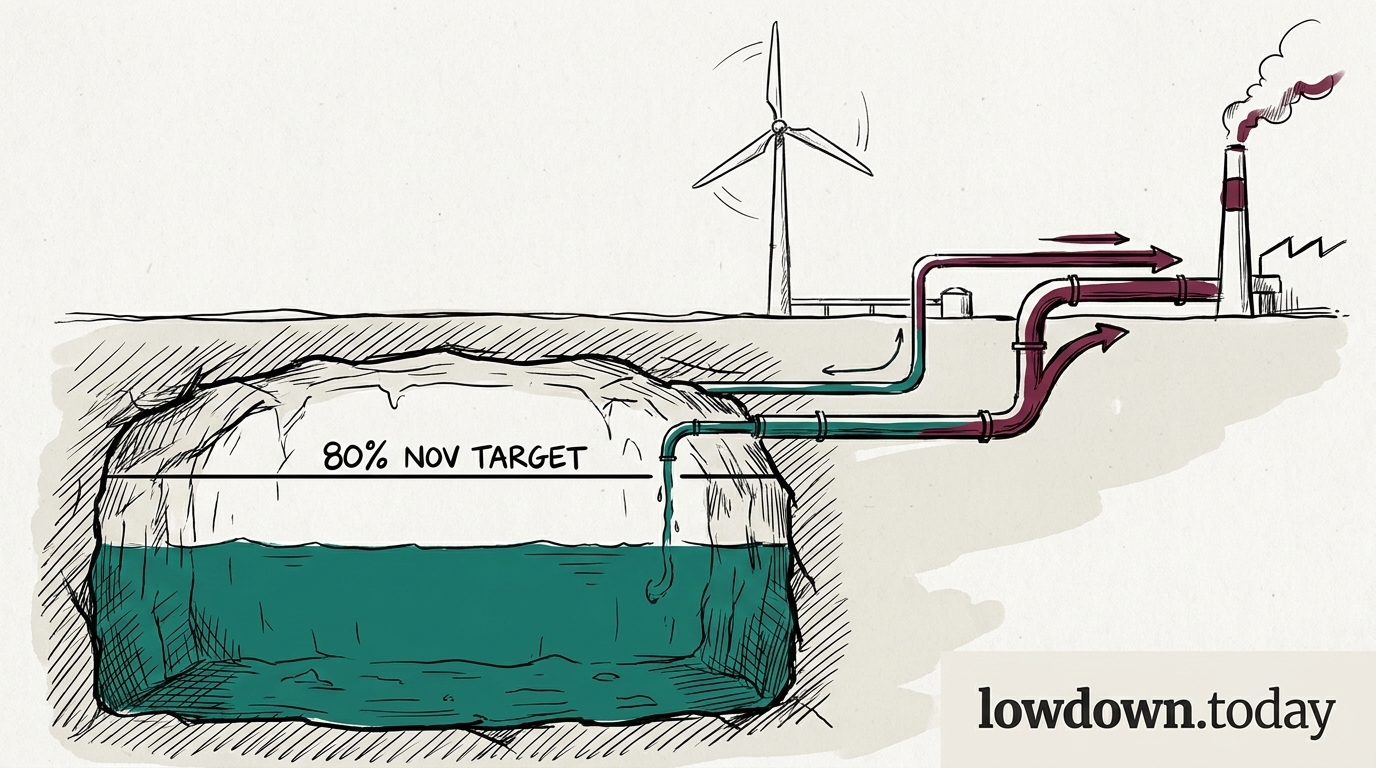
TTF is the main European gas price benchmark, like Brent crude for oil. When it breaks EUR 50, it means European wholesale gas costs more, which eventually flows through to household energy bills. The trigger this week was twofold: gas storage tanks are not filling fast enough for winter, and a report confirmed that over half of Europe's gas ship imports now come from a single country, the United States.

Deep Analysis
Root Causes

The 25 April 2026 EU Russian LNG short-term ban accelerated US LNG's share shift from 58% toward a projected 65% faster than the 2025 baseline assumed, removing the residual Russian short-term contract buffer that had kept US deliveries below two-thirds.

The 1 January 2026 abolition of Germany's gas storage levy removed the principal incentive instrument for early-season injection, leaving the EU without a mechanism to incentivise fills at TTF levels above industrial demand-destruction thresholds.

Middle East LNG to Europe fell to its lowest level since 2019 in April 2026 (Bruegel dataset), reducing the swing-supplier cushion that had historically moderated US pricing power in Atlantic Basin spot markets.

What could happen next?
  • Meaning

    If TTF holds above EUR 50 through June, the Bruegel EUR 26 billion refill cost estimate becomes materially understated on both the price and pace assumptions used in the model.

    Short term · Assessed
  • Meaning

    US LNG tariff exposure becomes a politically live risk vector for the first time since 2022: a 65% single-supplier share concentrates European gas pricing power in a single bilateral trade relationship.

    Short term · Assessed
  • Meaning

    Industrial demand destruction at EUR 50+ front-month may slow European gas consumption enough to partially offset the storage injection shortfall, creating an involuntary demand-side adjustment the EU has not formally planned for.

    Short term · Assessed
First Reported In

Update #10 · TTF breaks EUR 50; US LNG hits 58% of imports

EnergyRiskIQ / GIE AGSI+· 18 May 2026
Read original
Causes and effects
This Event
TTF breaks EUR 50; US LNG hits 58%
Two regimes priced at once: the storage deficit and a structural supplier-concentration story whose 2026 trajectory points to roughly a fifth of EU gas demand routing through one country's logistics chain.
Different Perspectives
Spain's LNG terminal operators
Spain's 9,145 GWh terminal inventory is the largest single stock in the EU LNG network, an option value that can reroute cargoes wherever the winter strip pays best rather than a cavern gas obligation tied to a fixed date. That flexibility matters more as Germany's cavern shortfall pushes more of the winter security question onto import infrastructure.
European Commission
European Commission
Brussels holds the bloc to 90% on a flexible window while Germany, holding roughly a quarter of EU storage capacity, tracks toward missing its own lower 80% figure by 21 points. A national shortfall this size in the anchor market matters more to bloc security than the flexible timetable alone can absorb.
French power exporters and CRE
French day-ahead rose in step with Germany but by less, reopening a EUR 7-17 premium that makes northward export flows commercially attractive again after the EUR 43.09 discount evaporated in days. CRE separately authorised RTE and Enedis to buy flexibility locally, betting the coming winter's binding constraint is grid congestion rather than a shortage of firm capacity.
TTF trading desk
TTF trading desk
A visible national shortfall like Germany's 21-point gap is a directional signal, not noise, for a desk holding the summer-winter spread. TTF's flat EUR 58-60 range through this week's German price swings says the market has not yet chosen to reprice refill risk into the front of the curve.
German cavern and CCGT operators
German caverns kept buying prompt gas at TTF near EUR 58-60 through the inversion; the wind collapse to 2.4 GW then flipped the spark spread to plus EUR 29 and put turbines back in the same queue. Every day turbines win that bid, injection at a third of the 877 GWh/day pace needed falls further behind.
Slovakia
Slovakia
Slovakia says it dropped its hold-out on the 21st sanctions package only after Ursula von der Leyen personally signed written gas-price and supply guarantees. The Council of the European Union's own 17,238-character release on the package names neither Slovakia nor any guarantee, leaving Bratislava's account unconfirmed by the institutional record.



