Skip to content
You can now search across every topic, entity and event.What's new
European Energy Markets
31JUL

IDF kills Radwan commander in Beirut

4 min read
09:44UTC

Israeli forces struck Dahiyeh, southern Beirut, on 7 May, killing Ahmed Ali Balout, commander of Hezbollah's Radwan Force; Iran's Foreign Ministry threatened within hours to collapse its own ceasefire with Israel.

EconomicDeveloping
Key takeaway

Iran's ceasefire threat puts Lebanon inside the strait file the day Pakistan delivered the US paper.

Israeli forces struck Dahiyeh, the southern Beirut suburb, on 7 May, killing Ahmed Ali Balout, commander of Hezbollah's Radwan Force elite commando unit 1. The strike was the first Israel Defense Forces (IDF) airstrike on the Lebanese capital since the Trump Ceasefire of 16 April. Iran's Foreign Ministry warned within hours that continued Israeli strikes on Lebanon would constitute grounds for collapse of Iran's own Ceasefire with Israel.

The Radwan Force is the Hezbollah unit organisationally closest to Iran's IRGC Quds Force, which is what makes the target's position structural rather than tactical. Israeli strikes on southern Lebanon killed 41 in the day to 2 May , but the geographic line between southern Lebanon and Beirut has carried policy weight throughout the Ceasefire: Washington and Israel have treated southern Lebanon as inside the truce envelope and the capital as not. The Dahiyeh strike crosses that line. Israeli Defence Minister Israel Katz said Hezbollah and its Iranian patrons were applying pressure out of concern Israel would crush Hezbollah; IDF Chief of Staff Eyal Zamir told reporters the IDF was ready for a "powerful and broad" Iran operation 2.

Washington and Israel have publicly maintained that the Iran-US Ceasefire excludes Lebanon; Tehran rejects that scoping. Iran's Foreign Ministry threat places Lebanon inside the same file as the US paper that arrived in Tehran the same day, which itself does not mention Lebanon. The threat therefore acts as an unofficial precondition on whatever paper Tehran sends back through Islamabad. If Iran follows through on collapsing the truce, the MOU dies on arrival; if Iran does not, the threat becomes informational only and weakens Tehran's leverage on the next written exchange.

The operational test is whether the IDF strikes Lebanon again before the 14-15 May Beijing summit. A second Beirut strike before the Trump-Xi meeting would force Tehran to make the choice publicly under conditions where Beijing has already pre-positioned its own legal architecture and Washington's paper is being read in Tehran. An Israeli pause is the cleanest tell that the document Pakistan delivered has political traction in Washington, because it would imply the administration has asked Israel to hold the geographic line during the negotiating window. Either move sends a written or kinetic answer to the question Iran's foreign ministry posed: what does the Iran-US Ceasefire actually cover.


Deep Analysis

In plain English

Israel carried out an airstrike in Dahiyeh, a part of south Beirut closely associated with Hezbollah, on 7 May, killing Ahmed Ali Balout, the commander of Hezbollah's elite Radwan Force fighting unit. This was the first Israeli airstrike on Beirut's capital area since a ceasefire was announced on 16 April. Iran responded within hours by threatening to collapse its own separate ceasefire with Israel, claiming that Israeli strikes on Lebanon violated the terms of the truce. This matters because Israel and the US say the ceasefire with Iran does not cover Lebanon, while Iran insists it does. The strike happened on the same day Pakistan delivered a US peace document to Tehran, creating a direct collision between the diplomatic and military tracks.

Deep Analysis
Root Causes

The ceasefire's Lebanon scope ambiguity produced the 7 May Dahiyeh strike's diplomatic weight. Israel's government explicitly excluded Lebanon from the Trump ceasefire of 16 April; Iran has consistently demanded Lebanon be included. Neither position has been written into a shared text.

The Araghchi-Wang Yi meeting in Beijing on 6 May gave Tehran Chinese diplomatic backing for the Lebanon-inclusive framing, with Wang Yi calling explicitly for a 'comprehensive ceasefire'. The IDF strike on Dahiyeh the following morning tests whether Washington will enforce the Lebanon-exclusion position by restraining the IDF, because Tehran's written reply to the MOU will incorporate whatever signal it reads from the 24 hours after Balout's killing.

What could happen next?
  • Risk

    Iran's Foreign Ministry threat to collapse its own ceasefire with Israel over Lebanon strikes converts the Lebanon front into an explicit precondition on the Pakistan paper track, meaning Tehran's reply to the MOU may be conditional on Israeli restraint in Lebanon.

    Immediate · 0.8
  • Consequence

    The Dahiyeh strike gives Wang Yi's 'comprehensive ceasefire' call concrete substance: a peace framework that excludes Lebanon demonstrably leaves the conflict active in a theatre Iran has now formally linked to the Iran-Israel truce.

    Short term · 0.75
  • Risk

    IDF Chief of Staff Zamir's statement that the IDF is ready for a 'powerful and broad' Iran operation, made on the same day the MOU arrived in Tehran, signals that the military option remains live in Israeli planning even as the diplomatic track advances.

    Short term · 0.7
First Reported In

Update #90 · Pakistan carries paper; Brent below $100

JNS· 7 May 2026
Read original
Different Perspectives
Spain's LNG terminal operators
Spain's 9,145 GWh terminal inventory is the largest single stock in the EU LNG network, an option value that can reroute cargoes wherever the winter strip pays best rather than a cavern gas obligation tied to a fixed date. That flexibility matters more as Germany's cavern shortfall pushes more of the winter security question onto import infrastructure.
European Commission
European Commission
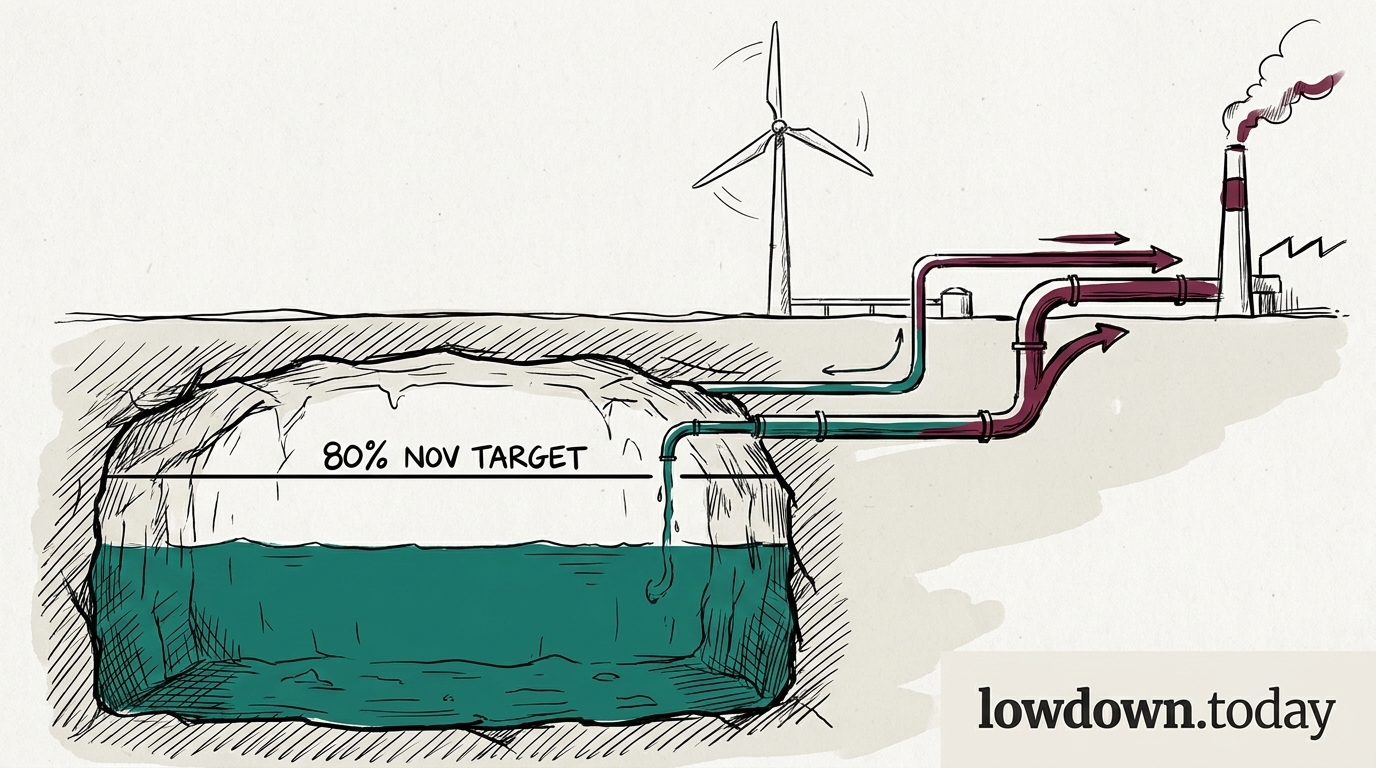
Brussels holds the bloc to 90% on a flexible window while Germany, holding roughly a quarter of EU storage capacity, tracks toward missing its own lower 80% figure by 21 points. A national shortfall this size in the anchor market matters more to bloc security than the flexible timetable alone can absorb.
French power exporters and CRE
French day-ahead rose in step with Germany but by less, reopening a EUR 7-17 premium that makes northward export flows commercially attractive again after the EUR 43.09 discount evaporated in days. CRE separately authorised RTE and Enedis to buy flexibility locally, betting the coming winter's binding constraint is grid congestion rather than a shortage of firm capacity.
TTF trading desk
TTF trading desk
A visible national shortfall like Germany's 21-point gap is a directional signal, not noise, for a desk holding the summer-winter spread. TTF's flat EUR 58-60 range through this week's German price swings says the market has not yet chosen to reprice refill risk into the front of the curve.
German cavern and CCGT operators
German caverns kept buying prompt gas at TTF near EUR 58-60 through the inversion; the wind collapse to 2.4 GW then flipped the spark spread to plus EUR 29 and put turbines back in the same queue. Every day turbines win that bid, injection at a third of the 877 GWh/day pace needed falls further behind.
Slovakia
Slovakia
Slovakia says it dropped its hold-out on the 21st sanctions package only after Ursula von der Leyen personally signed written gas-price and supply guarantees. The Council of the European Union's own 17,238-character release on the package names neither Slovakia nor any guarantee, leaving Bratislava's account unconfirmed by the institutional record.



