Skip to content
You can now search across every topic, entity and event.What's new
European Energy Markets
15JUN

TTF holds EUR 43-47 through Hormuz week

4 min read
12:23UTC

TTF front-month settled at EUR 44.84/MWh on 7 May and traded at EUR 44.21/MWh on 8 May, holding the EUR 43-47/MWh band through Project Freedom's collapse and Iran's new permit system.

EconomicDeveloping
Key takeaway

The benchmark has priced Hormuz-closed as equilibrium; reopening would be a downside surprise.

TTF (Title Transfer Facility) front-month settled at EUR 44.84/MWh on 7 May and traded at EUR 44.21/MWh at 06:36 GMT on 8 May, ICE Endex data via oilpriceapi shows. The benchmark held inside the EUR 43-47/MWh band through the launch of US Operation Project Freedom on 4 May , Trump's pause two days later on 6 May, and Iran's announcement of a new Persian Gulf Strait Authority permit system on 7 May.

TTF is the Dutch virtual gas trading hub operated by Gasunie Transport Services and the European wholesale natural gas benchmark. The 1.48% rise on the Project Freedom launch was not given back when the operation paused; the announcement of an Iranian permit system banning Israel-linked vessels and charging fees on non-hostile state ships did not produce a fresh move either.

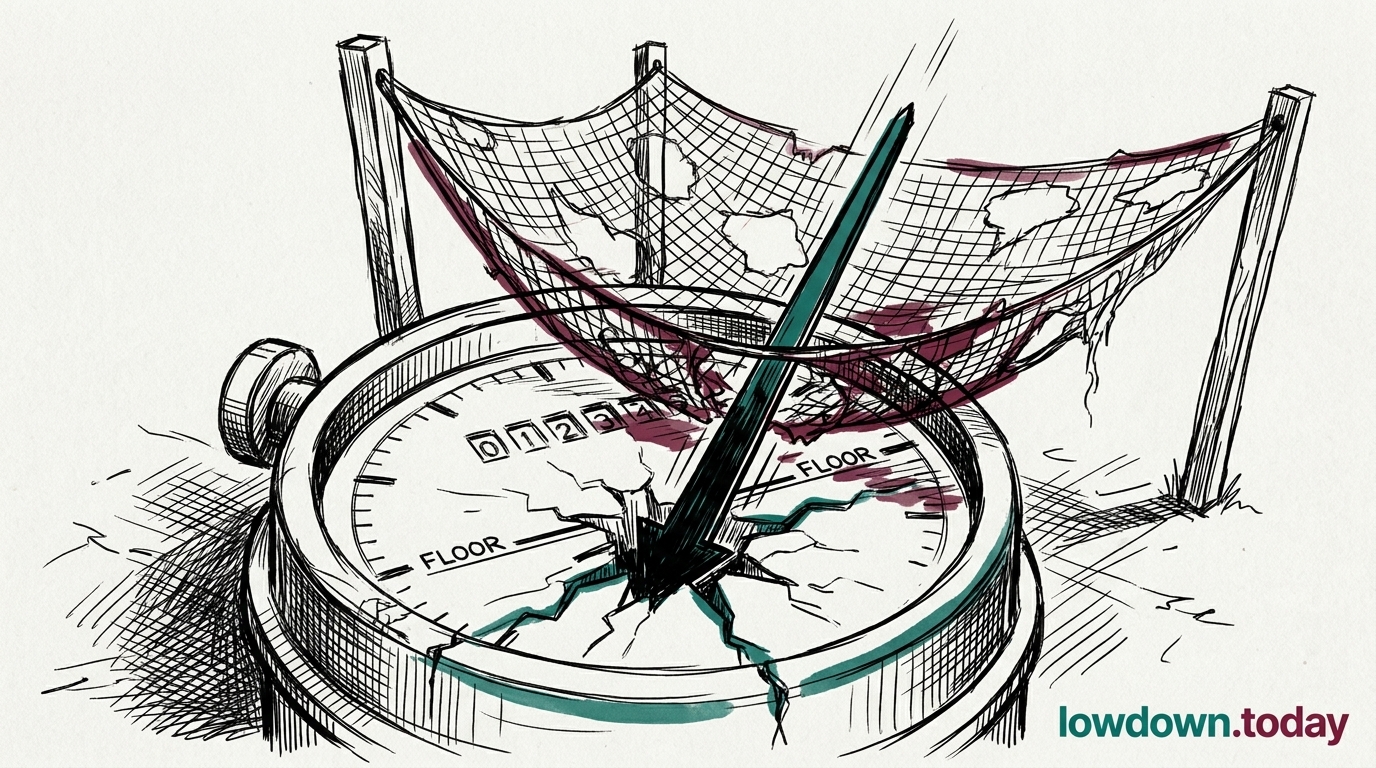
The corollary follows from what the band has absorbed without breaking. The market has priced the Hormuz-closed equilibrium as the equilibrium, not the wartime exception, which inverts the usual risk asymmetry: a confirmed reopening becomes a downside surprise for sellers, not upside relief for buyers. Anything short of a confirmed reopening, including operational pauses and unilateral Iranian permit theatre, sits inside the price already.

The JKM (Japan Korea Marker) sat in the low-USD 18s/MMBtu against TTF near USD 15.7/MMBtu, a JKM-TTF spread of roughly USD 2.90-3.30/MMBtu. That keeps flexible Atlantic LNG cargoes routing east, with European buyers below the cargo-diversion breakeven by USD 0.95-1.25/MMBtu. The same band that held last week has now absorbed two further escalations without re-pricing the route.


Deep Analysis

In plain English

TTF is the main European gas benchmark, named after a Dutch virtual trading hub. ICE Endex publishes TTF prices daily, and European utilities, industrial buyers, and traders use it as the reference for gas contracts across the continent. Think of it like a pump price for wholesale gas. This week, two big events happened that you might expect to have moved the price: the US launched and then quickly abandoned a military mission to open the Strait of Hormuz (the main route for Middle Eastern gas tankers), and Iran announced it would charge fees and screen ships that want to use the strait. Neither moved the price. TTF has traded in the EUR 43-47 range since late April, absorbing Iranian Hormuz restrictions that began 18 April without re-pricing on each new development. The price had already moved to reflect a closed-strait baseline weeks before Project Freedom launched. For the price to fall, something would need to genuinely reopen the strait in a sustained way. An operation that ran for two days and was paused on 6 May, plus a permit-fee announcement, are not that.

Deep Analysis
Root Causes

The market's equilibrium-at-EUR-44 pricing reflects three structural features acting in combination. First, the JKM-TTF spread at USD 2.90-3.30/MMBtu maintains Asian demand as the dominant pull on flexible Atlantic LNG cargoes, removing the marginal source that would move TTF.

Second, EU gas storage is filling rather than drawing, meaning the physical shortage that would create an emergency spot bid has not materialised in the near-term data. Third, the Hormuz permit architecture Iran announced, email-based transit permits, vessel screening, fee structure, gives buyers a procedural route to compliance that avoids the all-or-nothing supply disruption that would force an aggressive spot re-pricing.

These three factors are individually reversible. A JKM collapse on Chinese demand weakness, a storage-pace failure confirmed on 12 May, or an Iranian enforcement action that closes the permit route would each independently break the EUR 43-47 band. All three would need to hold simultaneously for the EUR 44 floor to remain intact through June.

What could happen next?
  • Risk

    TTF's EUR 43-47 band stability through Project Freedom and Iran permit news removes the forward-curve signal that would incentivise European utilities to bid aggressively for spot LNG cargoes now rather than waiting for winter.

    Short term · 0.78
  • Consequence

    A confirmed, sustained Hormuz reopening that collapses JKM-TTF spread to USD 1/MMBtu or below would produce a downside TTF move of EUR 4-7/MWh as sellers who are long the 'closed-is-permanent' position exit simultaneously.

    Medium term · 0.62
  • Opportunity

    Iranian permit compliance infrastructure, email-based per-vessel authorisation via Persian Gulf Strait Authority, creates a procedural path for non-Israel-linked LNG operators to resume Hormuz transits without triggering the all-or-nothing closure scenario the market has priced.

    Immediate · 0.55
First Reported In

Update #8 · Storage 34.3 as 12 May test nears; Hammerfest silent

oilpriceapi.com (relaying ICE Endex data)· 8 May 2026
Read original
Different Perspectives
Equinor
Equinor
Equinor stacked a 13-16 June planned maintenance window on Hammerfest LNG directly atop the unresolved compressor fault running since 22 April, creating two simultaneous live stoppages at 4.3 mtpa capacity for the first time. The 10 July return target carries overrun risk: the same compressor class slipped 24 days in the 2025 maintenance cycle.
EDF and French nuclear-anchored power buyers
EDF's fleet repriced French July contracts roughly 10% in two days on cooling-water curtailment risk, flipping the FR-DE spread to France EUR 1.6 above Germany after a EUR 96.20 record in the other direction a week earlier. Industrial buyers long France against short Germany face EUR 97.7/MWh of spread swing in seven calendar days.
Hungary and Slovakia supply-security ministries
Hungary's Tisza government has reframed Russian gas dependency as a systemic risk, removing Budapest as a co-plaintiff in the CJEU challenge; MVM's 3.5 bcm long-term TurkStream contract remains exempt to September 2027, so Budapest's near-term supply is intact. Slovakia under Fico presses its QMV challenge alone and faces a 3-4 bcm/year short-term supply gap with no contracted LNG alternative.
LNG spot traders and cargo routers
At JKM-TTF of USD 5.26/MMBtu, every uncommitted Atlantic cargo loading in late June routes east; the arb sits roughly twice the OIES-assessed diversion threshold of USD 2.50-3.00/MMBtu after freight. European storage terminals are the losing bid in the cargo auction until TTF recovers or JKM eases.
European Commission / ACER
The Commission structured Regulation 2026/261 as a QMV trade measure to resist Article 194 unanimity challenges; the six-origin prior-authorisation waiver acknowledges that LNG capacity cannot substitute pipeline gas within the legislative window. ACER's cross-border enforcement powers activate in H2 2026, but jurisdiction over the Kipi entry point is legally contested.
German CCGT capacity planners
Capacity planners at Uniper and RWE face the StromVKG Wirtschaftsausschuss scrutiny as the decisive near-term fork: if the Greens' hydrogen-conversion amendment passes, the September 2026 auction becomes unbiddable on technology risk grounds and the capacity-payment fix delays into winter. Plants that have run at -EUR 44 spark spread for weeks cannot commercially sustain extended shut-in.



